How to Keep Grass Green in Summer in 2026 (Easy Methods)
Your lawn was a deep, rich green in April. Now it looks like a patchwork of straw, crispy edges, and sad beige spots. You are not alone.
How to keep grass green in summer is the question every homeowner asks when the heat arrives and the sprinkler bill climbs. The answer has less to do with how often you water and more to do with knowing exactly what kind of grass you are working with.
Per National Turfgrass Evaluation Program data, the single biggest factor predicting summer lawn stress is grass type. Cool-season varieties and warm-season varieties respond to heat in completely opposite ways. Treat them the same and you will lose one of them.
Treat them right and you can keep green turf through July and August. Let us sort out which path you are on.
Problem / Pain Point – Why Your Lawn Turns Brown in Summer Heat

Browning is not random. It follows a pattern tied to three things: grass type, sun exposure, and soil condition.
Cool-season grasses like tall fescue, Kentucky bluegrass, and perennial ryegrass naturally slow their growth when soil temps climb above 75°F. They do not die. They go dormant.
The plant pulls energy into the roots and shuts down leaf production to survive. The brown you see is survival mode.
Warm-season grasses like Bermuda, Zoysia, and St. Augustine do the opposite. They thrive above 80°F.
They grow fastest in the heat. If your warm-season grass is browning, the cause is almost never heat. It is usually thirst, compaction, or grub damage.
That distinction matters because it changes everything about how you respond. If you water a dormant cool-season lawn the same way you water an actively growing warm-season lawn, you risk root rot and fungus. If you ignore a thirsty warm-season lawn, you get dead patches, not dormancy.
The real pain point is guessing. Homeowners who do not know their grass type end up following generic advice that works for neither.
Quick Answer – The One Thing That Changes Everything (Your Grass Type)
Here is the short version.
- Identify your grass type first.
- Mow high for cool-season. Mow lower for warm-season.
- Water deep but infrequent. Never daily.
- Feed only in spring and fall for cool-season. Feed mid-summer for warm-season.
That is the framework. Every other decision follows from step one. If you have a cool-season lawn, your goal is to reduce stress and let it coast.
If you have a warm-season lawn, your goal is to push growth and feed aggressively.
Core Explanation – How Cool-Season vs. Warm-Season Grasses Handle Summer Stress
Let us get into the biology a bit. It helps you understand why the rules flip.
Cool-season grasses evolved in cooler climates with spring and fall rain. They hit peak growth when soil temperatures sit between 50°F and 75°F. Above that, the plant produces less chlorophyll.
The leaves stop photosynthesizing efficiently. The green fades. If the stress continues, the plant goes fully dormant.
It can stay dormant for weeks. It will green back up when temperatures drop and rain returns.
Warm-season grasses evolved in hot climates with summer monsoon rains. They hit peak growth when soil temperatures are between 80°F and 95°F. Below 60°F they go dormant.
You can spot them easily. If your lawn is mostly green in January, you have warm-season grass. If it goes brown every winter and greens up in late spring, you have warm-season grass that is behaving normally.
The mismatch happens in the transition zone. That runs roughly from Virginia across to Kansas and down through Texas. Homeowners there often have a mix.
They might have a cool-season lawn planted in a warm-season climate. That combo takes serious maintenance in summer.
If you are unsure which type you have, look at the leaf blade. Cool-season grasses have a V-shaped boat tip on the leaf. Warm-season grasses have a sharper, folded tip.
You can also check your local cooperative extension guide for your region.
Condition Variable 1 – Sun Exposure: Full Sun, Partial Shade, or Deep Shade
Sun exposure changes your watering schedule more than any other factor. It also changes which grass can survive in a given spot.
Full sun means six or more hours of direct sunlight. Grass in full sun loses moisture fast. You will typically need to water toward the upper end of the recommended range.
For cool-season grass, that is about 1.5 inches per week. For warm-season grass, it is about 1 inch per week. The key is to water in one or two deep sessions rather than a daily sprinkle.
Partial shade means three to six hours of sun. Grass in partial shade holds moisture longer. You can usually cut watering by 25 to 30 percent.
The bigger risk here is fungus. Shaded areas stay damp longer. That creates conditions for brown patch and dollar spot.
If you have shade and see brown rings, reduce watering frequency before reaching for a fungicide.
Deep shade means less than three hours of direct sun. Grass does not grow well here. No amount of water will fix that.
The best solution is to either trim back trees to let in more light or replace the grass with shade-tolerant ground cover. Some fine fescue varieties handle low light better than others, but deep shade will thin any turf over time.
If you have a mix of sun and shade across your yard, treat them as separate zones. Water the sunny spots deeper. Water the shaded spots less often.
Most sprinkler systems can be adjusted by zone. Use that feature.
Condition Variable 2 – Soil Type: Clay, Sandy, Loam – And How It Affects Watering
Soil type determines how fast water soaks in and how long it stays. That determines your watering frequency more than the calendar does.
Clay soil absorbs water slowly but holds it well. It is dense. If you water clay soil for 15 minutes, most of the water runs off.
It pools on top. The roots do not get the drink you intended. The fix is to water clay soil in cycles.
Water for 10 minutes. Let it soak for 30 minutes. Water for another 10 minutes.
That two-cycle approach gets moisture deep without runoff.
Sandy soil absorbs water fast but holds almost nothing. It drains like a colander. If you water sandy soil the same way you water clay, the water passes through and the roots stay dry.
The fix is to water more frequently but still deeply. You might need two or three sessions per week in summer. A slow-release fertilizer is also valuable here because sandy soil leaches nutrients quickly.
Loam soil is the sweet spot. It absorbs water evenly and holds it at a consistent rate. It drains well but does not dry out instantly.
If you have loam, you can follow standard watering guidelines without much adjustment.
The simplest way to test your soil type is to grab a handful of damp soil and squeeze it. Clay forms a tight ball that holds its shape. Sandy soil crumbles immediately.
Loam holds together but breaks apart when poked.
Once you know your soil type, you can adjust your watering schedule to match. That alone will keep more grass green with less water.
Condition Variable 3 – Water Restrictions or Drought – When You Can't Water Freely
This is the curveball that changes everything. Local ordinances, HOA rules, or drought conditions can limit how much and when you water. You cannot just follow the standard schedule.
If you live in a drought-prone region, check your local water utility website before summer starts. Many municipalities publish a drought response plan. That plan tells you which stage you are in and what watering rules apply.
Stage 1 typically limits watering to certain days. Stage 2 might restrict you to hand watering only. Stage 3 can ban outdoor watering entirely.
Here is how to adjust for each scenario.
If you can water only on specific days. Water deeper on those days. Instead of 1 inch per week split into two sessions, apply 1.5 inches in a single session. Your grass will stretch between waterings.
It will not look as lush, but it will survive. Cool-season lawns may go dormant. That is okay.
They will green back up when restrictions lift.
If you can hand water only. Focus on high-traffic areas and the hottest parts of your yard. Skip shaded areas and areas near downspouts. Hand watering takes more time but lets you target thirsty spots precisely.
Use a watering wand with a shutoff trigger to avoid waste.
If watering is banned entirely. Let the lawn go dormant. Stop mowing. Do not fertilize.
Do not aerate. Traffic causes more damage to dormant grass than to actively growing grass. Keep foot traffic to a minimum.
The lawn will look brown for weeks. When rain returns and temperatures drop, it will recover.
A dormant lawn is not a dead lawn. Dormancy is a survival mechanism. Most cool-season grasses can stay dormant for four to six weeks without permanent damage.
Warm-season grasses can last longer. The risk is not the heat. The risk is people assuming the lawn is dead and digging it up or reseeding during a ban.
If you need to reseed after a drought, wait until the ban lifts and the weather cools. Fall is the best time for cool-season grass. Late spring is best for warm-season grass.
Decision Branch – Is Your Grass Dormant or Dead? How to Tell Before You Act
This is the most common question we see. Everyone wants to know if their lawn is coming back or if they need to start over.
The answer depends on the crown of the plant. The crown is the base where the leaf meets the root. If the crown is alive, the grass can recover.
If the crown is dead, the grass is gone.
Here is how to check.
Pull a handful of brown grass from different spots. Look at the base of each blade. If you see a small white or cream-colored area near the soil line, the crown is alive.
The grass is dormant. If the entire stem is brown and dry from tip to root, the crown is dead. That spot will not come back.
You can also do the tug test. Grip a clump of brown grass and pull gently. Dormant grass holds firm.
Dead grass pulls out easily with no resistance. If the roots come up with no effort, you have a dead patch.
What to do if it is dormant. Leave it alone. Reduce watering to once every two weeks. A quarter inch of water per session is enough to keep the crown hydrated.
Do not fertilize. Do not mow. Wait for temperatures to drop.
When night temps stay below 70°F for a week, start your normal routine again.
What to do if it is dead. You need to reseed or resod. Dead patches will not fill in on their own. Weeds will move in first.
For small dead spots, rake away the dead material, loosen the soil, and overseed. For large areas, consider core aeration and overseeding in the fall. If the entire lawn is dead, sod is faster but more expensive.
A key distinction: dead grass from heat stress looks different from dead grass from grubs. Heat stress kills in patches that follow sun patterns. Grubs kill in irregular patches that peel up like carpet.
If you can roll back a dead patch like a rug, you have grubs. You need a grub control treatment before reseeding. Check the right soil moisture level before doing any reseeding work.
Step-by-Step Process – The Decision-Tree Workflow to Keep Grass Green
This workflow assumes you already identified your grass type, sun exposure, soil type, and water restrictions. If you skipped those sections, go back. The steps below will fail without that foundation.
Step 1: Mow High and Leave Clippings
Set your mower deck to the highest recommended setting for your grass type. For cool-season grass, that is 3.5 to 4 inches. For warm-season grass, it is 2 to 2.5 inches.
Taller grass shades the soil. Shaded soil stays cooler. Cooler soil loses less moisture.
That simple height adjustment can reduce your watering needs by 20 to 30 percent.
Leave the clippings on the lawn. Clippings return nitrogen to the soil. They also act as a thin mulch layer.
Do not bag them unless the clippings are thick and clumping. If you cut only one third of the blade height per mow, clippings break down fast.
Make sure your mower blade is sharp. A dull blade tears the grass instead of cutting it. Torn grass loses more moisture.
It also turns brown at the tips. Clean the air filter and check the oil before summer mowing season starts.
Step 2: Water Deep and Infrequent – How to Measure Soil Moisture
Water deeply enough to reach the root zone. That means 6 to 8 inches deep for cool-season grass and 8 to 12 inches for warm-season grass.
The best tool for this is a simple soil moisture meter. Push the probe into the soil after watering. If it shows dry at the root level, you did not water long enough.
If it shows wet, you are on track.
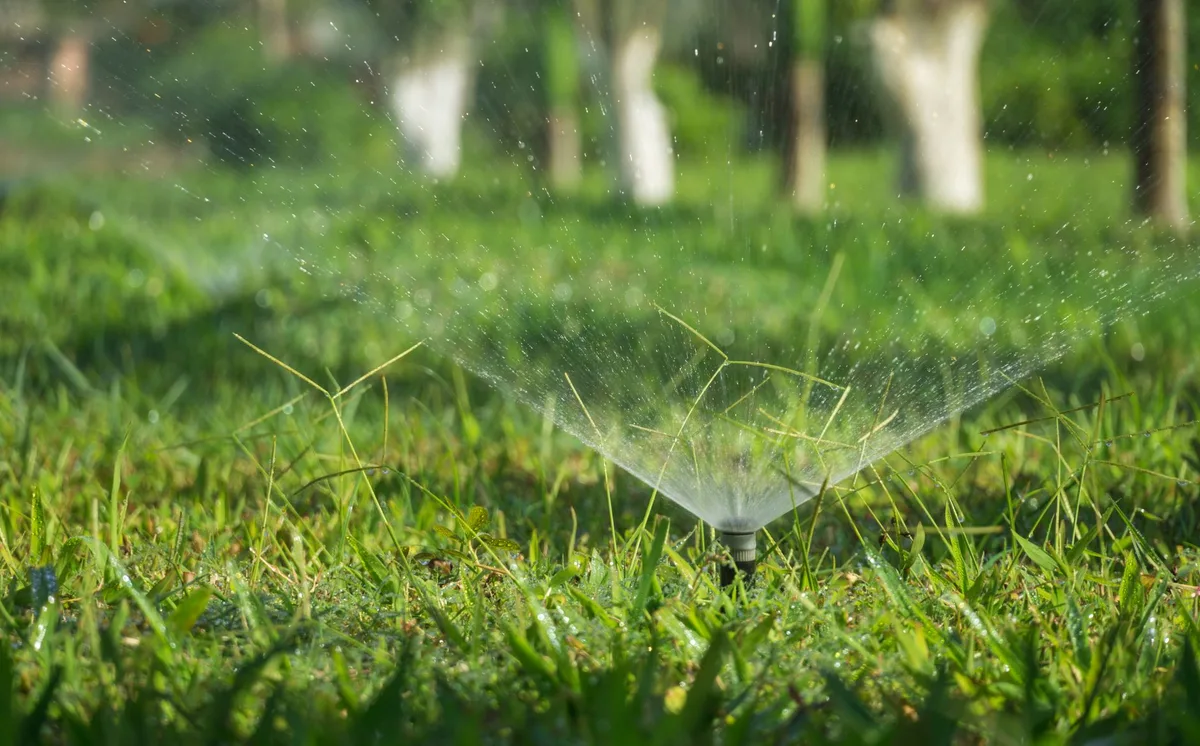
Water in the early morning. Between 4 AM and 6 AM is ideal. Wind is low, evaporation is minimal, and the grass has time to dry before nightfall.
Evening watering leaves the lawn wet overnight. That invites fungus.
If you use an automatic sprinkler system, run it in two cycles. Water for 10 minutes. Let it soak for 30 minutes.
Water for another 10 minutes. This prevents runoff on clay soil and ensures deep penetration on sandy soil.
Step 3: Fertilize Only if Needed (And Only the Right N-P-K)
Fertilizing in summer is different from fertilizing in spring or fall.
For cool-season grass, do not apply high-nitrogen fertilizer in July or August. The grass is already stressed. Pushing growth forces it to expend energy it should be saving for root health.
If you must fertilize, use a low-nitrogen formula like 5-10-10. Apply at half the recommended rate.
For warm-season grass, summer is the prime growing window. Apply a balanced fertilizer like 15-5-10 in late June and again in early August. Slow-release formulas work best.
They feed steadily without causing a growth spike.
Avoid weed-and-feed products in summer. The herbicide component can stress the grass further. Spot-treat weeds separately.
Step 4: Core Aerate to Break Thatch and Compaction
Compacted soil is a silent killer in summer. Roots cannot push deep. Water runs off instead of soaking in.
Air cannot reach the root zone.
Core aeration solves all three problems. It pulls small plugs of soil out of the lawn. Those plugs create channels for water, air, and nutrients.
The plugs break down on top and add organic matter.
Aerate in late spring for warm-season grass. Aerate in early fall for cool-season grass. Do not aerate during a heat wave.
Wait for mild weather.
If your lawn has more than half an inch of thatch, aeration alone might not be enough. You may need to dethatch first. Check the thatch layer by cutting a small slice of turf and measuring the brown spongy layer between the grass and the soil.
Step 5: Control Grubs and Weeds Without Harming Your Lawn
Grubs feed on grass roots. Damaged roots cannot take up water. The grass browns fast, even with regular watering.
Look for signs. Irregular brown patches that feel spongy. Birds or skunks digging in the lawn.
If you pull up a patch and see white C-shaped grubs, you have a problem.
Apply a preventive grub control in late spring before eggs hatch. Curative grub control works in summer but requires watering it in immediately. Follow label rates exactly.
Overapplication can harm beneficial soil organisms.
For weeds, hand pull or spot spray. Avoid broadcast herbicides in summer heat. The chemicals can volatilize and drift.
They also stress the grass. If you must spray, do it early in the morning when temperatures are below 85°F.
Step 6: Topdress with Compost for Long-Term Health
Topdressing is the single best long-term investment you can make. Spread a quarter inch layer of fine compost over the lawn. Rake it evenly.
The compost works into the soil through rain and watering.
Compost adds organic matter. Organic matter improves water retention in sandy soil and drainage in clay soil. It feeds beneficial microbes.
Over time, it reduces your fertilizer needs.
Topdress in spring for warm-season grass and in fall for cool-season grass. Avoid summer application during heat waves. The compost can heat up and stress the roots.
Mistakes to Avoid – Common Errors That Worsen Summer Browning
Mistakes compound. One wrong move can undo weeks of good work.
Mowing too short. Scalping the lawn exposes soil to direct sun. Soil temperature rises. Root growth stops.
You end up watering more and getting less.
Watering every day. Daily watering trains roots to stay shallow. Shallow roots cannot reach deep moisture. When the surface dries, the grass browns fast.
Deep infrequent watering builds deep roots.
Watering at noon. Up to 40 percent of midday water evaporates before it hits the ground. You pay for water the grass never gets. Morning watering is the only efficient window.
Fertilizing dormant grass. Fertilizer on dormant grass does not get absorbed. It runs off into storm drains or burns the roots. Either way, it wastes money and harms the environment.
Wait until the grass is actively growing.
Ignoring soil pH. Grass grows best between pH 6.0 and 7.0. Outside that range, nutrients are locked up in the soil. You can water and fertilize perfectly and still see yellowing.
A simple soil test tells you if lime or sulfur is needed. Most cooperative extensions offer tests for under 20 dollars.
Applying fungicide without identifying the disease. Brown patches can be heat stress, drought, grubs, or fungus. Fungicide only helps if the cause is fungal. Misdiagnosis wastes money and delays the real fix.
Look for rings, spots with dark borders, or fuzzy growth at the base. Those are fungal signs.
Maintenance / Long-Term Optimization – Building a Drought-Tolerant Lawn
A drought-tolerant lawn is not a different grass species. It is a management style. You train the lawn to handle stress over time.
Raise your mowing height permanently. Even if you do not have summer heat yet, keep the grass longer. Longer grass means deeper roots. Deeper roots mean less water dependency.
Water less in spring. It sounds counterintuitive. If you water deeply but less often in spring, the roots grow deeper looking for moisture. By summer, those roots can reach water that shallow roots cannot.
This is called drought conditioning.
Add organic matter every year. Compost topdressing or leaving clippings builds soil health. Healthy soil holds more water. It also drains better.
You get a buffer against both drought and heavy rain.
Choose the right grass for your region. If you are in the transition zone and fighting with a cool-season lawn every summer, consider a better approach for hot dry climates. Some tall fescue varieties have deeper root systems than traditional Kentucky bluegrass. Warm-season options like Bermuda or Zoysia handle heat naturally.
Fix bare spots immediately. Bare soil loses moisture fast. It also invites weeds. Keep your lawn dense.
A dense lawn shades its own soil and reduces evaporation. Overseed thin areas in the appropriate season for your grass type.
Real Scenarios / Case Examples – How a Northern Lawn Differs from a Southern Lawn
A lawn in Minneapolis and a lawn in Atlanta face different problems. They need different solutions.
In the North, cool-season grass is standard. A homeowner near Chicago with Kentucky bluegrass should stop fertilizing by mid-June. Raise the mower to 4 inches.
Water 1.5 inches per week in two sessions. The grass will go partially dormant in August. That is normal.
It greens back up in September.
In the South, warm-season grass like Bermuda or St. Augustine dominates. A homeowner near Dallas should fertilize in June and July.
Mow at 2 inches. Water 1 inch per week. Watch for grubs and chinch bugs.
Warm-season grass looks its best in August.
In the transition zone, things get tricky. A homeowner near St. Louis with tall fescue faces the hardest summer.
Tall fescue can survive if mowed high and watered deep. But it will look thin and tired by late July. Overseed in the fall to fill gaps.
Consider switching to a warm-season variety for long-term ease.
Frequently Asked Questions
Should I water my lawn every day in summer?
No. Daily watering creates shallow roots that cannot handle heat. Water deeply once or twice per week.
Aim for 1 to 1.5 inches total per week. Deep roots survive dry spells.
Is it okay to let my lawn go dormant?
Yes. Dormancy is a natural survival strategy for cool-season grass. The lawn turns brown but stays alive.
Reduce watering to once every two weeks. Do not fertilize. It will green up when temperatures drop.
Can I mow during a drought?
Mow less frequently. Let the grass grow taller. Taller grass shades the soil and holds moisture.
Set your mower height to the maximum for your grass type. Leave clippings on the lawn.
How do I fix brown patches from dog urine?
Dilute the area with water immediately after your dog goes. The nitrogen in urine burns the grass. Rinse the spot thoroughly.
Reseed if the grass dies. Training your dog to drink more water also helps dilute the urine.
When should I apply fungicide for brown patch?
Only after confirming a fungal infection. Look for circular patches with dark borders. Check the base of the grass for fuzzy growth.
Fungicide works best when applied early in the infection. Apply in the morning when temperatures are below 85°F.
What is the best time of day to water grass in summer?
Early morning between 4 AM and 6 AM. Wind is low. Evaporation is minimal.
The grass dries before nightfall. Evening watering leaves the lawn wet overnight and invites fungal disease.
Final Recommendation / Decision Guide – One-Page Cheat Sheet for Your Lawn Type
Here is the direct path forward based on what you have.
If you have cool-season grass. Mow at 3.5 to 4 inches. Water 1.5 inches weekly in one or two sessions. Do not fertilize in summer.
Let it go dormant if needed. Overseed in fall.
If you have warm-season grass. Mow at 2 inches. Water 1 inch weekly. Fertilize in June and August.
Watch for grubs. Aerate in late spring. Topdress with compost after aeration.
If you face water restrictions. Prioritize hand watering on hot spots. Let the rest go dormant. Do not reseed until restrictions lift.
Dormant grass recovers faster than new seed establishes.
If you are in the transition zone. Choose tall fescue for cool-season or Bermuda for warm-season. Adjust watering based on the current season. Overseed thin areas every fall.
Consider a switch to warm-season for lower summer maintenance.
Follow the path that matches your lawn. Adjust one variable at a time. Your lawn will tell you what it needs.
Watch the color, feel the soil, and trust the pattern.