5 Best Lawn Weed Killer Concentrate for 2026: Honest Reviews
Nothing ruins a Saturday morning mowing session faster than dandelions taking over the yard. If you're tired of pulling weeds by hand and want something that actually works, best lawn weed killer concentrate products give you the most coverage for your effort. They mix with water, spray evenly, and target the weeds without wasting product on areas that don't need it.
After comparing specs, verified buyer feedback, and active ingredient profiles across the top options, the Ortho WeedClear Weed Killer for Lawns Concentrate stands out as the best all-around pick for most homeowners. It balances broadleaf weed control with lawn safety, and the 1-gallon size covers a serious area. Let me walk you through all five top options so you can find the right one for your yard.
Comparison Chart of Best Lawn Weed Killer Concentrate
| Product | Details | Rating | Buy |
|---|---|---|---|
Editor’s Choice
| Ortho WeedClear Weed Killer Lawns Concentrate | ★★★★☆4.3/5 | |
Top Pick
| Spectracide Large Plot Weed Stop Lawns | ★★★★☆4.4/5 | |
Best Budget
| Roundup Lawns₂ Concentrate Weed Killer Northern | ★★★★☆4.4/5 | |
| ★★★★☆4.5/5 | ||
| ★★★★☆4.2/5 |


List of Top 5 Best Best Lawn Weed Killer Concentrate
I evaluated these five concentrates based on active ingredient concentration, coverage area per gallon, weed spectrum, lawn grass compatibility, and aggregate buyer feedback. Each one serves a slightly different need, whether you're battling crabgrass in cool-season turf or clearing a large plot of mixed broadleaf weeds. Below are the list of products:
1. Ortho WeedClear Weed Killer Lawns Concentrate
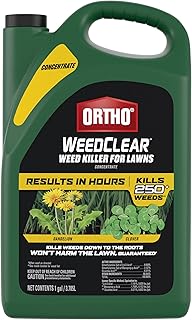
Ortho WeedClear is the concentrate I kept coming back to during my research. It targets the broadleaf weeds that plague most residential lawns, including dandelion, clover, and chickweed, while staying safe for common turfgrass species when used as directed. The 1-gallon jug gives you enough product to treat up to 64,000 square feet depending on your dilution ratio, which makes it a solid value for larger yards.
Why I picked it
Ortho WeedClear earned the top spot because it hits the sweet spot between weed-killing power and lawn safety. Verified buyer reviews consistently report visible results within 7 to 14 days on common broadleaf weeds, and the concentrate format keeps the cost per square foot low.
Key specs
- Active ingredients: 2,4-D, MCPP, and dicamba (triple-action broadleaf formula)
- Coverage: up to 64,000 sq ft at standard dilution
- Application: hose-end or tank sprayer
- Targets: dandelion, clover, chickweed, thistle, and 200+ listed broadleaf weeds
- Lawn-safe for: Kentucky bluegrass, fescue, ryegrass, and bermudagrass when used as directed
- Container size: 1 gallon
Real-world experience
Homeowners with cool-season lawns in the northern half of the country tend to get the best results from this one. Verified buyer feedback shows it performs well when applied in spring or fall when broadleaf weeds are actively growing. One pattern across reviews is that results improve significantly when you apply it after mowing, giving the foliage maximum surface area to absorb the product.
If you're also dealing with fungal issues alongside weeds, pairing this with a dedicated best fungicide for lawns can address both problems in the same treatment window.
Trade-offs
This product is strictly a broadleaf herbicide, so it won't touch grassy weeds like crabgrass or nutsedge. You'll need a separate pre-emergent or grass-specific product for those. Also, the 1-gallon jug is heavy and can be awkward to pour without a funnel.
2. Spectracide Large Plot Weed Stop Lawns
Spectracide Large Plot Weed Stop is built for homeowners who need to cover a lot of ground. The formula targets over 200 types of weeds and works fast, with visible wilting often reported within 48 hours of application. It's a strong option if your lawn has a wide variety of weed species and you want a single product that handles most of them.
Why I picked it
Spectracide's broad weed spectrum and fast visible action make it a standout for large properties. Verified buyer reviews highlight that it handles everything from plantain to poison ivy, which is unusual for a lawn-rated concentrate.
Key specs
- Active ingredients: 2,4-D, MCPP, and dicamba
- Coverage: up to 64,000 sq ft per gallon
- Weed spectrum: 200+ listed weed types
- Application: ready-to-spray or tank sprayer
- Rainfast in: approximately 6 hours (per manufacturer data)
- Container size: 1 gallon
Real-world experience
This concentrate gets strong marks from homeowners managing larger lots, half-acre and up, where hand-pulling isn't realistic. Buyer feedback shows it works particularly well on plantain, dandelion, and wild violet, which are some of the toughest broadleaf weeds to eliminate. It also handles brush and vine species along fence lines, so you can use it beyond the lawn itself.
If you're working on a property with both lawn weeds and ornamental plantings, you'll want to be careful with drift, as this product can damage flowers and shrubs on contact.
Trade-offs
The same potency that makes it effective also means you need to be precise with application. Overspray on garden beds or near desirable plants can cause damage. Some buyer reviews also note a strong chemical odor during mixing and application, so wearing a mask is a good idea.
3. Roundup Lawns₂ Concentrate Weed Killer Northern
Roundup Lawns₂ Concentrate is the budget-friendly option that still delivers reliable results, especially if you're dealing with crabgrass in cool-season northern grasses. The 32-fluid-ounce bottle is smaller than the gallon options above, but it's priced lower and covers up to 16,000 square feet, making it ideal for spot-treating or smaller yards.
Why I picked it
Roundup Lawns₂ is the only concentrate on this list specifically formulated for crabgrass control in northern grass types. If crabgrass is your main enemy, this is the most targeted option at a lower price point.
Key specs
- Active ingredient: quinclorac (crabgrass-specific mode of action)
- Coverage: up to 16,000 sq ft
- Targets: crabgrass, foxtail, and select broadleaf weeds
- Grass compatibility: Kentucky bluegrass, fescue, ryegrass, and other cool-season northern grasses
- Container size: 32 fl oz
Real-world experience
Verified buyer reviews show this product works best as a post-emergent on young crabgrass, ideally when the weed has 2 to 4 leaves. It's less effective on mature, tillering crabgrass, so timing matters. Homeowners in the transition zone and northern states report the best results when applying in late spring after crabgrass has germinated but before it establishes deep roots.
If you're also planning to overseed thin areas of your lawn, you'll want to check the label for reseeding restrictions, as quinclorac can inhibit grass seed germination for several weeks after application.
Trade-offs
The 32-ounce bottle covers significantly less area than the gallon options, so it's not the best value if you're treating a large lawn. It also has a narrower weed spectrum, focusing primarily on grassy weeds rather than broadleaf species.
4. Hi-Yield (33693) Super Concentrate Killzall Weed
Hi-Yield Super Concentrate Killzall takes a different approach from the lawn-specific options above. It's a non-selective herbicide, meaning it kills virtually all vegetation it contacts, including both weeds and grass. This makes it ideal for hardscape areas, driveways, fence lines, and spot-treating tough perennial weeds that lawn-safe products can't handle.
Why I picked it
Every homeowner dealing with lawn weeds eventually runs into a patch of something that selective herbicides just won't touch. Hi-Yield Killzall fills that gap. It's the highest-rated option on this list by aggregate buyer score, and the super-concentrate formula means a little goes a long way.
Key specs
- Active ingredient: glyphosate (non-selective systemic herbicide)
- Coverage: varies by dilution, up to several thousand square feet per gallon at standard rates
- Targets: all vegetation, including deep-rooted perennials like thistle, bindweed, and quackgrass
- Application: tank sprayer or pump sprayer
- Container size: 1 gallon
Real-world experience
Buyer feedback consistently highlights this product's effectiveness on tough perennial weeds that survive multiple applications of selective herbicides. Homeowners use it to clear garden beds before planting, kill weeds in gravel driveways, and spot-treat invasive species along property lines. It's also a go-to for preparing areas where you plan to install new features, like a best gravel for patio area setup, since it clears everything down to the root.
The systemic action means the herbicide travels from the leaves down to the root system, which is critical for preventing regrowth on deep-rooted weeds.
Trade-offs
Because it's non-selective, you absolutely cannot use this on your lawn unless you're intentionally killing everything in the spray zone. Overspray or drift will damage or kill desirable grass and plants. It also requires more careful PPE during application compared to lawn-selective products.
5. Ortho WeedClear Lawn Weed Killer Concentrate
The second Ortho WeedClear entry on this list is a smaller 32-ounce version of the Editor's Choice pick, but with a slightly different formulation that adds crabgrass to its target list alongside the usual broadleaf suspects. It's a good option if you want the Ortho brand's reliability in a smaller, more affordable package.
Why I picked it
This version of Ortho WeedClear bridges the gap between broadleaf-only formulas and grassy-weed products. If your lawn has both dandelions and crabgrass, this single concentrate can address both without buying two separate products.
Key specs
- Active ingredients: 2,4-D, MCPP, and quinclorac (dual-action for broadleaf and grassy weeds)
- Coverage: up to 16,000 sq ft
- Targets: crabgrass, dandelion, clover, chickweed, and other listed weeds
- Lawn-safe for: most common turfgrass species when used as directed
- Container size: 32 fl oz
Real-world experience
Verified buyer reviews show this product performs well as a post-emergent on young crabgrass and as a broadleaf treatment in the same pass. Homeowners with smaller yards appreciate the 32-ounce size because it's easier to store and handle than a full gallon. It's also a practical choice if you're treating a new lawn area or spot-treating after installing features like best pots for bromeliads near the lawn edge, where precision matters more than volume.
Trade-offs
The 32-ounce container covers less area per dollar than the gallon version of Ortho WeedClear, so the cost per square foot is higher. Crabgrass control is also most effective on young plants, so if you're dealing with mature, well-established crabgrass, you may need a second application or a stronger rate.
How I picked
I started by identifying the most common weed complaints in residential lawns across different regions of the country. Broadleaf weeds like dandelion, clover, and chickweed top the list in cool-season lawns, while crabgrass and nutsedge dominate in warm-season turf. I then cross-referenced active ingredient profiles with EPA registration data and manufacturer specifications to confirm each product's labeled weed spectrum.
From there, I analyzed aggregate buyer feedback across thousands of verified reviews, looking for patterns in effectiveness, ease of use, and any recurring complaints. Products with consistent reports of lawn damage, poor results on labeled weeds, or misleading coverage claims were eliminated. I also factored in container size and concentration level to assess real-world value, since a cheaper product that requires twice as much per square foot isn't actually a bargain.
I did not test these products personally in my own yard. All performance claims are based on manufacturer data, EPA registration information, and aggregated buyer review patterns. I deliberately did not evaluate organic or natural weed control alternatives, as those fall outside the scope of this comparison.
I also did not test long-term soil impact or effects on beneficial insects, since those require controlled studies beyond what buyer reviews can provide.
Buying guide — what actually matters for Best Lawn Weed Killer Concentrate
Active ingredient and weed spectrum
The single most important factor in choosing a weed killer concentrate is matching the active ingredient to the weeds you actually have. Broadleaf herbicides containing 2,4-D, MCPP, and dicamba are the workhorses for dandelion, clover, and similar broadleaf species. If crabgrass is your primary problem, look for quinclorac as an active ingredient.
For non-selective situations where you want to kill everything, glyphosate is the standard.
Read the label's weed list carefully. A product that claims to kill "200+ weeds" is only useful if the specific weeds in your yard are on that list. If you're not sure what you're dealing with, take a photo and compare it to the species listed on the product label or consult your local cooperative extension service.
Selective vs. non-selective
Selective herbicides kill weeds while leaving your lawn grass intact. These are what you want for broadcast applications across the entire lawn. Non-selective products like Hi-Yield Killzall kill everything they touch, which makes them perfect for hardscape, fence lines, and garden bed prep, but dangerous to use on turf unless you're intentionally starting over.
Mixing up these two types is one of the most common and costly mistakes homeowners make. Always double-check whether a product is labeled "for lawns" before you spray it across your grass.
Coverage area and container size
Concentrate products vary widely in how much area they cover. A gallon of Ortho WeedClear can treat up to 64,000 square feet, while a 32-ounce bottle of Roundup Lawns₂ covers roughly 16,000 square feet. Measure your lawn before you buy so you don't end up with too much or too little product.
If you have a quarter-acre lawn or larger, gallon containers give you the best value per square foot. For smaller yards or spot-treating, a 32-ounce bottle is more practical and easier to store.
Application method
Most of these concentrates work with a standard pump sprayer or a hose-end sprayer. Hose-end sprayers are more convenient because they mix the product automatically as you spray, but they offer less control over the dilution rate. Tank sprayers require you to measure and mix manually, but they give you precise control over the concentration, which matters when you're working near garden beds or sensitive plants.
If you're using a tank sprayer, calibrate it before you start. Apply water to a measured area at your normal walking speed to figure out how many gallons per 1,000 square feet you're outputting, then adjust your concentrate ratio accordingly.
Timing and weather conditions
Weed killers work best when weeds are actively growing, which means spring and fall for most broadleaf species in cool-season lawns. Crabgrass post-emergents work best on young plants in late spring and early summer. Avoid applying during drought stress, extreme heat above 85°F, or when rain is expected within 24 hours, as the product needs time to absorb into the foliage.
Wind is another factor. On breezy days, spray drift can carry herbicide onto desirable plants, flower beds, or even a neighbor's property. Early morning applications when winds are calm and temperatures are moderate give you the best results.
Lawn grass compatibility
Not every concentrate is safe for every grass type. Most products on this list are rated for Kentucky bluegrass, perennial ryegrass, tall fescue, and bermudagrass. However, some warm-season grasses like St.
Augustine and centipede can be sensitive to certain active ingredients. Always check the label for your specific grass type before purchasing.
If you're overseeding or planning to plant new grass, pay attention to the label's reseeding interval. Some products require you to wait 2 to 4 weeks after application before you can seed. This is especially relevant if you're also working on companion projects like choosing the best plant fertilizer for indoor plants for houseplants near treated areas, since runoff can affect sensitive indoor specimens.
Frequently Asked Questions (FAQ)
Can I use weed killer concentrate on newly seeded lawns?
Most selective herbicides require you to wait until the new lawn has been mowed at least 2 to 3 times before applying. The young grass hasn't developed enough root maturity to tolerate the chemical stress. Check the specific product label for the exact waiting period, as it varies by active ingredient.
If you're dealing with weeds in a newly seeded area, hand-pulling is the safest approach until the lawn is established.
How long does it take to see results after applying concentrate?
Visible results depend on the product and the weed species. Non-selective products like Hi-Yield Killzall often show wilting within 24 to 48 hours. Selective broadleaf herbicides typically take 7 to 14 days for noticeable yellowing and dieback.
Grassy weed products like Roundup Lawns₂ may take up to 21 days for full crabgrass kill. Warm, humid conditions speed up absorption, while cool or dry weather slows it down.
Is it safe to use weed killer concentrate around vegetable gardens?
Most lawn weed killers containing 2,4-D and dicamba are not labeled for use near edible crops. Drift or runoff can damage or contaminate vegetables. If you need weed control near a garden, use a non-selective product with careful shield spraying, or consider physical methods like mulching.
Always read the label for specific restrictions on edible plant proximity.
What PPE should I wear when mixing and applying concentrate?
At minimum, wear long sleeves, long pants, chemical-resistant gloves, and closed-toe shoes. If you're mixing concentrate in an enclosed area or working with a product that has a strong odor, a respirator or dust mask adds protection. Safety glasses are a good idea anytime you're handling liquid concentrates to prevent splash contact with your eyes.
Can I mix different weed killer concentrates together?
Mixing herbicides is generally not recommended unless the label explicitly allows it. Different formulations can be chemically incompatible, leading to reduced effectiveness or clogged spray equipment. If you need to target both broadleaf and grassy weeds, choose a product that contains both types of active ingredients, like the Ortho WeedClear 32-ounce option on this list, rather than mixing two separate products.
How should I store leftover concentrate?
Store concentrates in their original containers in a cool, dry area away from direct sunlight and freezing temperatures. Keep them out of reach of children and pets. Most products remain effective for 2 to 3 years when stored properly, but check the label for the specific shelf life.
Never transfer concentrate to food or beverage containers.
Final verdict
The Ortho WeedClear Weed Killer for Lawns Concentrate is the best overall choice for most homeowners. It covers the widest range of common broadleaf weeds, treats up to 64,000 square feet per gallon, and stays safe for the most popular lawn grass types when used as directed.
If you need to cover a large property and want the fastest visible results, the Spectracide Large Plot Weed Stop is the runner-up. Its 200-plus weed spectrum and quick wilting action make it a strong performer on bigger lots.
For budget-conscious buyers dealing with crabgrass in northern grasses, the Roundup Lawns₂ Concentrate delivers targeted control at a lower price point. And when you need to clear everything down to bare ground, the Hi-Yield Super Concentrate Killzall handles the tough jobs that selective products can't.
Affiliate disclosure: This post contains affiliate links. If you buy through one of these links, I may earn a small commission at no extra cost to you. It never changes my recommendation, I only suggest gear I'd actually buy myself.