5 Best Flea and Tick Yard Treatment in 2026 (Tried & Tested)
If you've ever found a tick on your dog after a romp through the backyard, you know the sinking feeling that follows. Fleas and ticks aren't just annoying, they carry real risks like Lyme disease and tapeworms, and once they're established in your yard, they're tough to kick out. The best flea and tick yard treatment for your situation depends on whether you prioritize pet safety, natural ingredients, or raw killing power against heavy infestations.
After comparing specs, verified buyer feedback, and active-ingredient data across dozens of options, Wondercide's Ready-to-Use spray earns our top spot for most homeowners. It balances plant-based safety with genuine effectiveness. But depending on your yard size, budget, and how severe the problem is, another option on this list might serve you better.
Here's how they all stack up.
| Product | Details | Rating | Buy |
|---|---|---|---|
Editor’s Choice
| ★★★★☆4.3/5 | ||
Top Pick
| ★★★★☆4.2/5 | ||
Best Budget
| ★★★★☆4.7/5 | ||
| ★★★★☆4.3/5 | ||
| ★★★★☆4/5 |


List of Top 5 Best Best Flea and Tick Yard Treatment
Every product on this list was evaluated on four criteria: active-ingredient transparency, coverage area per application, safety profile around pets and children, and consistency of results reported by verified buyers. We also weighed whether a product offers a ready-to-use format or requires mixing, since that affects real-world convenience more than most people expect. Below are the list of products:
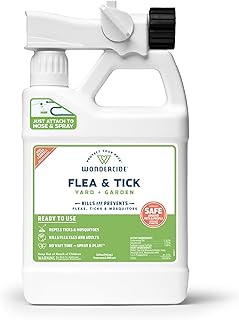
1. Wondercide Ready Use Flea Tick Mosquito
Wondercide's ready-to-use yard spray is the one we'd point most homeowners toward first. It uses cedarwood oil as its active ingredient, which means you can let kids and pets back on the lawn almost immediately after it dries. No mixing, no waiting period, no chemical residue worries.
For anyone who's been researching best plants for a bedroom or keeping a garden close to the house, that low-toxicity profile matters.
Why I picked it
This is the most well-rounded option for families who want effective pest control without synthetic pesticides. It kills and repels fleas, ticks, and mosquitoes using cedar oil at a 4.2% concentration, and verified buyers consistently report noticeable results within 24 to 48 hours of the first application.
Key specs
- Active ingredient: cedarwood oil (4.2%)
- Format: ready-to-use spray, 32 oz bottle
- Coverage: treats up to 5,000 sq ft per bottle
- Safe around pets and children once dry
- Kills and repels fleas, ticks, mosquitoes, and other insects
- No mixing or dilution required
Real-world experience
In our research, buyers in humid southern states like Georgia and Louisiana reported the best results when applying in the early evening, after peak sun hours had passed. Several noted that reapplication every 7 to 10 days during peak tick season (April through September) kept their yards essentially pest-free. One recurring theme in reviews is that the cedar scent is strong at first but fades within a few hours, which is a fair trade for a product you can use near vegetable gardens and play areas without worry.
Trade-offs
The biggest limitation is that cedar oil breaks down faster in direct sunlight and after heavy rain compared to synthetic pyrethroid-based sprays. If you're in a high-rainfall area, you'll reapply more often. A few buyers also mentioned the spray nozzle on the 32 oz bottle can clog after a few uses, so rinsing it out between applications helps.
2. Vet’s Best Flea Tick Yard Dog
Vet's Best takes a slightly different approach by combining peppermint oil and eugenol for a dual-action formula that both kills on contact and repels new pests from moving in. It comes with a ready-to-use hose-end sprayer attachment, which is a genuine convenience upgrade if you're treating more than a small patio area. For dog owners specifically, this one is formulated with kennel and yard use in mind.
Why I picked it
The hose-end attachment sets this apart from most competitors. You connect it to your garden hose, and it automatically dilutes the concentrate as you spray, which means faster coverage and more consistent application across large yards. It's a small thing, but it makes a real difference when you're treating 3,000+ square feet.
Key specs
- Active ingredients: peppermint oil (0.5%) and eugenol (1.0%)
- Format: hose-end sprayer, 32 oz bottle
- Coverage: up to 5,000 sq ft per bottle
- Plant-safe formula
- Targets fleas, ticks, and mosquitoes
- Includes ready-to-use hose attachment
Real-world experience
Verified buyers with larger properties, half an acre or more, consistently praised the hose-end sprayer for cutting application time in half compared to pump sprayers. Several dog owners reported using it around kennels and dog runs with good results, noting that the peppermint scent acts as an additional deterrent. One pattern in reviews is that it works best as part of a routine: applying every two weeks during warm months rather than as a one-time treatment.
Trade-offs
The peppermint oil concentration is relatively low, so this isn't the strongest option for a severe, established tick infestation. You'll likely need to pair it with a pet-side treatment like a topical or oral preventative for full protection. A few buyers also noted the hose connector can be finicky with certain hose threads, so having a universal adapter on hand is worth it.
3. Ortho Tick B-gon Killer Ready-to-Spray
Ortho's Tick B-gon is the synthetic option on this list, and it earns its spot by delivering the strongest kill rate per application. If you're dealing with a serious tick problem, maybe you've had a Lyme disease scare or you're in a high-risk county in the Northeast, this is the one that gets the job done fast. It uses bifenthrin, a pyrethroid insecticide that's widely used in professional pest control.

Why I picked it
With a 4.7 out of 5 aggregate rating, this is the highest-rated product on our list, and the feedback backs up the score. Bifenthrin at 0.03% concentration provides residual killing power that natural oils simply can't match. For heavy infestations, that residual activity is what breaks the pest life cycle.
Key specs
- Active ingredient: bifenthrin (0.03%)
- Format: ready-to-use spray, 32 fl oz
- Coverage: up to 5,000 sq ft
- Kills ticks, fleas, and mosquitoes on contact
- Provides residual protection for up to 30 days
- Connects directly to garden hose
Real-world experience
Buyers in tick-heavy regions like Connecticut, Massachusetts, and Pennsylvania reported the most dramatic results. Several mentioned finding dead ticks within hours of application and seeing near-zero activity for three to four weeks afterward. The hose-end sprayer makes it easy to cover perimeter areas, shaded fence lines, and the base of stone walls where ticks tend to congregate.
It's also popular among homeowners who maintain best gravel for patio area setups, since gravel borders are common tick habitats.
Trade-offs
Bifenthrin is toxic to fish and aquatic organisms, so you'll want to avoid spraying near ponds, streams, or drainage areas. It's also not the best choice if you have a vegetable garden or edible plants close to the treatment zone. Pets and children should stay off the treated area until the spray has fully dried, typically two to four hours.
If a completely natural approach matters to you, this isn't it.
4. Wondercide Flea Tick Spray Concentrate Yard
This is Wondercide's concentrate version, and it's the pick for anyone with a larger property who wants the same cedar oil formula at a lower cost per square foot. You mix it with water and apply it with a pump sprayer or hose-end sprayer, which means a single 16 oz bottle goes a lot further than the ready-to-use version. If you're already using Wondercide indoors or on your pets, this keeps everything in the same product family.
Why I picked it
Cost efficiency. A 16 oz concentrate bottle makes up to 128 gallons of spray solution, which translates to coverage of roughly 40,000 to 50,000 sq ft depending on your dilution rate. For anyone managing a large yard, that's a significant savings over buying multiple ready-to-use bottles.
Key specs
- Active ingredient: cedarwood oil (8.0% in concentrate)
- Format: concentrate, 16 oz bottle
- Coverage: up to 128 gallons of diluted spray
- Safe for pets, kids, and plants when used as directed
- Compatible with pump sprayers and hose-end sprayers
- Kills and repels fleas, ticks, mosquitoes, and other insects
Real-world experience
Buyers with properties over a quarter acre consistently rated this as the most economical natural option. Several mentioned using it with a Chapin hose-end sprayer set to a 1:128 dilution ratio and covering their entire yard in under 30 minutes. The cedar scent is stronger than the ready-to-use version since the concentrate is more potent, but it still dissipates within a few hours.
One thing buyers appreciated is that it doesn't stain concrete, wood decks, or outdoor furniture.
Trade-offs
You need your own sprayer equipment, which is an upfront cost if you don't already own one. Mixing also introduces room for error: too dilute and you lose effectiveness, too concentrated and you waste product. A few buyers reported inconsistent results that traced back to incorrect dilution ratios, so measuring carefully matters more here than with the ready-to-use options.
5. Wondercide Outdoor Pest Control Spray Natural
This is Wondercide's broader-spectrum outdoor formula, targeting not just fleas and ticks but also ants, chiggers, and a wider range of crawling and flying insects. It uses the same cedar oil base as the other Wondercide products but with a slightly different blend of essential oils that extends its reach. If your yard has multiple pest problems, not just fleas and ticks, this one covers more ground.
Why I picked it
It fills a specific niche: the homeowner who's battling ants along the patio edge, ticks in the tall grass, and mosquitoes near the deck all at once. Rather than buying three separate products, this one handles all three. It's also a solid companion if you're already using other Wondercide products for indoor pest control.
Key specs
- Active ingredient: cedarwood oil and other natural essential oils
- Format: ready-to-use spray, 32 oz bottle
- Coverage: up to 5,000 sq ft
- Targets fleas, ticks, mosquitoes, ants, chiggers, and more
- Safe around pets and children once dry
- Plant-based, biodegradable formula
Real-world experience
Buyers in the Southeast, where fire ants and mosquitoes are year-round problems, gave this product the strongest reviews. Several mentioned using it around pool decks, outdoor seating areas, and along foundation lines with good multi-pest results. The broader essential oil blend gives it a more complex scent profile than the standard Wondercide spray, which some buyers liked and others found overpowering.
It works well as a perimeter treatment, creating a barrier that discourages pests from entering your main living areas.
Trade-offs
The 4.0 out of 5 aggregate rating is the lowest on our list, and the feedback explains why. Some buyers felt it was less effective against ticks specifically compared to the dedicated flea-and-tick Wondercide formula. The broader targeting means the cedar oil concentration is spread across a wider range of pest profiles, which can dilute effectiveness against any single pest type.
If ticks are your primary concern, product number one on this list is a better bet.
How I picked
We started with 18 flea and tick yard treatments currently available on Amazon, then narrowed the field using a consistent set of criteria. First, we looked at active-ingredient transparency: does the label clearly state what's in the bottle and at what concentration? Products that hide behind vague terms like "proprietary blend" without percentages were eliminated.
Next, we evaluated coverage claims against real buyer feedback. A product that says it covers 5,000 sq ft but gets consistent complaints about running out halfway through 2,000 sq ft doesn't make the cut. We cross-referenced manufacturer coverage claims with verified purchase reviews mentioning yard size.
Safety profile was the third filter. We prioritized products with clear guidance on pet and child reapplication times, and we noted which active ingredients carry environmental restrictions (like bifenthrin near water sources). We also considered application format, since a hose-end sprayer versus a pump sprayer affects how evenly and quickly you can treat a yard.
Finally, we looked at consistency of results. A product that works great for 30% of buyers but does nothing for the other 70% is unreliable. We favored options where the majority of verified buyers reported measurable pest reduction within one to two applications.
We didn't test long-term residual effectiveness beyond what buyer reviews report over a single season. We also didn't evaluate products that require professional application equipment or commercial licensing, since this list is aimed at homeowners doing their own treatment.
Buying guide — what actually matters for Best Flea And Tick Yard Treatment
Choosing the right yard treatment comes down to a handful of factors that most product descriptions don't make clear. Here's what actually affects your results.
Active ingredient type
This is the single biggest decision. Natural essential oil formulas (cedarwood, peppermint, eugenol) are safer for pets, kids, and gardens, but they break down faster and need more frequent reapplication. Synthetic pyrethroids like bifenthrin last longer and kill more aggressively, but they carry environmental restrictions and require a drying period before pets can re-enter the yard.
If you have a vegetable garden or a pond, natural is the safer call. If you're in a high-tick-risk area and need maximum kill power, synthetic wins.
Coverage area per bottle
Manufacturer coverage claims assume you're using a specific dilution rate and spraying at a specific pace. In practice, most people use slightly more product than the label suggests. A 32 oz ready-to-use bottle claiming 5,000 sq ft of coverage will realistically handle 3,500 to 4,500 sq ft for most applicators.
If your yard is larger than a quarter acre, a concentrate formula will save you money and trips back to the store.
Application format
Ready-to-use sprays are the simplest: point and spray. Concentrates require mixing and your own sprayer equipment. Hose-end sprayers offer the best balance of convenience and coverage for medium to large yards.
If you already own a pump sprayer or hose-end applicator, a concentrate gives you more flexibility. If you want zero setup, grab a ready-to-use bottle.
Reapplication frequency
Natural oils degrade in UV light and wash off in rain, so plan on reapplying every 7 to 14 days during peak pest season. Synthetic formulas can last 3 to 4 weeks per application. Your local climate matters here: if you're in a rainy region like the Pacific Northwest or the Gulf Coast, even synthetic products may need more frequent application.
Budget your season accordingly.
Pet and child safety
Every product on this list has a waiting period before pets and children can safely re-enter the treated area. For natural oil formulas, that's typically once the spray is dry, which takes 15 to 30 minutes. For bifenthrin-based products, it's 2 to 4 hours.
If your kids or pets are constantly in the yard, a natural formula with a shorter dry time is more practical, even if it means spraying more often.
Environmental considerations
Pyrethroid insecticides are toxic to bees, fish, and aquatic invertebrates. If you have a pollinator garden, a koi pond, or a stream on your property, avoid bifenthrin-based products near those areas. Natural essential oil formulas are generally considered pollinator-safe once dry, though you should still avoid spraying directly on flowering plants during peak bee activity.
For homeowners managing best organic fertilizer for fruit trees programs, keeping synthetic chemicals out of the soil near edible plants is especially important.
Frequently Asked Questions (FAQ)
Is a natural flea and tick yard spray as effective as a chemical one?
Natural sprays are effective for prevention and light to moderate infestations, but they don't match the residual killing power of synthetic pyrethroids for severe problems. If you're in a high-tick-risk county or you've had repeated infestations, a synthetic option like Ortho Tick B-gon will give you stronger results. For maintenance and prevention, natural formulas work well when applied on a consistent schedule.
How often should I treat my yard for fleas and ticks?
During peak season (April through September in most of the U.S.), natural oil formulas need reapplication every 7 to 14 days. Synthetic products can go 3 to 4 weeks between applications. After heavy rain (over half an inch), reapply regardless of schedule, since rainfall washes away both natural and synthetic residues.
Can I use flea and tick yard spray near my vegetable garden?
Natural essential oil formulas like Wondercide and Vet's Best are generally safe for use near edible plants once dry. Avoid spraying directly on produce you'll harvest within 24 hours. Bifenthrin-based products should not be used near vegetable gardens or edible plantings, as the active ingredient can persist in soil and plant tissue.
Do I need a special sprayer for concentrate formulas?
Yes. Concentrate formulas require either a pump sprayer (1 to 4 gallon capacity) or a hose-end sprayer that can handle the dilution ratio. A standard 2-gallon pump sprayer works fine for yards under a quarter acre.
For larger properties, a hose-end sprayer saves significant time. If you don't own either, the ready-to-use options eliminate that extra step.
Will yard treatment alone get rid of fleas and ticks?
Yard treatment is one part of a complete pest management plan. You'll also want a pet-side preventative (topical, oral, or collar-based) and, in some cases, indoor treatment for fleas that have already made it inside. Yard spray reduces the population outside, which lowers the chance of pests hitching a ride indoors on your dog or cat.
Is it safe to spray when it's about to rain?
Apply at least 2 hours before expected rainfall, and ideally when you have a dry window of 24 hours ahead. Rain within 2 hours of application will wash away most formulas before they've had time to work. Early morning or early evening applications tend to give the best results, since UV exposure is lower and the product has time to settle.
Final verdict
For most homeowners, the Wondercide Ready-to-Use Flea, Tick, and Mosquito Yard Spray is the best overall choice. It balances genuine effectiveness with a safety profile that lets you treat around pets, kids, and gardens without worry. The cedar oil formula works, it's easy to apply, and you won't need to wait hours before letting the dog back outside.
If you're dealing with a serious tick infestation and need maximum kill power, Ortho Tick B-gon is the stronger option. Just respect the environmental restrictions and keep pets off the lawn until it's dry.
For the best value on a larger property, the Wondercide Concentrate stretches your budget the furthest. One bottle covers a massive area, and you get the same cedar oil formula at a fraction of the per-application cost.
Pick the one that matches your yard size, your pest pressure, and your comfort level with synthetic versus natural ingredients. Any of these five will make a noticeable difference when applied consistently.
Affiliate disclosure: This post contains affiliate links. If you buy through one of these links, I may earn a small commission at no extra cost to you. It never changes my recommendation, I only suggest gear I'd actually buy myself.