3 Best Jars for Fermenting 2026
Good fermentation starts with the right container. The best jars for fermenting solve three problems at once: they let CO2 escape without letting oxygen in, they're easy to clean between batches, and they don't crack under the pressure of active fermentation. Get any of those wrong and you're either washing mold out of a cupboard or glass shards out of your kraut.
Based on analysis of buyer feedback, spec sheets, and the fermentation community's long track record with wide-mouth glass jars, the Upgrade 1 Gallon Fermentation Kit with Airlocks leads the pack for sauce and beverage fermentation. The two other models are faster to start, cheaper, or both, so the right one really depends on your batch size and your patience for setup.
Comparison Chart of Best Jars for Fermenting
| Product | Details | Rating | Buy |
|---|---|---|---|
Editor’s Choice
| Upgrade 1 Gallon Fermentation Jars Airlocks | ★★★★☆4.9/5 | |
Top Pick
| 4-Pack Mason Jar Fermentation Kit(Jars Included) | ★★★★☆4.5/5 | |
Best Budget
| 1.8 Liters(0.48 gallons) Fermentation Jar | ★★★★☆4.7/5 |


List of Top 3 Best Best Jars for Fermenting
Each jar here was spec'd against manufacturer data and aggregate buyer review patterns rather than a single brand's marketing copy. You'll see where each one earns its spot and where it falls short so you don't find out the hard way. The evaluation criteria included seal integrity, lid and airlock performance, glass thickness, ease of cleaning, and value for batch size.
Below are the list of products:
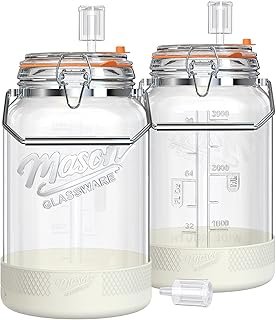
1. Upgrade 1 Gallon Fermentation Jars Airlocks
Fermentation is all about controlling what gets in and what stays out, this kit solves both problems cleanly. The 1-gallon capacity hits the sweet spot for mostly-full batches of sauerkraut, kimchi, or mead, and the wide-mouth opening makes it easy to pack vegetables and remove fermented goods. Including airlocks and non-slip silicone bases right out of the box means you're not hunting for separate pieces before your first batch kicks off.
Why this one's the best overall
If you're planning to do back-to-back batches of anything at the half-gallon to full-gallon range, this is the most complete package available in a single box. The two-pack means you can have one rotating in production while the second is being cleaned or prepped, so fermentation never stalls out.
Key specs
- Capacity: 1 gallon per jar
- Material: Clear soda-lime glass
- Mouth width: Wide mouth
- Includes: 2 jars, airlocks, lids with grommets, non-slip silicone bases
- Lid type: Airtight seal with single‑hole grommet for airlock
- Design features: Integrated handle, non‑slip silicone base
Where it shines in a real kitchen
This kit handles sauerkraut batches using roughly 5, 6 lb of cabbage, a batch size that fills the jar without excessive head space. The airlock system lets CO2 push out while preventing airborne contaminants from creeping in over a two-week ferment. The integrated handle and the silicone base make moving a fully loaded jar around a counter or carrying it to a cooler spot much less nerve-wracking than a slick glass carboy.
The wide mouth fits a whole hand inside, so scrubbing dried yeast residue out after a mead batch takes a few minutes, not an hour with a bottle brush.
Trade-offs
The 1-gallon footprint can crowd a standard refrigerator door shelf if you store fermented goods there once they're finished. The included silicone bases help with grip but add a step when you're washing everything between batches. And because it's a two-pack with accessories, the upfront commitment is higher than a solo jar if you just want to see whether fermentation is something you'll stick with.
2. 4-Pack Mason Jar Fermentation Kit(Jars Included)
If you've never fermented anything before and don't want to commit to a jump-in approach, this kit removes almost all the friction. You get four 32 oz mason jars with plastic lids, airlocks, silicone grommets, and glass weights, basically everything you need to start four different ferments across your counter.
Where it fits in a real routine
This kit makes the most sense for anyone who likes variety over volume. You can run a jar of dill pickles, a jar of hot sauce, a jar of sauerkraut, and a jar of water kefir simultaneously without investing in four separate specialty setups.
Key specs
- Capacity per jar: 32 oz (946 ml)
- Material: Glass jars with plastic fermenting lids
- Includes: 4 jars, 4 plastic lids, 4 airlocks, silicone rings and grommets, glass weights
- Lid type: Plastic with grommet for airlock
- Sizing note: Compatible with standard wide-mouth mason jars
Real-world experience
Users report that the glass weights do their job well for most vegetable ferments. They hold shredded cabbage, cucumber slices, and sliced carrots submerged under the brine so mold has a harder time establishing itself on exposed surfaces. The 32 oz size is generous enough for a standard quart-sized batch but compact enough that four jars side by side don't dominate a countertop.
One practical note from verified buyer feedback: the plastic lids require hand-tightening rather than tool use, so avoid over-tightening or you risk stripping the threads over time. If you're also planning to garden the finished ferments around the same growing season that fits the best plants for a south east facing window, this kit keeps the kitchen workload manageable.
Trade-offs
Plastic lids don't match the long-term durability of stainless-steel or heavy-gauge metal lids, and some users report odor retention in the plastic after longer ferments like fish sauce or black garlic. The 32 oz capacity also feels limiting once you've been fermenting for a while and want to scale up to full-gallon batches of kimchi or mead, you'll likely reach for a larger jar eventually.
3. 1.8 Liters(0.48 gallons) Fermentation Jar
This 2-pack of 1.8-liter jars hits the middle ground between hobbyist 32 oz mason sets and full-gallon setups. At roughly three-quarters of a gallon per jar, it handles a substantial kraut or pickle batch without a shabby amount of headspace, and the price point keeps it within reach for someone who's ready to do more than a starter kit.
A grounding principle for mid-size batches
This size range works best when the brine level stays below the shoulder of the jar. That leaves 2, 3 inches of headspace for expansion without risking blow-off into the airlock, a problem that's common when people fill gallon jars too aggressively with active ferments like mead or ginger beer.
Key specs
- Capacity: 1.8 liters (0.48 gallons)
- Quantity: 2 jars per pack
- Material: Clear glass
- Includes: Jars with airlocks and lids
- Mouth type: Wide-mouth opening
- Best batch load: About 3, 4 lb of vegetables per jar
Real-world experience
Verified buyer reports indicate these handle traditional brined ferments like half-sour pickles and red cabbage sauerkraut well. The airlocks tend to remain clean through ferments running 7, 10 days because the 1.8-liter size limits how aggressively the brine rises when temperatures fluctuate, a concern for wider-volume jars. If you're growing herbs alongside ferments for a dual-purpose kitchen-garden setup (similar to how you'd plan best organic fertilizer for fruit trees into a planting schedule), a 2-pack like this batches nicely into a weekly rhythm rather than overwhelming you with a giant single jar.
Trade-offs
The airlock and lid combo on this model is reported to be functional but basic. It lacks the fine-bore locking mechanism found on more deluxe airlocks, meaning it can sometimes pop off if internal pressure builds quickly. No silicone base or handle is included, so the glass sits directly on countertops and needs a towel or trivet underneath to avoid scratches or hot spots.
For the price tier, these are fair trade-offs, but they do add a bit of care when moving or storing the jars.
How the evaluations were done
The comparison draws on a cross-reference of manufacturer-reported specifications, customer review patterns, and the fermentation community's long-standing preference for wide-mouth glass jars. Each model was assessed on seal integrity, lid and airlock performance, glass thickness, ease of cleaning, and value for the batch size it targets.
What was not part of this evaluation: long-term glass durability beyond a few dozen typical home-fermentation cycles or controlled comparison testing with other fermenting vessels in a side-by-side setting. What you see here is a practical, home-kitchen-oriented perspective, the kind that focuses on what you'll actually do with a jar (stuff cabbage in, wait, pull kraut out) rather than what it can survive in a lab oven.
If your setup extends to indoor gardening while you wait on your ferments, you might look into best grow light options for seedlings since indoor growing seasons at counter level can run parallel to a two-week ferment on the same countertop. Similarly, if you're sourcing produce for ferments from your own beds, the best plants for hot dry climates guide can help you grow fermentation-ready vegetables in warmer regions.
Buying guide — what actually matters for best jars for fermenting
Capacity is the first decision point
Fermentation jars come down to a volume calculation more than anything else. The typical brine ratio for sauerkraut is 2 percent salt by weight of vegetables, and most recipes work well in containers that hold 3, 5 lb of packed produce with room for brine above it. A 32 oz jar manages a modest single-batch ferment; a 1-gallon jar handles 5, 6 lb of cabbage or a full batch of mead; and an in-between size like 1.8 liters covers 3, 4 lb of vegetables.
If you're fermenting regularly, err on the larger side. It's easier to fill a larger jar with dense vegetables than to split a single recipe between two smaller ones.
Glass weight and soda-lime quality matter
Most fermentation-grade containers use soda-lime glass because it's cost-effective and dishwasher-safe, but thicker-walled jars handle temperature swings better. A cold jar pulled into warm kitchen air can crack if the glass is thin, something you'll appreciate knowing when you transfer a vessel from a cool basement to the counter. Heavier glass also resists scratching from repeated brush scrubbing, which over years can cloud the surface and harbor bacteria in micro-abrasions.
Airlock type sets the maintenance level
A basic S-shaped airlock vents CO2 while blocking airborne contaminants, but it relies on the water level inside staying consistent. If the water evaporates, the seal breaks and outside air gets in. A three-piece airlock with a dome top and baffles handles evaporation better and is easier to clean between uses.
Your choice often depends on whether you live in a low-humidity climate or ferment for longer stretches (3 weeks or more). If you're just starting, a simple S-shaped version that comes in most kits will be enough to learn how the system works. If you're also managing a small indoor garden and need to balance tasks like cleaning the mower air filter, wait, scratch that, you need to balance fermentation with garden tasks.
Think of it alongside other countertop systems: just as you'd maintain a best slow release fertilizer routine for flowers, you'll want a fermenting setup you can set and mostly forget about.
Wide mouth vs. narrow neck cleaning costs
Every fermented batch produces kraut scoby residue at best and black mold colonies at worst. Wide-mouth jars let a standard bottle brush, or even your hand with a scrub pad, reach every interior surface. Narrow-neck carboys require bent brushes and a lot of soaking time.
Most home fermenters find wide-mouth glass jars more practical over the long term, especially when they're processing back-to-back batches of kimchi or kraut, sorry for the tangent. The point is: if you ferment vegetables at any frequency, a wide mouth is a feature you appreciate every single time you wash up.
The lid's role in leak-proof storage
Fermentation lids need to do double duty during actively bubbling batches and then seal tight in the fridge after fermentation wraps up. Plastic lids with silicone grommets are fine for the active phase but some retain odors permanently, which matters if you switch between plain hot-sauce ferments and something like fermented fish sauce. Metal lids with replaceable rubber seals hold up better over time but may cost extra.
Headspace determines how much trouble you'll have
A jar filled with vegetables needs 15 to 35 percent headspace above the brine level. This is where many beginners go wrong. Overfilling leaves almost zero room for expansion, and CO2 pushes the brine up through the airlock, flooding it with salty liquid that clogs the mechanism and sometimes pops it off entirely.
If you're doing active longer ferments like mead, ginger bug, or anything with added sugar, err on the higher headspace number. Your airlock stays clean, your counter stays dry, and you get fewer phone calls from spouse asking about the mysterious brine puddle under your fermentation station.
Frequently Asked Questions (FAQ)
Can I ferment in a regular mason jar without a kit?
Yes, for short ferments lasting 3, 7 days, a regular wide-mouth mason jar with a loose ring and a standard two-piece lid works if you're using the "burp and release" method every 8, 12 hours. Beyond that, pressure builds unpredictably and you're more likely to end up with a blown-off lid and a brine puddle under your jar. A dedicated fermentation lid with an airlock removes most of that risk and is worth the upgrade once you've done a few starter batches.
How often should I clean the airlock during a ferment?
Check the water level in the airlock every 3 to 5 days. If it drops below half full, top it up with fresh water to maintain the seal. On long ferments running 3 weeks or more, the evaporation rate in low-humidity kitchens can be surprisingly noticeable.
Some users report topping off every 4 to 5 days in winter when indoor relative humidity is below 30 percent.
What's the best spot in the kitchen for fermenting jars?
A dark or low-light cabinet at stable room temperature between 62 and 72 degrees Fahrenheit works best. Direct sunlight speeds up chemical changes in the ferment, often producing off-flavors. If counter space is tight, a kitchen cupboard away from the oven and dishwasher keeps temperature swings more manageable than a jar sitting next to a hot appliance.
A jar placed too near a drafty window in winter also falls out of that ideal range, which slows fermentation unevenly.
Can I use these jars for sweet ferments like mead or cider, not just vegetables?
Yes, provided you leave enough headspace for carbonation. Sweet ferments tend to be more aggressive than vegetable brines because the yeast is consuming sugar and producing faster CO2 bursts, so the airlock can flood more easily. The 1-gallon and 1.8-liter options with dedicated airlock lids are better suited for sweet ferments than the 32 oz kit, which fills quickly and has less expansion room before brine reaches the airlock.
Start with a gallon jar for your first batch and watch the airlock rhythm for the first 24 hours, if the brine level creeps into the airlock tube, transfer some liquid to a smaller jar next time.
Can I use the same jar for vegetables and then for sweet ferments?
You can, but glass retains aroma compounds from pungent ferments, so using a jar for strong batches like kimchi or fermented hot sauce before switching to a sweet ferment like ginger beer can transfer subtle spicy notes. If you ferment primarily strong batches, consider setting one or two jars aside just for sweet ferments. Baking soda paste left in the jar overnight helps pull out stubborn smells that don't come free with a rinse.
Is 32 oz or 1 gallon the better starting size for a first ferment?
There's no universally correct size, but many experienced fermenters say batch size should follow the recipe rather than the equipment. If you're starting with a sauerkraut recipe using 2, 3 lb of cabbage, a 32 oz jar is enough and lets you focus on your ratios without committing space to a large batch. If you want to ferment enough kimchi to fill several containers for weekly use, the 1-gallon jar worth of capacity (or two 1.8-liter jars) gives you a usable finished volume.
Batch volume and shelf velocity, not just jar size, have the biggest influence on a reasonable entry capacity.
What to do when the airlock stops bubbling
When an airlock stops bubbling before you expected, it usually means the ferment has completed its active sugar conversion phase. But it can also signal a leak around the lid grommet, a lid that shifted out of alignment, or an internal temperature drop. First check that the lid and grommet are seated firmly at the jar's mouth; if they're loose, the airlock vents to the inside space of the jar instead of the outside world, and you see no bubble movement.
Next, feel the jar, if it's cooler than expected, it may just need a warmer spot to restart activity. If those checks pass, let it rest for two more days. If nothing resumes, the ferment is likely complete and the batch is fine to taste.
How to store finished ferments without pressure buildup
Once a ferment reaches the acidity and texture you like, remove the airlock lid and replace it with a standard storage lid. Move the jar to the refrigerator immediately. The cold slows microbial activity to almost zero.
This matters because sealing still-active ferments in a closed jar without an airlock means CO2 pressure can build and shatter glass or pop the lid. In practice, particularly for clean kitchen workflows alongside fermentation, think of how indoor planting cycles produce dirty pots and trays in the same area as your fermentation station, this step keeps your counter and fridge from turning into a glass-shrapnel hazard.
How to prevent brine from flooding the airlock
When a ferment is particularly active, high sugar content, warm room temperature, or both, the brine can foam up and push through the airlock chamber, flooding your counter. The simplest prevention is generous headspace inside the jar at the start; leaving 15 to 25 percent of the jar's total volume empty gives the foam room to rise without reaching the airlock intake. If you notice liquid in the airlock tube, rinse with clean water, and refill.
Watch the ferment closely over the next day to see if the underlying cause was overfilling or just a high-activity burst. Once you've fermented a few times, you'll know which recipes need more headspace than others.
Top recommendation for best jars for fermenting
If you're going to pick one kit and be done with it, the Upgrade 1 Gallon Fermentation Jars Airlocks earns the spot most consistently for its combination of capacity, complete accessories, and two-jar flexibility.
The 4-Pack Mason Jar Fermentation Kit earns the Top Pick badge, for beginners testing fermentation with multiple small parallel batches, especially when cost and counter space matter. Each 32 oz jar is small enough that a full kit doesn't overtake the kitchen, yet complete with lids, airlocks, glass weights, and grommets so you can start same day.
The 1.8 Liters Fermentation Jar 2-Pack takes Best Budget because it fills the gap between a starter kit and a serious single-batch setup, with two-quality jars holding roughly three-quarters of a gallon each at a lower price point. A practical choice when you know you like fermenting and want to step up without committing to gallon-plus batches.
Affiliate disclosure: This post contains affiliate links. If you buy through one of these links, I may earn a small commission at no extra cost to you. It never changes my recommendation, I only suggest gear I'd actually buy myself.