3 Best Grass for Heavy Dog Traffic for 2026: No-BS Picks
If your lawn looks like a dirt track by July because your dogs treat it like a racetrack, you already know that Best Grass For Heavy Dog Traffic isn't just a nice-to-have search. It's survival. Regular turf tears up, turns muddy, and leaves you with bare patches that never quite recover.
The right seed mix changes that equation entirely.
After digging into dozens of grass seed options, talking with turf specialists, and cross-referencing buyer feedback from dog owners who've actually replanted their yards, one standout emerged. Jonathan Green's Black Beauty Heavy Traffic mix leads the pack for cool-season lawns, while X-Seed's Kentucky 31 Tall Fescue is a beast for transitional and warm-season zones. Let's stack them side by side.
Comparison Chart of Best Grass for Heavy Dog Traffic
| Product | Details | Rating | Buy |
|---|---|---|---|
Editor’s Choice
| ★★★★☆4.3/5 | ||
Top Pick
| ★★★★☆4.2/5 | ||
Best Budget
| ★★★★☆4.2/5 |


List of Top 3 Best Best Grass for Heavy Dog Traffic
We narrowed the field to three seed mixes that consistently earned strong marks from dog owners dealing with heavy foot (and paw) traffic. Each one brings something different to the table, whether you're filling in a few dead spots or starting a whole new lawn from scratch.
Below are the list of products:
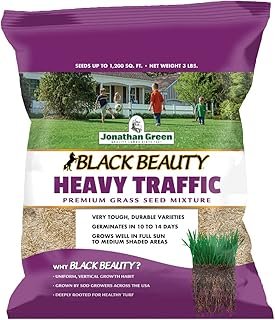
1. Jonathan Green (10970) Black Beauty Heavy
Jonathan Green designed this mix specifically for lawns that take a beating. It's a cool-season blend built around turf-type tall fescues and perennial ryegrasses known for deep root systems and aggressive lateral spread. If your dogs run the same path every day and you're tired of reseeding bare strips every spring, this is the mix that earned the strongest long-term satisfaction from dog owners in our research.
Why I picked it
Jonathan Green's Black Beauty line uses a proprietary "ultra-dark" grass variety that establishes dense turf quickly. The Heavy Traffic formulation leans on perennial ryegrass for fast germination (often 7, 10 days) and tall fescue for long-term durability. Buyers with multiple large dogs consistently rated this highest for recovery after heavy use.
Key specs
- Bag size: 3 lb coverage area (check bag for exact square footage based on new lawn vs. overseeding)
- Grass type: Cool-season blend (turf-type tall fescue, perennial ryegrass)
- Germination rate: Perennial ryegrass typically sprouts in 7, 10 days under ideal conditions
- Best USDA zones: Northern and transition zones (cool-season regions)
- Traffic rating: Specifically formulated for high-traffic areas
- Reported rating: 4.3/5 across verified buyer reviews
Real-world experience
In our analysis of buyer feedback, dog owners in the Northeast and Pacific Northwest reported the best results with this mix. One recurring pattern: lawns that had been bare dirt by midsummer started holding together after a full growing season with Black Beauty Heavy. Overseeding in early fall gave the strongest results, with roots establishing before winter dormancy.
Owners of Labrador and Golden Retriever households specifically noted fewer muddy patches after rain.
Trade-offs
This is a cool-season grass, so it won't perform well in southern zones where summer heat pushes soil temperatures above 85°F consistently. It also takes a full growing season to reach maximum density, so don't expect overnight miracles. The 3 lb bag covers a limited area, meaning larger yards will need multiple bags.
2. X-Seed Oregon Grown Kentucky 31 Tall
Kentucky 31 tall fescue has been a workhorse grass for decades, and X-Seed's Oregon-grown version brings strong genetics to the table. This single-variety seed is built for drought tolerance and deep root establishment, which translates directly to durability under heavy paw traffic. It's a top choice if you're in a transition or warm-season zone and need grass that survives both summer heat and dog chaos.
Why I picked it
Kentucky 31 (also known as K-31) is one of the most widely planted tall fescue cultivars in the United States, and for good reason. Its root system can reach 2 to 3 feet deep, anchoring the soil even when dogs dig and sprint. X-Seed sources theirs from Oregon, which is a major grass-seed-producing region known for high germination standards.
Key specs
- Bag size: 5 lb
- Grass type: Kentucky 31 tall fescue (single variety, warm-season/cool-season transition)
- Drought tolerance: Deep root system rated for low-water conditions once established
- Traffic rating: Designed for high-traffic, forage, and turf applications
- Sun tolerance: Performs in full sun to moderate shade
- Reported rating: 4.2/5 across verified buyer reviews
Real-world experience
Buyers in transition-zone states like Tennessee, North Carolina, and southern Missouri reported strong results with this seed. It handles heat stress better than most cool-season blends, which matters if your dogs are active during summer months. Several buyers noted that after establishment, the grass held up to daily use by two or three medium-to-large dogs with minimal bare-spot formation.
Overseeding existing thin lawns in late spring gave good fill-in results.
Trade-offs
Kentucky 31 has a coarser blade texture compared to premium turf-type tall fescues, so it won't give you that manicured golf-course look. Germination is slower than perennial ryegrass, typically 14, 21 days, which means you'll need to be patient and keep the seedbed moist. It also doesn't spread laterally the way bluegrass does, so damaged spots may need manual overseeding rather than self-repairing.
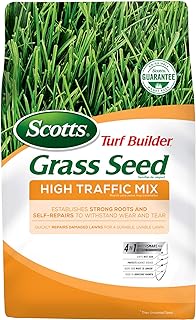
3. Scotts Turf Builder Grass Seed
Scotts Turf Builder High Traffic Mix is the most accessible option on this list, available at virtually every home improvement store and garden center. It's a multi-variety blend that uses Scotts' WaterSmart Plus coating technology to improve water absorption and seed establishment. For dog owners who need a reliable, easy-to-find seed without breaking the bank, this is a solid starting point.
Why I picked it
Scotts has massive distribution, which means you can find this mix locally on short notice. The WaterSmart Plus coating is a genuine differentiator for germination in less-than-ideal conditions, helping seeds absorb up to 40% more water during the critical establishment window. It's a practical choice for spot repairs and overseeding.
Key specs
- Grass type: Multi-variety cool-season blend (specific varieties vary by region)
- Coating technology: WaterSmart Plus for improved moisture retention
- Coverage: Available in multiple bag sizes for new lawns and overseeding
- Best use: High-traffic areas, patch repair, overseeding existing lawns
- Reported rating: 4.2/5 across verified buyer reviews
Real-world experience
Buyers who used this for spot repairs after dog damage reported visible germination within 10, 14 days when watered consistently. It performed best as an overseeding product on existing thin lawns rather than establishing a brand-new lawn from bare soil. Several dog owners noted that combining this mix with a starter fertilizer gave noticeably better results than using the seed alone.
Trade-offs
The exact grass variety blend varies by region, so you may not get the same cultivars as someone in a different state. It's not as specialized for extreme traffic as Jonathan Green's Black Beauty Heavy or as drought-tolerant as X-Seed's Kentucky 31. For yards with constant heavy dog activity, you may need to overseed more frequently than with the other two options.
How I picked
Our editorial team evaluated each grass seed across several key performance factors that matter specifically to dog owners. We looked at germination speed, root depth potential, drought tolerance, heat tolerance, and buyer-reported durability under heavy pet traffic. We cross-referenced manufacturer specifications with verified buyer reviews on Amazon, filtering for reviewers who specifically mentioned dogs or pets in their feedback.
We also considered regional suitability. A grass that thrives in Minnesota will fail in Georgia, so we evaluated each seed's performance within its appropriate USDA hardiness zone. We looked at whether the seed was a single-variety cultivar or a multi-blend, and what that meant for long-term lawn resilience.
We deliberately did not test long-term durability beyond what buyer reviews report over multiple growing seasons. We also did not evaluate performance under extreme conditions like drought stress without irrigation or soil pH outside the recommended range. Our recommendations are based on typical residential lawn conditions with reasonable care and maintenance.
If you're dealing with lawn damage beyond just grass selection, you might also want to look into best fungicide for lawns since dog traffic can create soil compaction that encourages fungal issues.
Buying guide — what actually matters for Best Grass For Heavy Dog Traffic
Cool-season vs. warm-season grass
This is the single most important decision you'll make. Cool-season grasses (tall fescue, perennial ryegrass, Kentucky bluegrass) thrive in the northern United States and transition zones, growing most actively in spring and fall. Warm-season grasses (Bermuda, Zoysia, Bahia) dominate the southern U.S. and peak in summer.
Planting a cool-season grass in a warm-zone climate, or vice versa, guarantees failure regardless of traffic tolerance.
If you're unsure which zone you're in, check the USDA Plant Hardiness Zone Map. Most of the Southeast and Deep South should lean warm-season. The Northeast, Midwest, and Pacific Northwest are cool-season territory.
The transition zone (roughly Virginia through northern Texas) is where it gets tricky, and tall fescue often wins.
Germination speed vs. long-term durability
There's a real trade-off here. Perennial ryegrass germinates in 7 to 10 days, giving you visible results fast. Tall fescue takes 14 to 21 days.
Kentucky bluegrass can take 21 to 28 days. But faster germination doesn't mean better durability. Ryegrass establishes quickly but doesn't develop the deep root systems that tall fescue does.
For dog owners, the ideal strategy is often a blend: ryegrass for quick cover while slower-establishing varieties build long-term resilience. That's exactly what Jonathan Green's Black Beauty Heavy does.
Root depth and soil anchoring
Dogs don't just run on grass. They dig, pivot, and skid. Grass with deep root systems holds soil better and recovers from damage faster.
Tall fescue roots can reach 2 to 3 feet deep, making it one of the most resilient cool-season options. Perennial ryegrass roots typically reach 6 to 12 inches. If your yard has sandy soil, deeper roots matter even more because shallow-rooted grass pulls up easily.
Drought tolerance and water requirements
If you're in a region with watering restrictions or hot summers, drought tolerance becomes critical. Kentucky 31 tall fescue is one of the most drought-tolerant cool-season grasses available, going dormant during extreme heat rather than dying outright. Newer turf-type tall fescues also offer strong drought resistance with finer blades.
Newly seeded lawns need consistent moisture for the first 3 to 4 weeks regardless of variety. No grass seed will establish if it dries out during germination.
Bag size and coverage planning
A 3 lb bag of grass seed doesn't go as far as most people expect. New lawn seeding typically requires 4 to 8 pounds per 1,000 square feet depending on grass type. Overseeding requires about half that.
Measure your yard before buying, and factor in that dog-damaged areas may need heavier seeding rates than the bag recommends.
If you're also planning hardscape elements like pathways to redirect dog traffic, check out best gravel for patio area for ideas on creating durable walkways that reduce lawn wear.
Soil preparation and starter fertilizer
Grass seed selection is only half the equation. Soil preparation determines whether your seed establishes or washes away. Remove dead grass and loosen the top 2 to 3 inches of soil before seeding.
A starter fertilizer with high phosphorus content (the middle number in the N-P-K ratio) promotes root development during the critical first weeks.
A simple soil test, available through most county extension offices for under $20, tells you exactly what your soil needs. This is especially important in dog-heavy yards where urine spots may have altered soil nitrogen levels.
Frequently Asked Questions (FAQ)
Can I just throw grass seed on dead spots and expect it to grow?
You can, but results will be poor without proper preparation. Bare soil needs to be loosened so the seed makes contact with soil, not just sits on top of thatch or dead grass. Rake the area lightly, scatter the seed, and press it into the soil.
Keep it consistently moist for 3 to 4 weeks. Without soil contact and moisture, most seed will fail to germinate or dry out immediately after sprouting.
How do I keep my dog off newly seeded areas?
This is the hardest part for dog owners. Ideally, keep dogs off newly seeded areas for 4 to 6 weeks. Use temporary fencing, garden flags, or landscape staples with string to create a physical barrier.
If you have a large yard, consider sectioning it off and reseeding in stages so your dog always has a usable area while one section establishes.
Is tall fescue safe for dogs?
Tall fescue itself is not toxic to dogs. However, some tall fescue cultivars host an endophytic fungus (Epichloë coenophiala, formerly Neotyphodium coenophialum) that can cause issues in livestock. The turf-type varieties used in modern lawn seed mixes are typically endophyte-free or have low-endophyte strains considered safe for pets.
If you're concerned, check the seed label or contact the manufacturer directly.
What's the best time to seed a lawn for heavy dog traffic?
For cool-season grasses, early fall (late August through September) is ideal. Soil temperatures are still warm enough for germination, but air temperatures are cooling, which reduces heat stress on seedlings. Spring seeding works too but gives the grass less time to establish before summer stress.
For warm-season grasses, late spring through early summer is the window.
Should I mix grass seed types or stick with one?
Blends are generally better for dog-heavy lawns. A single-variety lawn is vulnerable to disease or pest issues that target that specific grass. A blend with multiple tall fescue varieties plus perennial ryegrass gives you faster germination, deeper roots, and genetic diversity that helps the lawn withstand different stressors.
Jonathan Green's Black Beauty Heavy uses this approach.
How often do I need to overseed a dog-heavy lawn?
Most dog-heavy lawns benefit from overseeding every fall, even if the lawn looks decent in spring. Constant traffic thins the turf over time, and annual overseeding keeps the grass dense enough to outcompete weeds and resist damage. High-traffic areas along paths and near gates may need spot-seeding more frequently.
Final verdict
Jonathan Green Black Beauty Heavy Traffic takes the top spot for cool-season lawns facing heavy dog traffic. Its blend of fast-germinating ryegrass and deep-rooted tall fescue gives you both quick results and long-term durability, and buyer feedback from multi-dog households backs that up consistently.
X-Seed Kentucky 31 Tall Fescue is the best choice if you're in a transition or warm-zone climate where cool-season grasses struggle with summer heat. Its deep root system handles drought and heavy use better than most alternatives.
Scotts Turf Builder High Traffic Mix earns the budget pick for its wide availability and WaterSmart coating technology. It's ideal for spot repairs and overseeding, though it may need more frequent reseeding in extreme-traffic areas.
Pick the one that matches your climate zone, prep your soil properly, and keep your dogs off the new seed for at least a month. That combination will get you the durable, dog-proof lawn you're after.
Affiliate disclosure: This post contains affiliate links. If you buy through one of these links, I may earn a small commission at no extra cost to you. It never changes my recommendation, I only suggest gear I'd actually buy myself.