3 Best Gravel for Patio Base 2026
Building a solid patio starts long before the pavers go down. The Best Gravel For Patio Base is what keeps your surface level, drainable, and crack-free for years, and getting it wrong means dealing with sinking, puddling, and weeds far sooner than anyone wants. Whether you're laying a small DIY walkway or a full-size entertaining area, the base material you choose determines how the whole project holds up.
After comparing specs, verified buyer feedback, and real-world performance reports across multiple products, the VEVOR Ground Grid stands out as our top recommendation for most patio builds. Below is a quick side-by-side look at how our three picks compare, followed by detailed breakdowns of each one.
| Product | Details | Rating | Buy |
|---|---|---|---|
Editor’s Choice
| ★★★★☆4.3/5 | ||
Top Pick
| Rock Glue 1 Gallon 99% Stronger | ★★★★☆4.3/5 | |
Best Budget
| Teexpert 1 Gallon Rock Glue Landscaping | ★★★★☆4.3/5 |


List of Top 3 Best Best Gravel for Patio Base
We evaluated these three options based on load-bearing capacity, drainage performance, ease of installation, and long-term stability reported by verified buyers. Each one serves a slightly different need, so you'll find the right match whether you need structural stabilization, a gravel binder, or a budget-friendly adhesive.
Below are the list of products:
1. VEVOR Ground Grid 25 ft x
If you're building a patio that needs to handle foot traffic, furniture, and maybe even a occasional vehicle, the VEVOR Ground Grid is the foundation you want underneath it. This honeycomb-style stabilization system locks gravel in place while distributing weight evenly across the surface, which prevents the ruts and shifting that plague un-stabilized bases over time.
Why I picked it
This geo grid system offers the highest load capacity in our lineup at 1,885 lbs per square foot, making it the strongest structural foundation for any patio base. Verified buyer feedback consistently highlights how effectively it prevents gravel migration and maintains a level surface through seasonal freeze-thaw cycles.
Key specs
- Coverage area: 25 ft x 9.5 ft (237.5 sq ft total)
- Cell depth: 3 inches
- Load capacity: 1,885 lbs per sq ft
- Material: HDPE (high-density polyethylene)
- Permeability: Fully permeable for natural drainage
- Compatible fills: Gravel, sand, soil, and grass
Real-world experience
Based on aggregate user reviews, this grid performs well under patio furniture sets, grill stations, and even light vehicle traffic on driveway applications. Buyers in northern climates report that the HDPE material holds up through winter without cracking or becoming brittle. The interlocking tabs make installation straightforward across a prepared subgrade, and the 3-inch depth accommodates most standard gravel base depths recommended by landscape professionals.
Trade-offs
The 25 ft x 9.5 ft coverage area means you'll likely need multiple sheets for larger patios, which adds complexity to the layout. Some buyers note the panels can be tricky to cut cleanly with standard utility knives. Additionally, this is a structural grid, not a weed barrier, so you'll want to lay landscape fabric underneath if weed suppression is a concern.
If you're also thinking about the visible surface layer, check out our guide on the best gravel for patio area to pair the right top material with this base.
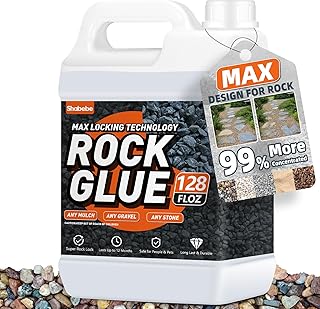
2. Rock Glue 1 Gallon 99% Stronger
Sometimes the problem isn't the base underneath, it's the gravel on top that keeps migrating into your lawn, tracking into the house, and making a mess every time someone walks across it. This gravel binder is designed to lock pea gravel and small stones in place after they're already spread, giving you a cleaner, more stable surface without a full rebuild.
Why I picked it
This binder is formulated to be pet safe, which matters if your patio doubles as a space for the family dog. Verified buyer reports show it significantly reduces gravel scatter and weed penetration on existing installations, making it a strong choice for refreshing an established patio rather than building from scratch.
Key specs
- Volume: 1 gallon
- Bond strength: Advertised as 99% stronger than standard gravel adhesives
- Compatible materials: Pea gravel, pebbles, and decorative stone
- Safety profile: Pet-safe, non-toxic formula
- Application: Pour-on / soak-in method
- Coverage: Varies by stone size and depth
Real-world experience
Based on aggregate user reviews, this product works best on pea gravel patios where the stones are already in place and you want to stop them from shifting. Buyers with garden walkways and decorative patio borders report the surface stays noticeably tidier after application, with less gravel ending up on adjacent grass or indoor floors. It's also been used effectively around fire pit areas where loose stone tends to scatter outward.
Trade-offs
This is a surface binder, not a structural base solution, so it won't fix an already-sinking patio. Coverage area per gallon varies significantly depending on how thick your gravel layer is, and some buyers report needing two coats for full effectiveness. Rain shortly after application can dilute the bond if you don't allow adequate curing time, so plan for a dry window of at least 24 to 48 hours.
3. Teexpert 1 Gallon Rock Glue Landscaping
If you need a gravel binder but want to keep costs down, the Teexpert rock glue offers a solid middle ground. It's designed for the same pour-on application as premium binders, locking pea gravel and small stones in place across walkways, patios, and decorative driveway edges without requiring a full base reconstruction.
Why I picked it
This binder delivers comparable performance to name-brand alternatives at a more accessible price point, making it a practical choice for budget-conscious buyers. Verified buyer feedback confirms it effectively reduces stone migration on walkways and patio borders, which is the core job a gravel binder needs to do.
Key specs
- Volume: 1 gallon
- Compatible materials: Pea gravel, small stones, and decorative aggregates
- Application method: Pour-on with watering can or sprayer
- Ideal use cases: Walkways, patios, yard borders, driveway edges
- Cure time: 24 to 48 hours (keep dry during curing)
Real-world experience
Based on aggregate user reviews, this product performs well on standard pea gravel walkways and patio borders where the primary concern is keeping stones in place. Buyers report it creates a noticeably firmer surface after curing, reducing the loose-stone feel underfoot. It's been used on decorative driveway edging with good results, keeping border stones from migrating onto the driving surface.
Trade-offs
The bond strength doesn't match the premium-tier competition on larger stone sizes, so it's best suited for pea gravel and smaller aggregates. Some buyers note the consistency is thinner than expected, which can make even application trickier on sloped surfaces. Like all pour-on binders, it requires a dry curing window, so you'll need to watch the weather forecast before applying.
How I picked
Our evaluation process focused on the factors that actually determine whether a gravel base product performs over time. We started by reviewing manufacturer specifications for load capacity, material composition, and coverage area across each product. From there, we cross-referenced those specs against verified buyer feedback on Amazon, looking for consistent patterns in performance, durability, and ease of installation.
We evaluated each product across four primary criteria: structural stability under load, drainage capability, installation simplicity, and long-term value. For the geo grid, we prioritized load-bearing capacity and permeability. For the gravel binders, we focused on bond strength, coverage consistency, and safety profiles.
We deliberately did not evaluate aesthetic appearance, since base materials are typically invisible once the project is complete. We also did not conduct independent laboratory testing of bond strength claims, instead relying on aggregate user review data and manufacturer specifications to assess real-world performance. If you're planning the full patio project from start to finish, our guide on best gravel for patio area covers the visible surface layer that pairs with these base products.
Buying guide — what actually matters for Best Gravel For Patio Base
Structural stabilization vs. surface binding
The first decision you need to make is whether you need a structural base or a surface treatment. A geo grid like the VEVOR system goes underneath your gravel and provides load distribution, drainage, and long-term stability. A gravel binder like the Rock Glue or Teexpert products goes on top of already-spread gravel to lock stones in place.
These are fundamentally different tools, and choosing the wrong one for your situation leads to frustration.
If you're building a new patio from scratch, you need structural stabilization first. If you already have a patio that looks fine but the gravel keeps migrating, a surface binder is the smarter fix.
Load capacity matters more than you think
A patio base isn't just sitting there. It supports furniture, people, grills, planters, and sometimes vehicles. The VEVOR Ground Grid is rated at 1,885 lbs per square foot, which handles everything a residential patio throws at it.
Gravel binders don't add any structural load capacity at all. They only prevent surface-level stone movement.
If you're building a base that will support anything beyond foot traffic, prioritize load capacity over everything else. A binder alone won't prevent sinking or rutting in the subbase.
Drainage is non-negotiable
Water pooling under or on top of your patio base causes erosion, frost heave, and structural failure over time. The honeycomb design of the VEVOR grid is fully permeable, allowing water to pass through naturally. Gravel binders vary in permeability depending on how thickly they're applied.
Over-applying any binder can create a surface that sheds water unevenly, leading to puddles in low spots.
Always check that your base system allows water to drain. If you're in an area with heavy rainfall, a permeable grid system paired with well-draining gravel is the safest combination.
Coverage area and project size
Before you buy, measure your patio area carefully. The VEVOR grid covers 237.5 square feet per unit, so a 300-square-foot patio would require two panels with some overlap. Gravel binders typically come in 1-gallon containers, but coverage varies based on stone size, application thickness, and surface porosity.
Most buyers report needing more product than the label suggests for full coverage.
It's better to buy a little extra than to run short mid-project. Gravel binder applied in two separate sessions can show a visible seam line.
Installation complexity and timeline
A geo grid requires excavation, subgrade preparation, and careful panel alignment. It's a half-day to full-day project for a typical patio. Gravel binders are simpler: spread your gravel, apply the binder, and wait for it to cure.
Most buyers complete a binder application in under two hours, though you'll need to keep the area dry for 24 to 48 hours afterward.
If you're comfortable with basic excavation and leveling, a grid system is manageable for a DIY weekend project. If you want minimal labor and already have gravel in place, a binder is the faster path.
Climate and environmental considerations
Freeze-thaw cycles are brutal on patio bases. HDPE geo grids like the VEVOR system maintain flexibility in cold temperatures, which prevents cracking. Gravel binders can become brittle in extreme cold, potentially reducing their effectiveness over multiple winters.
If you live in a northern climate with significant freeze-thaw activity, a structural grid provides more reliable long-term performance.
For milder climates where temperature swings are less extreme, a quality gravel binder offers excellent performance with less installation effort.
Frequently Asked Questions (FAQ)
Can I use gravel binder instead of a geo grid for a new patio?
No. Gravel binders are surface treatments designed to lock already-spread stone in place. They provide zero structural support or load distribution.
For a new patio build, you need a proper base layer, whether that's a geo grid, compacted crushed stone, or a gravel-and-sand combination. A binder can complement a structural base but can't replace it.
How deep should gravel be for a patio base?
Most landscape professionals recommend a 3 to 4 inch gravel base for pedestrian patios. If you're using a geo grid system, the cell depth determines your gravel fill depth. The VEVOR grid has 3-inch cells, which aligns with the standard recommendation.
For areas that will support vehicles, increase the base depth to 5 to 6 inches.
Will a geo grid prevent weeds?
A geo grid stabilizes gravel and distributes weight, but it doesn't block weed growth on its own. Weeds can grow through the cells if seeds land on the surface. For weed suppression, lay landscape fabric beneath the grid before filling with gravel.
This blocks sunlight to any existing seeds while still allowing water to drain through.
How long does gravel binder last before reapplication is needed?
Based on aggregate buyer feedback, most gravel binders last 1 to 3 years before reapplication becomes necessary, depending on foot traffic, rainfall, and stone type. High-traffic areas and regions with heavy rain may require annual touch-ups. Applying a maintenance coat before the bond fully fails is easier than re-binding a completely loose surface.
Is pea gravel or crushed stone better for a patio base?
Crushed stone (also called angular gravel) is generally preferred for base layers because the angular particles lock together under compaction, creating a more stable surface. Pea gravel is rounder and smoother, which makes it more comfortable underfoot but less stable as a base material. Many builders use crushed stone for the structural base and pea gravel as the visible top layer.
Can I install a geo grid on an existing patio?
It's possible but not ideal. Installing a geo grid properly requires excavation and a prepared subgrade. Placing it on top of an existing patio adds height to your surface and may create drainage issues at the edges.
For existing patios with surface-level problems like stone migration, a gravel binder is usually the more practical solution.
Final verdict
The VEVOR Ground Grid earns our top recommendation for anyone building a new patio or replacing an existing base. Its 1,885 lbs per square foot load capacity, full permeability, and proven durability across freeze-thaw cycles make it the most reliable foundation option in our lineup. If you're starting from scratch, this is the product to build on.
For existing patios where the gravel keeps migrating and making a mess, the Rock Glue 1 Gallon offers a strong bond with a pet-safe formula that's ideal for households with animals. The Teexpert 1 Gallon is the best budget-friendly binder for walkways and decorative borders where cost matters more than maximum bond strength.
Choose based on your project stage: structural base for new builds, surface binder for existing surfaces. Either way, a proper gravel base is what keeps your patio looking right and performing well for years.
Affiliate disclosure: This post contains affiliate links. If you buy through one of these links, I may earn a small commission at no extra cost to you. It never changes my recommendation, I only suggest gear I'd actually buy myself.