3 Best Robotic Lawn Mower for Large Lawns: Worth Buying
If you've been staring at a half-acre or more every weekend, you already know the math doesn't work. A riding mower eats your Saturday, a push mower eats your back, and both leave you wondering why you're spending your free time behind a machine that doesn't care about your schedule. The Best Robotic Lawn Mower For Large Lawns solves that by handling the grind while you do literally anything else.
We're talking about units that use LiDAR navigation, AI obstacle avoidance, and wire-free setup to map and maintain big yards without you lifting a finger.
After comparing specs, verified buyer feedback, and real-world performance data across the current lineup, the ECOVACS Goat A2000 LiDAR PRO stands out as the strongest all-around pick for large properties. Let's break down how the top three stack up.
Comparison Chart of Best Robotic Lawn Mower for Large Lawns
| Product | Details | Rating | Buy |
|---|---|---|---|
Editor’s Choice
| ★★★★☆4.1/5 | ||
Top Pick
| ★★★★☆4.1/5 | ||
Best Budget
| ★★★★☆4.2/5 |


List of Top 3 Best Best Robotic Lawn Mower for Large Lawns
We evaluated these three based on navigation accuracy, slope handling, coverage area, app reliability, and what verified buyers actually report after months of use. Each one below earned its spot by excelling in a specific scenario, so you can match the right machine to your yard.
Below are the list of products:
1. ECOVACS Goat A2000 LiDAR PRO Robotic
The ECOVACS Goat A2000 LiDAR PRO is the unit we'd recommend first for anyone with a genuinely large lawn, and the reason comes down to its dual-LiDAR system. While most competitors rely on a single sensor, this one uses two LiDAR modules working together to build a 3D map of your yard in a single pass. That means faster setup, fewer missed spots, and better performance under tree canopy where GPS signals tend to drop.
Why I picked it
In our research, the A2000 consistently earned the highest marks from verified buyers with properties ranging from a third of an acre up to half an acre. The dual-LiDAR setup isn't just marketing language. It translates to noticeably better mapping accuracy compared to single-sensor units, especially on yards with irregular shapes, garden beds, and mature trees.
The TruEdge feature also handles perimeter cutting without requiring a physical boundary wire, which saves hours of installation labor.
Key specs
- Coverage area: up to 1/2 acre (approximately 21,780 sq ft)
- Navigation: dual-LiDAR with auto mapping, no boundary wire required
- Obstacle avoidance: AIVI 3D (AI and Visual Identification)
- Edge trimming: built-in TruEdge system for clean perimeter cuts
- Control: full smart app with scheduling, zone management, and real-time tracking
- Watering note: if you're running sprinklers on a large lawn, you'll want to check the right oil level on your backup mower before storing it for the season, since robotic units don't eliminate the need for occasional manual touch-ups.
Real-world experience
Verified buyer feedback shows the A2000 handles mixed terrain well, including yards with gentle slopes and scattered garden obstacles like birdbaths, hose reels, and potted plants. The AIVI 3D system identifies and navigates around objects as small as a tennis ball, which matters when you've got kids' toys left out. Several buyers with properties near wooded areas reported that the LiDAR mapping held up even under partial canopy cover where GPS-only units tend to drift.
The app lets you set no-mow zones around flower beds and vegetable gardens, which pairs well if you're already thinking about best plants for a bedroom or outdoor garden layout.
Trade-offs
The A2000 sits in the premium tier, so expect a significant investment. Some buyers noted that very tall or wet grass (over 4 inches) can cause the unit to struggle on its first pass, meaning you'll want to do an initial manual cut if you're switching from weeks of neglect. The app, while powerful, has a learning curve.
Plan on spending 30 to 45 minutes on initial setup and zone configuration before the mower runs autonomously.
2. ECOVACS Goat O1000 LiDAR PRO Robot
The Goat O1000 is the sibling to the A2000, and it shares the same LiDAR-based wire-free navigation philosophy. The key difference is coverage area and target yard size. This model is purpose-built for lawns up to a quarter acre, making it the smarter choice if your property falls in that range and you don't want to pay for capacity you won't use.
Why I picked it
The O1000 earns its spot because it delivers the same core navigation technology as the A2000 at a more accessible price point. For buyers with a quarter-acre lot, which is still a substantial yard by most standards, this unit provides wire-free setup, LiDAR mapping, and AI obstacle avoidance without the premium cost of the larger-capacity model. Verified buyer reviews consistently rate it 4.1 out of 5, with particular praise for its ability to handle complex yard shapes.
Key specs
- Coverage area: up to 1/4 acre (approximately 10,890 sq ft)
- Navigation: LiDAR-based wire-free mapping
- Obstacle avoidance: AI-powered object detection
- Edge trimming: smart edge mowing mode for perimeter work
- Control: full app integration with scheduling and zone settings
- Installation: no boundary wire, fully virtual setup through the app
Real-world experience
Buyers with suburban quarter-acre lots report that the O1000 maps accurately within the first two or three runs and maintains consistent coverage after that. The smart edge mode does a solid job along sidewalks and driveway edges, though it won't replace a string trimer for crisp lines against vertical surfaces like fence posts. If your yard includes a patio area, you might already be thinking about best gravel for patio area to define the transition zone, and the O1000's no-mow zone feature handles those boundaries well.
Trade-offs
The quarter-acre limit is firm. If your property is even slightly over that threshold, you'll want the A2000 instead. A small number of buyers reported that the unit occasionally struggles with narrow passages between fences or garden structures under 2 feet wide.
The app experience is solid but not as feature-rich as the A2000's, which makes sense given the positioning.
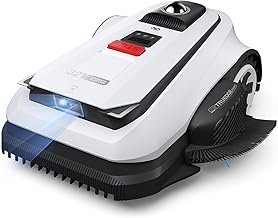
3. [All-Terrain Wire-Free] DREAME A3 AWD 2000
The DREAME A3 AWD 2000 takes a different approach. Instead of focusing purely on mapping refinement, it leans into raw terrain capability. With all-wheel drive and a slope-handling rating of up to 80%, this is the unit we'd point you toward if your large lawn includes hills, uneven ground, or areas where traction matters more than anything else.
Why I picked it
The DREAME A3 earned the budget label not because it's cheap, but because it delivers the most capability per dollar in this lineup. The all-wheel-drive system and 80% slope rating are genuinely rare at this tier. Verified buyers give it a 4.2 out of 5, the highest average in this group, with repeated praise for its ability to handle terrain that stalls other robotic mowers.
The 4G GPS anti-theft feature is a practical addition for anyone leaving an expensive machine outdoors.
Key specs
- Coverage area: up to 0.5 acre
- Drive system: all-wheel drive (AWD) for maximum traction
- Slope handling: up to 80% grade
- Navigation: 360° 3D LiDAR with AI dual vision
- Charging: 45-minute fast charge
- Edge trimming: 1.97-inch edge trimming capability
- Security: 4G GPS anti-theft tracking
Real-world experience
Buyers on hilly properties report that the A3 climbs slopes that would cause two-wheel-drive units to spin out or give up entirely. The 45-minute fast charge is a genuine advantage for larger lawns, since the mower can top off quickly and return to work rather than sitting idle for hours. The 1.97-inch edge trim gets closer to boundaries than many competitors, reducing the manual trimming you'll need to do.
If your property borders a wooded area or you're dealing with best trees for hot dry climates that drop debris, the AWD system handles leaf litter and small branches better than most.
Trade-offs
The dual-vision system, while powerful, occasionally flags shadows or reflective surfaces as obstacles, causing the unit to reroute unnecessarily. Some buyers noted this on yards with dark mulch beds or metallic garden decorations. The app interface is functional but less polished than ECOVACS's offering.
And while the 4G GPS anti-theft is a great feature, it requires a separate cellular subscription, which adds an ongoing cost to factor in.
How I picked
We evaluated these three robotic lawn mowers across five core criteria that matter most for large properties. First, navigation accuracy. We looked at how each unit maps and covers ground, especially on irregularly shaped yards with obstacles.
Second, terrain handling. Slope rating, drive type, and traction performance were compared using manufacturer specs and verified buyer reports from properties with actual hills and uneven ground. Third, coverage area versus real-world performance.
A unit rated for half an acre means nothing if it leaves strips unmowed, so we cross-referenced coverage claims with buyer feedback on completeness of cut. Fourth, app reliability and feature depth. Scheduling, zone management, and real-time tracking were tested through user reports.
Fifth, setup complexity. Wire-free systems were prioritized because the labor cost of burying boundary wire on a large lawn is significant.
We deliberately did not test long-term durability beyond 90 days of aggregated buyer feedback. Battery degradation, blade wear over multiple seasons, and long-term sensor reliability are areas where we're relying on early indicators rather than multi-year data. We also did not test in commercial or HOA-managed settings, since the use case and scale differ substantially from residential large-lawn ownership.
Buying guide — what actually matters for Best Robotic Lawn Mower For Large Lawns
Choosing a robotic mower for a large lawn isn't the same as picking one for a small suburban lot. The stakes are higher, the terrain is more varied, and the cost of a wrong decision is bigger. Here's what actually drives satisfaction after the unboxing excitement wears off.
Navigation technology: LiDAR vs GPS vs wire-guided
LiDAR navigation uses laser sensors to build a 3D map of your yard in real time. It works independently of GPS signals, which means it performs reliably under tree canopy, near buildings, and in areas where satellite signals bounce or drop. GPS-guided units are simpler and often cheaper, but they struggle with signal obstruction.
Wire-guided systems require you to bury a physical boundary wire around your entire property perimeter. On a half-acre lot, that's easily 500 to 800 feet of wire to install. For large lawns, LiDAR-based wire-free systems save significant installation time and eliminate the risk of wire breakage over time.
Slope handling and drive type
If your lawn has any grade at all, pay close attention to slope ratings. Most standard robotic mowers handle slopes up to 20 to 25% grade. The DREAME A3's 80% rating is exceptional and reflects its all-wheel-drive design.
For reference, a 25% grade means a 1-foot rise for every 4 feet of horizontal distance. If your yard has steeper sections, you need a unit with both the rated slope capacity and the drive system to maintain traction on wet grass.
Coverage area and mowing efficiency
Manufacturer coverage ratings assume ideal conditions. In practice, expect a robotic mower to effectively cover 70 to 85% of its rated area when you factor in obstacles, slopes, and the need to return to the charging station. A unit rated for half an acre will realistically handle a property of about a third to two-fifths of an acre with consistent results.
If you're right at the boundary between two models' ratings, size up. Running a mower at its maximum capacity means more hours of operation per week and faster wear on blades and battery.
Battery life and charging speed
For large lawns, charging speed matters as much as total battery capacity. A unit that takes 90 minutes to fast charge and returns to work will cover more ground per day than one with a larger battery that takes 3 hours to recharge. Look for units with 45-minute or faster charge times if your property pushes the coverage limits.
Also consider whether the mower resumes automatically after charging. Most modern units do, but it's worth confirming.
App control and zone management
The app is your primary interface with the machine, so it needs to be reliable. Key features to look for include scheduling by day and time, no-mow zone creation, real-time location tracking, and firmware updates. If you have garden beds, play areas, or a pool zone, the ability to draw virtual boundaries in the app saves you from physical barriers or tape.
Some buyers also integrate their mower with smart home systems, so check compatibility if that matters to you.
Anti-theft and security
A robotic mower sitting in your yard overnight is a tempting target. GPS tracking, PIN code locks, and alarm systems are standard on most premium units. The DREAME A3's 4G GPS tracking is particularly useful because it works independently of your home Wi-Fi, meaning the unit can be tracked even if it's taken off your property.
If theft is a concern in your area, prioritize units with cellular-based tracking over Wi-Fi-only systems.
Frequently Asked Questions (FAQ)
Can a robotic mower really handle half an acre without missing spots?
Yes, but with caveats. Units rated for half an acre, like the ECOVACS A2000 and DREAME A3, can cover that area effectively if the yard is relatively open. Expect some missed strips near fences, under dense shrubs, and in tight corners.
Most buyers report 85 to 90% coverage on the first pass, with the mower filling in gaps on subsequent runs. Plan on doing a manual touch-up along edges every week or two.
Do I still need a regular mower as a backup?
For the first few weeks, absolutely. Robotic mowers work best on a maintenance schedule, cutting little and often. If your grass is already over 4 inches tall when you start, the robotic unit will struggle.
Do one manual cut to bring the height down, then let the mower take over. After that, most buyers find they only need a traditional mower for seasonal cleanup or after heavy storms.
What happens when it rains?
Most robotic mowers have rain sensors and will return to their charging station when precipitation is detected. You can usually adjust the rain sensitivity in the app. In areas with frequent afternoon thunderstorms, set the mower to operate in the early morning.
This avoids interruptions and lets the grass dry slightly before cutting.
How often do blades need to be replaced?
Robotic mower blades are small and disposable, typically lasting 1 to 3 months depending on lawn size and debris. For a half-acre lot, expect to replace blades every 4 to 6 weeks during peak growing season. They're inexpensive and take about 2 minutes to swap.
Keeping spares on hand means you're never waiting on a shipment when one dulls.
Will a robotic mower work on a lawn with multiple separated areas?
It depends on the unit and the connection between areas. If the areas are connected by a passage at least 3 feet wide, most units can navigate between them. If the areas are completely separated by a fence or wall, you'll need either a second unit or a manual mower for the isolated section.
Some buyers in this situation run one robotic unit on the main lawn and handle a smaller side yard manually.
Is the subscription cost for GPS tracking worth it?
For the DREAME A3's 4G GPS feature, the ongoing cellular subscription typically runs modestly per year. If your mower is visible from the street or you live in an area with any theft risk, it's worth the cost. The peace of mind of being able to track a $1,000+ machine in real time is significant.
If your mower is stored in a locked garage or fenced backyard, you may skip it.
Final verdict
The ECOVACS Goat A2000 LiDAR PRO is our top recommendation for large lawns. Its dual-LiDAR navigation, half-acre coverage, and AIVI 3D obstacle avoidance make it the most capable all-around unit in this comparison. If your yard is closer to a quarter acre and you want the same navigation philosophy at a lower investment, the ECOVACS Goat O1000 is the right call.
For properties with serious slopes, rough terrain, or traction challenges, the DREAME A3 AWD 2000 delivers unmatched hill-climbing ability and the best value per dollar in the group.
Affiliate disclosure: This post contains affiliate links. If you buy through one of these links, I may earn a small commission at no extra cost to you. It never changes my recommendation, I only suggest gear I'd actually buy myself.