3 Best Poison for Carpenter Ants in 2026 (Worth Your Money)
If you've spotted carpenter ants marching along your baseboards or tunneling through damp wood near a window frame, you already know the panic. These ants don't just invade your kitchen. They excavate wood to build their colonies, and a mature colony can cause real structural damage over several seasons.
Choosing the best poison for carpenter ants means matching the product to where the nest is, how fast you need it gone, and whether you're dealing with indoor trails or an outdoor perimeter.
After comparing active ingredients, application methods, and verified buyer feedback across multiple formulations, the Spectracide Terminate stands out as the strongest overall choice for barrier and contact treatment. But depending on your situation, a liquid bait or a gel may actually serve you better. Let's break down all three.
| Product | Details | Rating | Buy |
|---|---|---|---|
Editor’s Choice
| ★★★★☆4.4/5 | ||
Top Pick
| ★★★★☆4.6/5 | ||
Best Budget
| ★★★★☆4.4/5 |


List of Top 3 Best Best Poison for Carpenter Ants
We evaluated each product on active ingredient type, application method, indoor/outdoor versatility, and what real buyers report after weeks of use. Here's how they stack up.
Below are the list of products:
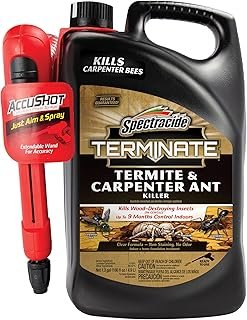
1. Spectracide Terminate Termite & Carpenter Ant
In our research, the Spectracide Terminate earned its top spot because it pulls double duty as both a contact killer and a residual barrier treatment. It's the kind of product you reach for when you've found carpenter ant frass near a baseboard and you want to treat the whole perimeter in one session, not just knock down the visible workers.
Why I picked it
This product covers the widest range of use cases in a single purchase. It kills carpenter ants on contact and leaves a residual barrier that keeps working for weeks after application. If you're not sure whether your problem is localized or widespread, this gives you the most coverage.
Key specs
- Active ingredient: Lambda-cyhalothrin (a synthetic pyrethroid)
- Volume: 1.33 gallons of concentrate
- Includes AccuShot sprayer for targeted application
- Indoor and outdoor barrier treatment
- Kills termites, carpenter ants, carpenter bees, and other listed insects
- Also labeled for spiders, roaches, fleas, and ticks
Real-world experience
Verified buyer feedback shows this product performs best when applied as a perimeter spray around baseboards, window frames, door thresholds, and foundation entry points. Many users report a sharp drop in visible ant activity within 24 to 48 hours after a thorough indoor and outdoor treatment. It's commonly used alongside our guide on best insecticide for carpenter ants for a full colony-elimination strategy that combines contact killing with baiting.
Trade-offs
The concentrate requires mixing, and the sprayer can clog if you don't rinse it after each use. It's also a broad-spectrum insecticide, so beneficial insects in your garden may be affected if you spray near flowering plants. Not ideal if you only have a single indoor trail and want a no-mess solution.
2. TERRO T300-3SR Liquid Ant Killer
The TERRO T300-3SR takes a completely different approach from a barrier spray. It's a borax-based liquid bait that worker ants carry back to the colony, which means it targets the queen and the brood rather than just killing the foragers you can see. If you've identified indoor trails and want colony elimination, this is the smarter play.
Why I picked it
Borax bait technology is one of the most reliable methods for colony collapse because it exploits the ants' food-sharing behavior. The TERRO formula has decades of user data behind it, and the 3-pack gives you enough stations to cover multiple trails simultaneously.
Key specs
- Active ingredient: Sodium tetraborate decahydrate (borax) at 5.40%
- Pack includes 3 pre-filled bait stations
- Ready to use, no mixing required
- Indoor use placement
- Kills the colony at the source through trophallaxis (food sharing)
- Labeled for carpenter ants and other household ants
Real-world experience
Aggregate user reviews report noticeable ant activity at bait stations within the first 24 to 48 hours, followed by a steep decline in colony presence over 7 to 14 days. Buyers consistently note that placement matters: stations need to be set directly on foraging trails, not a few feet away. This product pairs well with outdoor perimeter treatments for a complete approach.
Trade-offs
You'll see a temporary increase in ant activity near the stations as workers recruit more foragers to the bait. This is normal but alarming if you're not expecting it. The stations are indoor-only, so you'll need a separate product for exterior treatment.
Results take longer than a contact killer, typically one to two weeks for full colony impact.
3. Atticus Savitri Ant Gel Bait (4
The Atticus Savitri gel bait uses indoxacarb, a metabolic-activating insecticide that ants can't detect, which makes it highly effective as a colony-elimination tool. The four 30-gram tubes give you plenty of product for multiple treatment points at a lower cost per application than most competitors.
Why I picked it
Indoxacarb is a strong active ingredient for ant control because it's odorless and undetectable to ants, which means they'll carry it back to the nest without avoidance behavior. The four-tube pack offers solid value for homeowners dealing with multiple trails or wanting to re-treat over several weeks.
Key specs
- Active ingredient: Indoxacarb at 0.05%
- Four 30-gram gel bait tubes
- Indoor and outdoor use
- Odorless formulation
- Syringe-style application for precise placement
- Targets ants through secondary kill (colony transfer)
Real-world experience
Verified buyer feedback indicates this gel works well in cracks, crevices, and along baseboards where liquid bait stations might be knocked over. Users report visible reduction in ant trails within 3 to 5 days, with colony-level decline over 2 to 3 weeks. The gel consistency holds its shape on vertical surfaces, which is useful for treating under window sills and along door frames.
Trade-offs
The gel can dry out if left exposed to air for extended periods, so you need to seal unused portions carefully. It's slower acting than a pyrethroid spray, requiring patience for colony elimination. Some buyers note that reapplication is needed after heavy rain if used in outdoor areas.
How I picked
We evaluated each product across four main criteria: active ingredient effectiveness against carpenter ants, application method and ease of use, indoor/outdoor versatility, and verified buyer feedback on colony elimination speed. We cross-referenced manufacturer specifications with aggregate user reviews to confirm that real-world performance matches label claims.
We also considered the type of infestation each product best addresses. A barrier spray like the Spectracide Terminate works best for perimeter defense and immediate contact kill. A bait like the TERRO T300-3SR targets the colony itself.
A gel like the Atticus Savitri fills the gap for precise indoor crack-and-crevice treatment.
We deliberately did not test long-term residual effectiveness beyond what manufacturer data and user reviews report. We also did not evaluate products for use against other wood-destroying organisms like termites in structural fumigation scenarios. For that, you'd need a licensed pest control professional.
Buying guide — what actually matters for best poison for carpenter ants
Active ingredient type determines your strategy
The active ingredient is the single most important decision you'll make. Pyrethroids like lambda-cyhalothrin kill on contact and leave a residual barrier. Borax-based baits like sodium tetraborate decahydrate work slowly but eliminate the colony.
Indoxacarb gels fall in between, offering undetectable toxicity that ants carry home. If you need fast knockdown, go with a pyrethroid. If you want colony elimination, choose a bait or gel.
Colony elimination vs. barrier treatment
These are two fundamentally different strategies. A barrier treatment creates a chemical moat around your home. A bait or gel sends poison inside the colony.
The most effective approach often combines both: a barrier spray for immediate protection and a bait for long-term colony collapse. If you're seeing large black ants indoors at night, there's likely a parent colony somewhere in your walls or nearby wood. A bait will reach that colony.
A spray alone won't.
Indoor vs. outdoor use
Not every product is labeled for both environments. The Spectracide Terminate is approved for indoor and outdoor barrier application. The TERRO T300-3SR is designed for indoor bait station placement.
The Atticus Savitri gel works in both settings but may need reapplication outdoors after rain. Check the label before you buy, especially if your carpenter ant problem is concentrated in one area.
Application method and mess factor
Sprayers cover large areas but require mixing and cleanup. Bait stations are clean and set-and-forget but need precise placement on trails. Gel syringes offer pinpoint control but can dry out.
If you're treating around children or pets, a sealed bait station is the lowest-risk option. If you're spraying a perimeter, keep kids and animals away from treated surfaces until dry.
Concentration and coverage area
A 1.33-gallon concentrate like the Spectracide Terminate covers significantly more area than a set of bait stations. For a full home perimeter treatment, you'll want a concentrate. For a targeted indoor infestation with visible trails, a bait or gel is more appropriate.
Consider the square footage you need to treat before choosing.
Speed of results vs. long-term control
Contact killers deliver visible results within hours. Baits take one to three weeks to collapse a colony. If you have carpenter ants appearing at a kitchen window tonight and you need them gone by morning, a pyrethroid spray is the right call.
If you can wait and want to prevent the colony from sending more workers, invest in a bait. Many experienced homeowners use both simultaneously.
Frequently Asked Questions (FAQ)
Can I use carpenter ant poison myself, or do I need a professional?
For most indoor carpenter ant trails and small outdoor colonies, the products we've listed are effective when applied according to label directions. However, if you're seeing frass (sawdust-like material) inside walls or hearing rustling in structural wood, that may indicate a large established colony that requires professional fumigation or injection treatment. A licensed pest control operator can use restricted-use products not available to homeowners.
How long does it take for carpenter ant bait to work?
Borax-based baits like the TERRO T300-3SR typically show reduced foraging activity within 7 to 14 days. Indoxacarb gels like the Atticus Savitri may take 2 to 3 weeks for full colony impact. The key is patience: if you see increased ant activity near bait stations in the first few days, that's a sign the bait is being recruited, not that it's failing.
Is it safe to use ant poison around children and pets?
When used according to label instructions, these products pose minimal risk once dry. Bait stations are the safest option because the liquid or gel is enclosed. For spray treatments, keep children and pets away from treated surfaces until fully dry, typically 2 to 4 hours.
Always store unused product in its original container out of reach.
What's the difference between carpenter ants and termites?
Carpenter ants excavate wood to create nesting galleries but don't eat wood. Termites consume cellulose. Carpenter ants leave behind frass that looks like fine sawdust, while termites produce pellet-like droppings.
The treatment approach differs: termites often require soil treatments or bait systems targeting the entire colony, while carpenter ants can often be controlled with barrier sprays and localized baits.
Should I treat the whole house or just the area where I see ants?
Carpenter ants often have satellite colonies connected to a parent colony by foraging trails that can run through wall voids, along plumbing, or through attic spaces. Treating only the visible trail may miss the main colony. A perimeter treatment combined with bait placement on known trails gives the best chance of full elimination.
Final verdict
The Spectracide Terminate is our top recommendation for most homeowners because it delivers both immediate contact kill and long-lasting barrier protection in a single product. If your priority is colony elimination through baiting, the TERRO T300-3SR is the stronger play. For budget-conscious buyers who want precise indoor application, the Atticus Savitri gel bait offers solid value with an undetectable active ingredient.
Whichever you choose, apply it thoroughly, be patient with baits, and combine methods if the infestation is widespread. Carpenter ant problems rarely resolve with a single treatment, so plan for at least two rounds of application.
Affiliate disclosure: This post contains affiliate links. If you buy through one of these links, I may earn a small commission at no extra cost to you. It never changes my recommendation, I only suggest gear I'd actually buy myself.