How to Prevent Japanese Beetles 2026: Everything You Need
You step outside one morning and your prized roses look like they’ve been through a paper shredder. Skeletonized leaves, tiny brown beetles everywhere, and a sinking feeling that the damage just keeps getting worse. If that sounds familiar, you’re dealing with Japanese beetles.
How to prevent Japanese beetles starts with understanding their two life stages: the adult beetles eating your plants right now, and the grubs underground that will become next year’s swarm.
The good news is that a single season of smart, targeted action can drastically reduce both populations. University extension research, like the 2025 recommendations from Cornell and Penn State, confirms that an integrated approach works far better than any one spray or trap. As of 2026, the most effective strategy combines physical removal, biological controls, and precise timing.
Let’s walk through exactly how to build that strategy for your yard.
Quick Answer
Identify whether you have adults, grubs, or both. For adults, hand-pick daily or use neem oil. For grubs, apply milky spore or beneficial nematodes in late summer.
Place pheromone traps far from your plants. Avoid spraying open blooms to protect bees. Plan treatments around the beetle life cycle for long-term control.
The Situation: Why Your Plants Look Like Lace Overnight
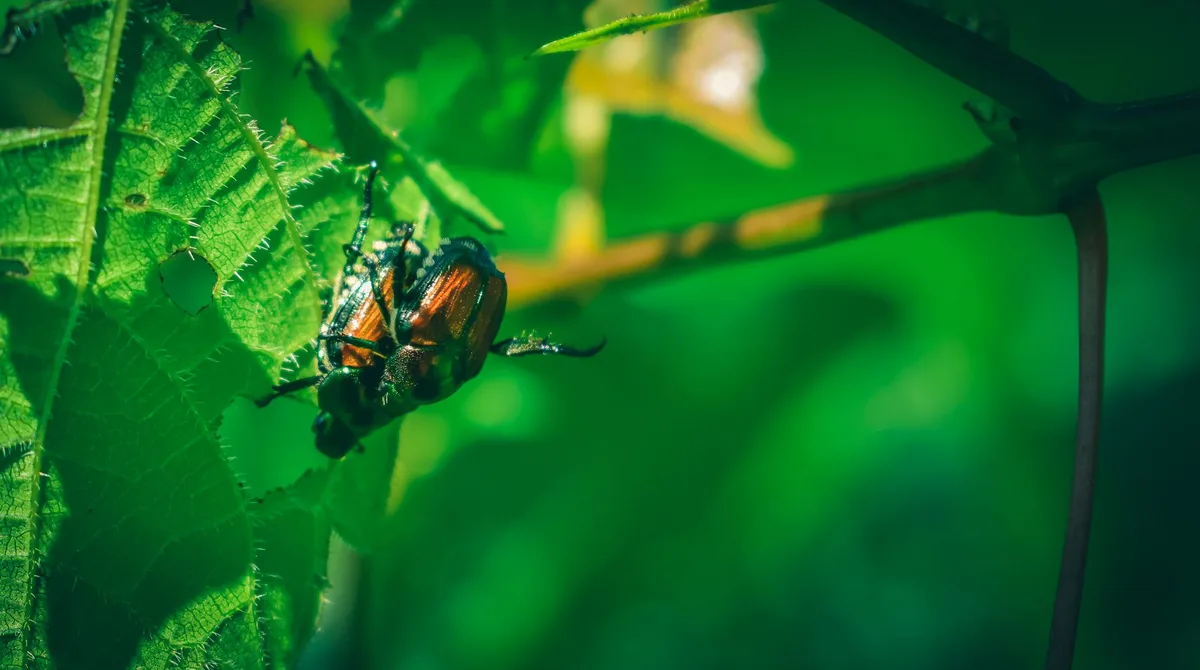
Japanese beetles (Popillia japonica) feed in groups, releasing a “congregation scent” that attracts more beetles to the same plant. That’s why one afternoon of quiet munching can turn a healthy rose bush into a lace skeleton by evening. They target over 300 plant species, but favorites include linden trees, crabapples, grapes, raspberries, and Japanese maples.
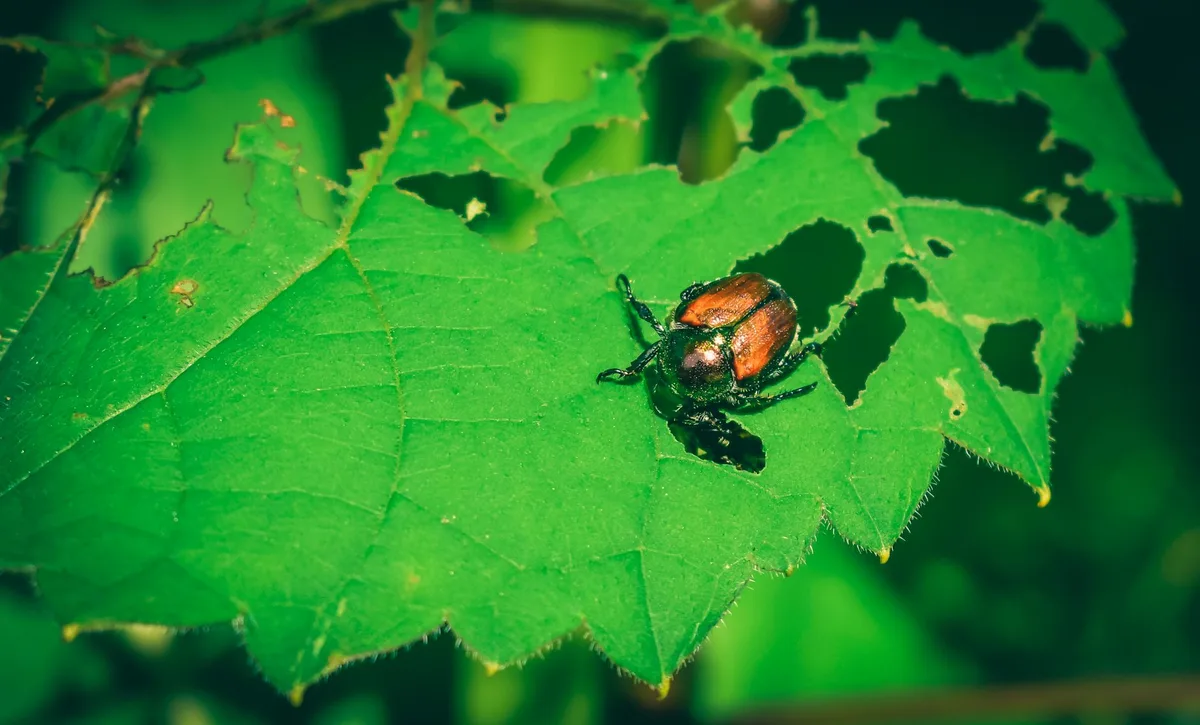
The damage pattern is distinctive: beetles eat the soft tissue between leaf veins, leaving only the major veins intact. That’s the skeletonized look. And while the adult beetles cause the visible harm, the real long-term problem lives underground.
The grubs chew on grass roots, creating brown patches in your lawn that animals like skunks and crows dig up looking for a meal.
So when you see adult beetles now, you’re also seeing the warning sign of next year’s grubs. Ignore one stage and you’re stuck repeating the cycle. That’s why the first decision, are you fighting adults, grubs, or both, matters more than any product choice.
The Key Decision: Are You Fighting Adults, Grubs, or Both?
Here’s the simplest way to think about it. If you see beetles on your plants in June or July, you have an adult problem. You need to protect your foliage and fruit immediately.
If you had beetles last year and now you’re seeing brown patches in your lawn or animals digging up the turf, you likely have a grub problem for next season.
But most yards have both. Adults lay eggs that become grubs, and grubs turn into adults. So the smartest approach is to treat both stages on their own timelines.
| Target Stage | Signs to Look For | Best Action Window |
|---|---|---|
| Adult beetles | Skeletonized leaves, beetles feeding on flowers and fruit | Late June through August |
| Grubs | Brown lawn patches, loose turf, animals digging | Late July through September |
Your goal: stop the adults now, and prevent the grubs before they become adults next year. That double attack is what actually breaks the cycle. If you only spray adults and ignore grubs, you’ll have the same problem next summer.
And if you only treat grubs, the adults from neighboring yards can still fly in and do plenty of damage.
First, Assess Your Conditions: Garden Size, Infestation Level, and Philosophy
Not every method works for every yard size or gardener’s comfort level. Before you choose your tactics, take stock of these three factors.
Small Garden (Under 500 sq ft): Hand-Picking and Barriers
If you have a small flower bed or a few patio pots, your best bet is physical removal and simple barriers. You can walk the garden in 10 minutes each morning and pick off beetles by hand. A bucket of soapy water does the job perfectly.
Row covers over your most valuable plants keep beetles off entirely. You don’t need sprays or traps when the area is small enough to inspect every leaf daily.
Hand-picking is research-backed as highly effective for small spaces. The key is consistency. Miss a day and beetles multiply fast, but stay on it and you remove hundreds over a season.
Medium to Large Yard (500–5,000+ sq ft): Biologicals and Targeted Sprays
Once your garden covers more ground, hand-picking becomes impractical. You need a broader strategy. For medium and large yards, the best approach combines biological grub control with targeted sprays for adults.
Milky spore or beneficial nematodes treat the lawn areas where grubs live. Neem oil or pyrethrin sprays protect your high-value plants. Pheromone traps can help if placed far from your garden, but they can backfire if positioned too close.
For a large property, you’ll also want to coordinate with neighbors if possible. Beetles don’t respect property lines. A community-wide effort reduces overall beetle pressure more effectively than a single yard treatment.
Decision Branch 1: Adult Control Options (For This Season)
You’re in the heat of beetle season. Your roses are under attack. Here’s your menu of proven adult-control methods.
Hand-Picking With Soapy Water – Free, Effective, But Time-Consuming
This is the cheapest and most targeted method. Fill a bucket with water and a squirt of dish soap. In the early morning when beetles are sluggish, knock them off the leaves into the bucket.
The soap breaks surface tension so they sink and drown instead of flying away.

It works because each beetle you remove is one less beetle laying eggs. Research from University of Kentucky entomology suggests that consistent daily hand-picking can reduce local populations by 60, 80% over a season. The downsides?
It takes 10, 20 minutes daily, and you won’t get every beetle. But for small gardens, it’s the most environmentally friendly option.
Neem Oil or Pyrethrin – Organic Sprays That Work If Timed Right
Neem oil (azadirachtin) works as an antifeedant and repellent. Beetles stop eating after contact and eventually die. It’s OMRI-listed for organic gardening and safe for pollinators once dry.
But you need to reapply every 7, 14 days or after rain. Aggregate reviews report good results when applied consistently before heavy infestation.
Pyrethrin is a fast-contact killer derived from chrysanthemums. It knocks beetles down within minutes but breaks down in sunlight within 6, 12 hours. It’s effective for immediate control but can harm bees if sprayed on open flowers.
Always spray late evening when pollinators aren’t active, and avoid blooming plants entirely.
Kaolin Clay – The Particle Barrier That Confuses Beetles
Kaolin clay (brand name Surround WP) sprays onto leaves as a white film. Beetles don’t recognize the coated leaves as food, so they move on. It’s non-toxic and safe for beneficial insects.
The film washes off with rain, so reapply after storms. It leaves a visible white residue on plants, which some gardeners find unattractive, but it’s a trade-off for zero chemicals on edibles.
Row Covers – Full Physical Block (But You Remove for Pollination)
Lightweight row covers create a physical barrier that keeps beetles off your plants. They work especially well for vegetable gardens and young fruit trees. The catch: you must remove covers during bloom if your plants need pollinators (bees, butterflies).
Put covers back on after pollination. This method is labor-intensive but chemical-free and 100% effective while in place.
Pheromone Traps – Powerful Lure, But Only If Placed Correctly
Pheromone traps use a floral-scented lure and a sex attractant to draw beetles into a bag or jar. They catch hundreds of beetles per trap per week. But here’s the catch that many people miss: traps attract beetles from up to a quarter-mile away.
If you place the trap near your garden, you’re inviting every beetle in the neighborhood to stop by on the way to the trap. They’ll feed on your plants before they get caught.
The correct placement is at the far edge of your property, at least 30, 50 feet from any plants you want to protect. Empty the bag regularly or it becomes a stinking, overflowing mess. For large yards, traps can help reduce the overall beetle population.
For small yards, they often cause more harm than good. If you’re not confident in placement, skip the traps and stick with hand-picking.
Decision Branch 2: Grub Control Options (For Next Season)
While adults cause the visible damage, grubs are the engine that drives next year’s infestation. A single female beetle lays 40 to 60 eggs in your lawn over the summer. Those eggs hatch into grubs that feed on grass roots, then overwinter and emerge as adults the following June.
Breaking that cycle is how you stop the problem long-term.
Milky Spore – Set It and Forget It (Takes 1–3 Years)
Milky spore (Paenibacillus popilliae) is a naturally occurring bacterium that infects and kills Japanese beetle grubs. It’s applied as a powder or granular spread to your lawn. The bacteria multiply inside the grubs, and when the grubs die, billions of new spores release into the soil.
The major advantage is persistence. Once established, milky spore lasts 10 years or more in the soil. The trade-off is patience.
It takes one to three years for the spore population to build to effective levels. You won’t see results the first season. Apply it in late summer or early fall when grubs are actively feeding, and water it in thoroughly.
Soil temperature needs to be above 60°F for the spores to work.
Milky spore is OMRI-listed, safe for pets, children, and beneficial insects, and works best on lawns with consistent grub pressure. For a one-time application that provides long-term control, it’s hard to beat.
Beneficial Nematodes – Fast-Acting but Need Perfect Conditions
Beneficial nematodes are microscopic roundworms that seek out grubs and infect them with a lethal bacteria. Unlike milky spore, they work fast. You can see grub population reductions within two weeks of application.
But nematodes are living organisms, and they’re fussy about conditions. They need moist soil, temperatures above 50°F, and protection from UV light. Apply them in the evening or on a cloudy day, and water the lawn before and after application.
You also need to use them soon after purchase because they have a short shelf life.
For best results, apply in late summer when grubs are small and actively feeding near the surface. You’ll need to reapply each year because nematodes don’t persist in the soil like milky spore. They’re ideal if you want immediate grub control and are willing to follow the application steps carefully.
Chemical Grub Killers – Fast, But Watch Bee Safety and Local Laws
Synthetic grub control products, such as chlorantraniliprole or imidacloprid, kill grubs quickly and reliably. They’re often applied as a granular spread in spring or early summer, targeting the first-instar grubs before they cause lawn damage.
The downsides are significant. Imidacloprid belongs to the neonicotinoid class, which is toxic to bees and other pollinators. Several states, including New York, Maryland, and Massachusetts, have restricted its retail sale for outdoor use as of 2026.
Chlorantraniliprole is less harmful to bees but still requires careful application.
Only use chemical grub killers if you have a confirmed grub problem exceeding 10 grubs per square foot of lawn. Follow the label instructions exactly. Keep granules off flowering weeds where bees forage.
And consider whether biological options could achieve the same results without the environmental risk.
Timing Is Everything: When to Apply Each Method
Japanese beetles follow a predictable seasonal cycle. Apply the wrong method at the wrong time and you waste money and effort.
| Month | Beetle Life Stage | Best Action |
|---|---|---|
| Late May – Early June | Adults emerge | Set out traps (far from garden), apply row covers, start monitoring |
| Late June – July | Adults feeding and laying eggs | Hand-pick, spray neem oil, apply kaolin clay |
| Late July – August | Eggs hatch, young grubs in soil | Apply nematodes or milky spore, water in well |
| September – October | Grubs growing, lawn damage visible | Apply chemical grub killer if threshold is high |
| November – March | Grubs overwinter deep in soil | No treatment needed |
| April – May | Grubs move up to feed again | Spot-treat if damage appears, but focus on preventative |
The most critical window for grub control is late July through August. That’s when eggs have hatched and the young grubs are close to the surface, feeding on roots. Nematodes and milky spore catch them at their most vulnerable stage.
For adults, the peak flight period in most regions runs from mid-June through late July. Start your monitoring and hand-picking routine the first day you spot a beetle. Early intervention prevents the congregation scent from drawing in dozens more.
Mistakes to Avoid: Trap Placement, Spraying Blooms, and Half-Measures
Even experienced gardeners make errors that undermine their beetle control. Here are the most common ones.
Placing traps too close to plants. This is the top mistake we see in research and user reports. A pheromone trap placed in the middle of your rose bed acts like a dinner bell. Beetles fly toward the trap, stop at your roses on the way, and you end up with more damage than before.
Always place traps at the perimeter of your property, at least 30 feet from any plants you want to protect.
Spraying insecticides on open flowers. This kills pollinators outright. Neem oil, pyrethrin, and chemical sprays all harm bees if applied to blooms. Spray only in the evening after bees have returned to their hives.
Avoid spraying flowers entirely if you can. Use row covers or hand-picking near blooming plants instead.
Treating only one stage of the beetle life cycle. Many people spray adults in July, feel satisfied when the beetles disappear in August, and forget about grubs entirely. Then the next June, the same problem returns. You need to address both stages for lasting results.
Combine adult control this season with grub control for next season.
Skipping the neighbor conversation. Japanese beetles fly up to a mile from where they hatch. If your neighbor’s yard is untreated, you’ll keep getting new beetles flying in. A cooperative neighborhood approach, even just asking neighbors to treat their lawn grubs, multiplies everyone’s results.
It’s awkward but effective.
The Decision Guide: A Simple Flowchart for Your Situation
This is where everything comes together. Use these branching questions to choose your specific plan.
Are you seeing adults on your plants right now?
- Yes → Go to adult control options.
- No → Skip to grub control.
Is your garden small (under 500 sq ft)?
- Yes → Hand-pick daily and use row covers on valuables. Skip traps.
- No → Use neem oil or pyrethrin sprays on foliage. Place one trap at the far edge of property.
Do you have lawn damage or digging animals?
- Yes → You likely have grubs. Confirm by pulling back a section of turf. If you count 10+ grubs per square foot, proceed to grub control.
- No → Monitor for next season and consider a preventative milky spore application.
Do you want a long-term, low-effort solution?
- Yes → Apply milky spore in late summer. Accept the 1, 3 year establishment period.
- No → Apply beneficial nematodes each year for faster, but repeat, control.
Are chemical restrictions a concern in your state?
- Yes → Stick with biological options (milky spore, nematodes, neem oil).
- No → Consider chlorantraniliprole for quick grub knockdown, but follow all safety labels.
This decision tree eliminates guesswork. You end up with a plan tailored to your yard size, infestation level, and personal preference for organic versus synthetic inputs.
Expert Tips: What Works Best in Practice
After reviewing university extension guides and aggregate grower feedback, a few strategies consistently outperform the rest.
Start grub control before you see adult beetles. Milky spore and nematodes work best when applied proactively, before a heavy infestation takes hold. If you had beetles last year, treat the lawn this summer regardless of current adult sightings.
Combine cultural practices with treatments. Healthy, well-watered grass can tolerate more grub feeding without showing damage. Avoid over-fertilizing with nitrogen, which creates lush growth that attracts beetles. Keep your lawn at a mowing height of three inches or taller to encourage deep root systems.
Strong turf recovers faster from grub damage.
Rotate methods to prevent resistance. Some beetle populations have developed resistance to pyrethroid sprays and neonicotinoids. Alternate between biological, physical, and chemical methods to keep the beetles from adapting. One season of neem oil, the next of nematodes, and hand-picking as a constant baseline.
Know your local beetle flight patterns. Emergence timing varies by region and climate. In the southern parts of their range, beetles emerge in early June. In northern areas, it may be late June or early July.
Use growing degree day models from your local extension service to predict peak emergence in your county. The University of Illinois and Cornell both provide free online calculators.