How to Identify Japanese Beetle Damage (2026) — Simple Steps
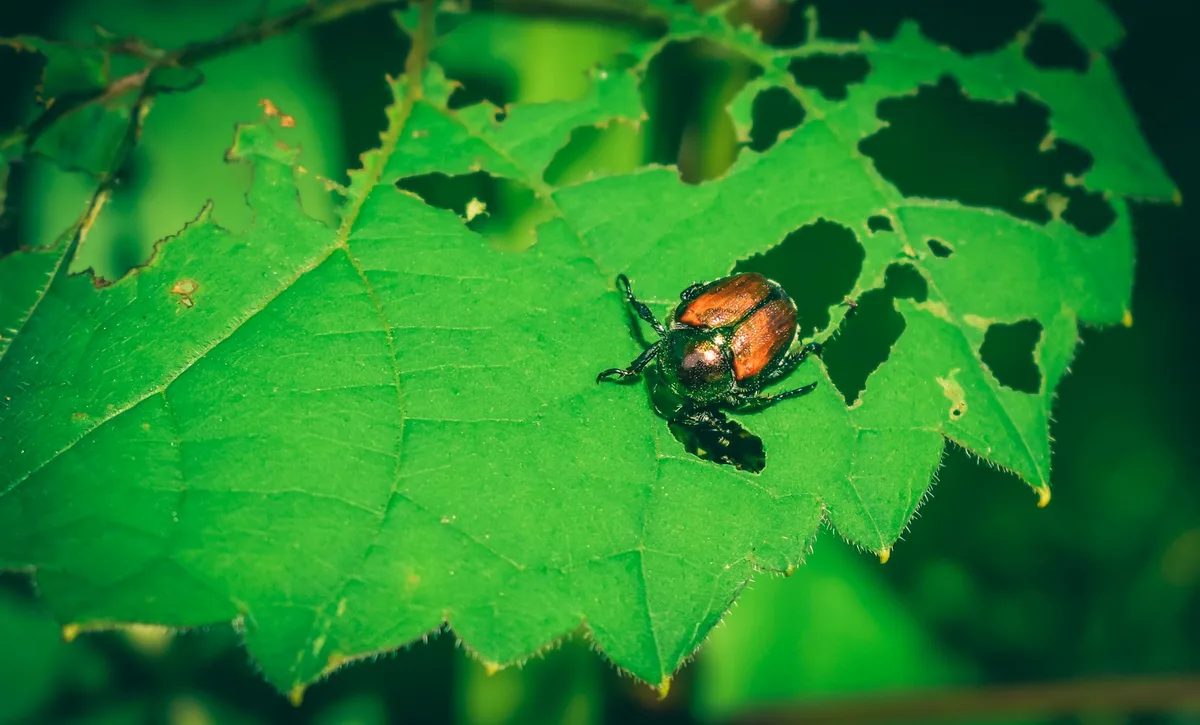
Finding lace-like leaves on your roses or chewed-up grape vines is alarming. Knowing how to identify Japanese beetle damage correctly is the first step to protecting your garden. Mistake it for something else, and you might waste time on the wrong treatment while the beetles keep feeding.
The Japanese beetle (Popillia japonica) has been a problem in the U.S. since 1916. As of 2026, it continues to spread westward from its original foothold in New Jersey. A single female lays 40 to 60 eggs in her lifetime, so early detection really matters.
Once you know the visual signs, you can spot the damage quickly and take action.
Quick Answer
Japanese beetle damage looks like lace. The beetles eat leaf tissue between veins. This creates skeletonized leaves with a scalloped edge.
Look for metallic green beetles feeding in groups. Check the top of your plants first.
Why Visual ID Matters for Japanese Beetle Damage
Getting the identification wrong costs you time and plants. People often confuse skeletonized leaves with sunburn, disease, or other insects. That leads to spraying the wrong product while the beetles keep eating.
Here is what is at stake if you misidentify the damage.
You waste money on ineffective treatments. If you treat for a fungal disease when beetles are the problem, the leaves keep getting eaten. The same goes for using a general insecticide that misses the beetles entirely. Our research shows that misidentification is the number one reason home gardeners fail to control Japanese beetles in their first season.
You let the population explode. Japanese beetles release aggregation pheromones. One beetle attracts more beetles. If you do not catch the damage early, a small group can turn into a full infestation within days.
A single mating pair can produce hundreds of offspring by the end of summer.
You miss the grub stage entirely. Adult beetle damage happens above ground. Grub damage happens below ground in your lawn. Many people treat the adults but ignore the grubs.
That means next year’s beetles are already developing underground. Proper visual ID helps you recognize both stages and break the cycle.
The good news is that Japanese beetle damage is one of the most distinctive patterns in the garden. Once you know it, you will spot it from across the yard. This guide walks you through exactly what to look for.
The Two Faces of Japanese Beetle Damage
Japanese beetles have two life stages that damage your plants. You need to recognize both.
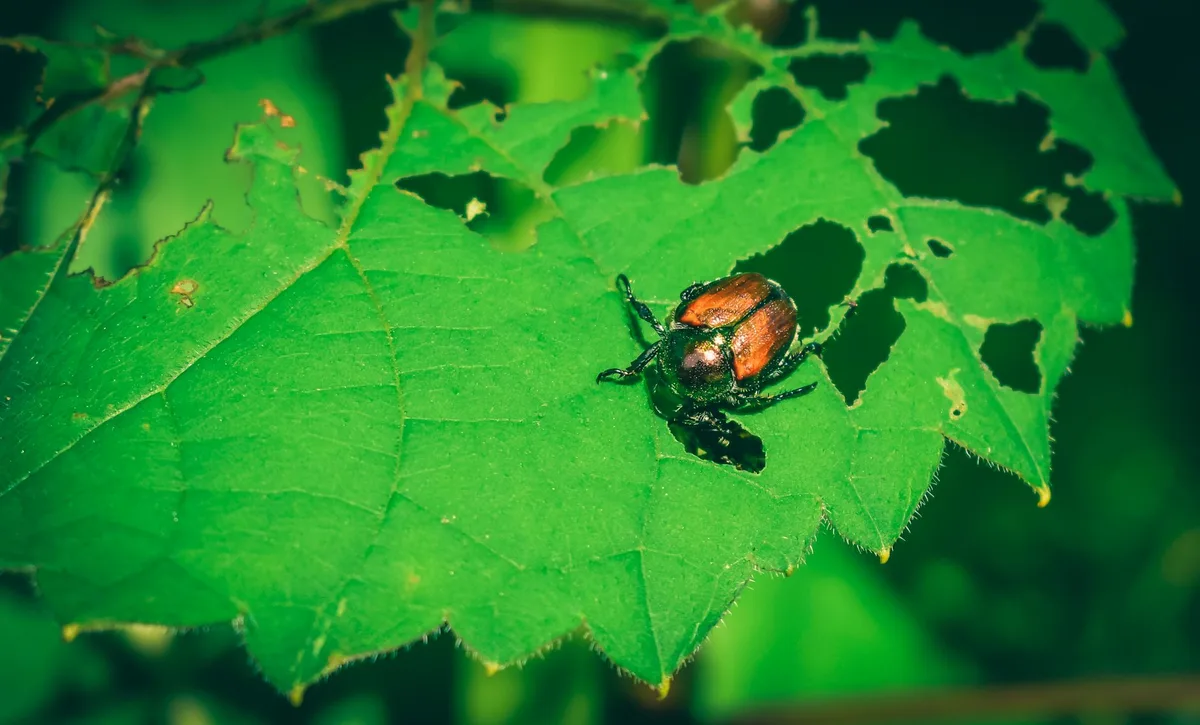
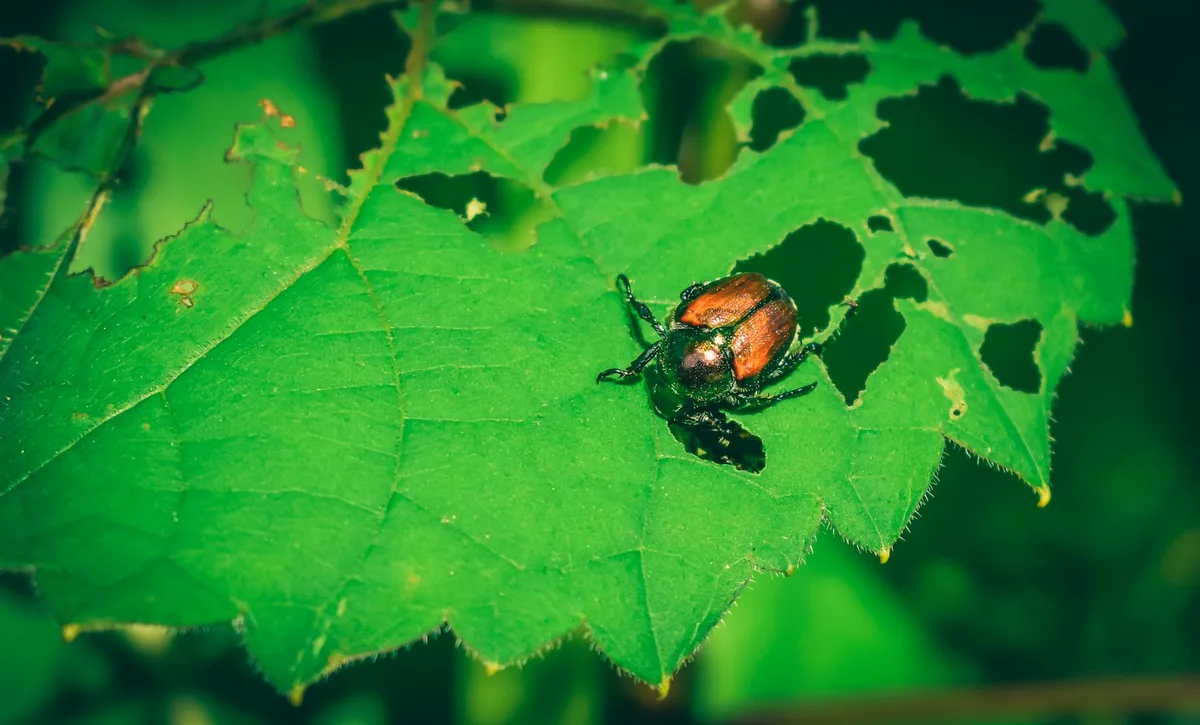
Adult beetle damage happens on leaves, flowers, and fruit. The adults chew through leaf tissue but leave the veins intact. This creates a skeletonized or lace-like appearance. They feed from the top of the plant downward.
Heavily infested plants look like someone took a hole punch to every leaf.
Grub damage happens in the lawn. The larvae live underground and feed on grass roots. Damaged turf turns brown in irregular patches. Unlike drought stress, the dead grass peels up easily because the roots have been severed.
This is often confused with fungal disease or dry weather.
The table below summarizes the key differences.
| Damage Type | Location | Visual Sign | Active Season |
|---|---|---|---|
| Adult feeding | Leaves, flowers, fruit | Skeletonized leaves with veins intact | Mid-June through August |
| Grub feeding | Lawn turf | Brown patches that peel up like carpet | Late summer to early fall |
Understanding both faces matters because treatment is different for each stage. Adult beetles are controlled with contact sprays or physical removal. Grubs require soil treatments or biological controls like milky spore.
If you only treat for adults, the grubs will produce next year’s beetles.
Quick Field ID: What to Look For First
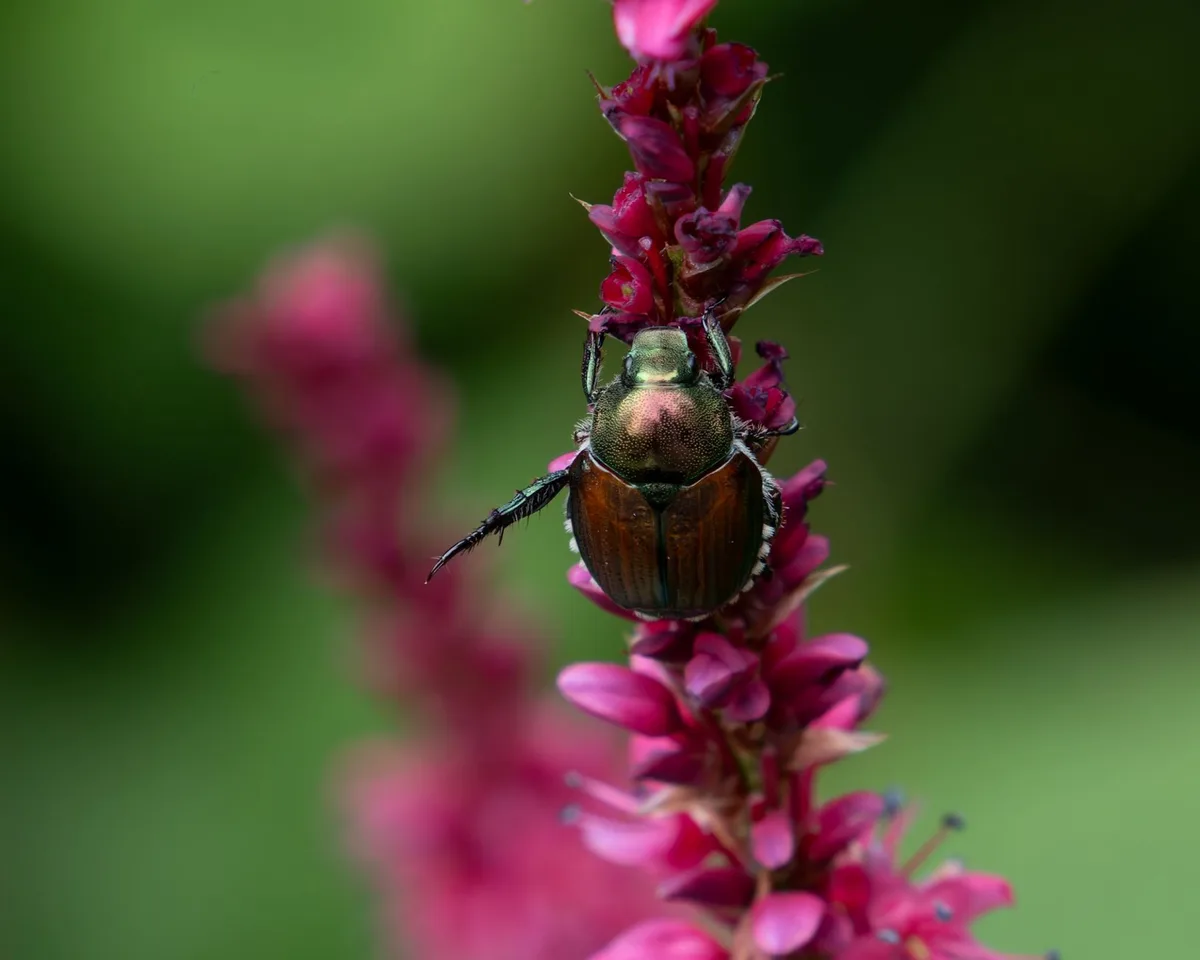
Start with the beetle itself. The adult Japanese beetle is easy to identify once you know what to look for.
Body shape and size. Adults are about half an inch long. They have a broad, oval body shape. This is slightly smaller than a June bug and more compact than a cucumber beetle.
Color pattern. The head and thorax are a shiny metallic green. The wing covers are a coppery brown. These two colors together make them almost unmistakable.
If you see a beetle with that green-and-copper combo, it is almost certainly a Japanese beetle.
White tufts. Along the sides of the abdomen, you will see five small white tufts of hair on each side. These are visible when the beetle is viewed from above. No other common garden beetle has this exact pattern.
Feeding behavior. Japanese beetles feed in groups. You will rarely see just one. They cluster on the same leaf or branch, often mating while they eat.
They are most active on warm sunny days above 85 degrees Fahrenheit.
Leaf damage pattern. The beetles start feeding at the top of the plant and work downward. They eat the soft tissue between the veins. This leaves a skeletonized leaf that looks like a delicate green lace pattern.
The edges of the chewed areas have a scalloped, almost scalloped appearance rather than ragged bites.
If you see dead leaves on the ground or a ragged appearance from a distance, get closer. Shake the branch over a white cloth or piece of paper. The beetles will drop, and you can see their color pattern clearly.
Step-by-Step Visual Checklist for Foliage Damage
Use this checklist to confirm Japanese beetle damage on your plants. Follow the steps in order for the most reliable identification.
Step 1: Check the leaf veins. Look at the chewed areas closely. Are the veins still intact? Japanese beetles eat the green tissue between veins but leave the vein structure alone.
If the veins are also eaten, you are likely looking at a different pest like grasshoppers or caterpillars.
Step 2: Examine the damage edge. The chewed edge should look scalloped or slightly rounded. Japanese beetles have chewing mouthparts that create a clean, curved edge. Ragged or torn edges suggest other insects or physical damage.
Step 3: Look at the top of the plant first. Beetles start at the highest leaves and work downward. Heavy damage at the top with less damage lower down is a strong clue. Other pests often start from the bottom or middle.
Step 4: Shake branches over a white surface. This is the fastest confirmation method. Hold a white cloth, paper plate, or sheet of paper under a damaged branch. Shake the branch firmly.
Japanese beetles drop when disturbed. You will see metallic green and copper beetles land on the white surface.
Step 5: Check flowers and fruit. Japanese beetles are not picky. They feed on flower petals, especially roses and zinnias. They also chew on soft fruit like raspberries, grapes, and plums.
If you see damage on both leaves and fruit, Japanese beetles are a strong suspect.
Step 6: Note the time of year. Adult Japanese beetles emerge in mid-June in most regions. Activity peaks in July and August. If you see skeletonized leaves in May or September, it is probably a different pest.
Seasonal timing is one of the most reliable clues.
Keep a small notebook or take photos for comparison. The more examples you look at, the faster you will get at spotting the pattern. Once you have seen it a few times, you will be able to spot it from across the yard.
How to Spot Grub Damage in Your Lawn
Lawn damage from Japanese beetle grubs looks different from adult foliage damage. Here is how to identify it.
Look for irregular brown patches. Damaged turf turns brown in spots that do not follow a pattern. Unlike drought stress, the brown patches are not uniform across the lawn. They appear in scattered areas where grub populations are highest.
Do the peel test. Grab a handful of dead grass and pull gently. If the turf peels up like a strip of carpet, you have grub damage. The roots have been chewed off by the larvae.
Healthy grass holds firmly to the soil. This test is the quickest way to confirm grub activity.
Count the grubs per square foot. Dig up a small square of turf about 6 inches deep. Sift through the soil. Count the C-shaped white grubs.
Damage becomes visible at about 10 to 15 grubs per square foot. Higher numbers mean more severe damage.
Check the timing. Grub damage appears in late summer and early fall. The larvae are most active in August and September. You might not notice the damage until the lawn starts browning in late summer.
This timing often misleads gardeners who assume the problem is drought or disease.
Distinguish from fungal disease. Fungal diseases like brown patch create circular spots with distinct edges. Grub damage creates irregular patches with no clear border. If you treat with a lawn fungicide and the damage continues spreading, grubs are likely the real cause.
Consider using a preventative treatment if you have had grubs before. Milky spore and beneficial nematodes are biological options that target grubs specifically. They take time to build up but provide long-term suppression. Chemical grub preventers need to be applied in early summer before the eggs hatch.
One important note. You might only see the lawn damage and assume you do not have adult beetles. That is not always true.
The adults can fly in from neighboring properties. Grub damage in your lawn means the beetles are breeding nearby. Check your garden plants for adult damage too, even if the lawn is your main concern.