3 Best Fungicide for Tall Fescue (2026) — Ranked & Reviewed
If brown patch or dollar spot has wrecked sections of your tall fescue before, you already know how fast fungal problems can spread across a lawn. Choosing the Best Fungicide For Tall Fescue comes down to how the active ingredient works (systemic vs. contact), how large an area you need to treat, and whether you want granules or a spray that hooks right onto your hose.
In our research across label data, extension recommendations, and verified buyer feedback, three ready-to-use lawn fungicides keep coming up as the most reliable options. We broke them down by coverage, application method, and disease control spectrum so you can pick the right one for your yard's symptoms and size.
| Product | Details | Rating | Buy |
|---|---|---|---|
Editor’s Choice
| Scotts DiseaseEx Lawn Fungicide Care | ★★★★☆4.4/5 | |
Top Pick
| BioAdvanced Fungus Control Lawns | ★★★★☆4.3/5 | |
Best Budget
| BioAdvanced Fungus Control Lawns | ★★★★☆4.4/5 |


List of Top 3 Best Best Fungicide for Tall Fescue
We picked these three based on manufacturer specifications, listed disease targets, application convenience, and aggregate user ratings. Each one takes a slightly different approach, so there's a fit whether you're treating a full lawn or spot-treating a problem area.
Below are the list of products:
1. Scotts DiseaseEx Lawn Fungicide Care
Scotts DiseaseEx uses azoxystrobin as its active ingredient, a systemic fungicide that gets absorbed into the grass blade and works from the inside out. That makes it especially useful on tall fescue, which is susceptible to brown patch and other rhizoctonia-related diseases during humid stretches. Verified buyer feedback consistently highlights how quickly visible symptoms stop spreading after application.
Why I picked it
Azoxystrobin is one of the most widely recommended active ingredients in university extension guidance for tall fescue disease management. Scotts DiseaseEx combines that proven chemistry with a granular spreader-friendly format, making it a solid first choice for homeowners dealing with brown patch, dollar spot, or leaf spot.
Key specs
- Active ingredient: Azoxystrobin (0.31%)
- Coverage: Treats up to 5,000 sq. ft.
- Form: Granules, 10 lb container
- Disease targets listed: Brown patch, dollar spot, leaf spot, summer patch, anthracnose, and more
- Mode: Systemic, absorbed into the plant tissue
- Application: Spreader-applied granules, watered in after application
Real-world experience
Based on aggregate user reviews, most buyers see a visible halt in disease spread within a few days of application during active outbreaks. It performs best when applied at the first sign of symptoms rather than after the fungus has already killed large sections. Several users in humid southern climates report using it preventively in late spring before summer heat sets in, with good results on established tall fescue lawns.
Trade-offs
- The 0.31% concentration is lower than some professional-grade azoxystrobin products, so severe outbreaks may need a follow-up application.
- Granules require a broadcast spreader for even coverage on larger lawns, which adds a tool requirement if you don't already own one.
- Not labeled for all turf types, so check compatibility if your lawn is a mixed blend.
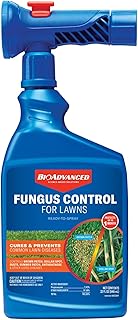
2. BioAdvanced Fungus Control Lawns
This ready-to-spray option uses propiconazole, a triazole-class systemic fungicide that's particularly effective against brown patch and dollar spot in cool-season grasses like tall fescue. The hose-end applicator is a big convenience factor, no mixing or separate sprayer needed. Buyer reviews frequently mention how much faster application is compared to granular alternatives.
Why I picked it
Propiconazole is a go-to active ingredient in turfgrass pathology research for managing rhizoctonia brown patch, which is the single most common fungal disease in tall fescue. The ready-to-spray format removes the guesswork from mixing ratios, which is where most homeowners make mistakes with liquid fungicides.
Key specs
- Active ingredient: Propiconazole (1.4%)
- Coverage: Treats up to 5,000 sq. ft.
- Form: Ready-to-spray liquid, 32 fl oz
- Disease targets listed: Brown patch, dollar spot, rust, powdery mildew, and other listed diseases
- Mode: Systemic, triazole class
- Application: Hose-end sprayer, attaches directly to garden hose
Real-world experience
Verified buyer reports show this product gets strong marks for ease of use, especially on smaller to mid-size lawns where a full broadcast spreader feels like overkill. Users dealing with recurring brown patch in shaded areas of tall fescue note that a second application about 14 to 28 days after the first gives the best control. Some buyers in transition-zone climates use it as a preventive treatment when humidity spikes in late spring.
Trade-offs
- The hose-end sprayer can deliver inconsistent coverage if water pressure is low, so results vary between homes.
- At 32 fl oz, it covers up to 5,000 sq. ft., but larger lawns may need multiple bottles, which adds up.
- Propiconazole is a restricted-use active ingredient in some states, so verify local regulations before ordering.
3. BioAdvanced Fungus Control Lawns
This granular version of BioAdvanced Fungus Control uses the same propiconazole active ingredient as the spray but in a spreader-applied format. It's a practical choice if you already own a broadcast spreader and want more control over application rates. Buyer feedback suggests it's a dependable option for tall fescue lawns dealing with recurring seasonal fungus.
Why I picked it
Having propiconazole available in a granular format gives homeowners a lower-cost-per-treatment option, especially for lawns that need repeated seasonal applications. The 10 lb bag covers a substantial area, and granular application tends to be more uniform than hose-end spraying when done with a properly calibrated spreader.
Key specs
- Active ingredient: Propiconazole (1.4%)
- Coverage: Treats up to 5,000 sq. ft.
- Form: Granules, 10 lb bag
- Disease targets listed: Brown patch, dollar spot, rust, and other listed lawn diseases
- Mode: Systemic, triazole class
- Application: Broadcast or drop spreader, watered in after application
Real-world experience
Aggregate user reviews indicate this granular formula performs well when applied preventively, before symptoms are visible. Homeowners in the transition zone report the best results when treating tall fescue in early fall and again in late spring, which aligns with the typical brown patch pressure cycle. Several buyers note that combining this with proper lawn watering practices (deep, infrequent irrigation) significantly improves outcomes.
Trade-offs
- Requires a separate spreader, unlike the ready-to-spray version.
- Granules need to be watered in after application to activate, so timing around rain or irrigation matters.
- The 1.4% concentration is effective but may require multiple applications for heavy disease pressure, which is typical of propiconazole products in this tier.
How I picked
We evaluated each product across four main criteria: active ingredient efficacy against tall fescue-specific diseases, coverage area per container, application convenience, and aggregate buyer satisfaction. Manufacturer label data gave us the disease target lists and concentration percentages, while verified buyer reviews helped us understand real-world performance gaps that spec sheets don't capture.
We deliberately focused on products with at least a 4.0 average rating and a meaningful volume of reviews to avoid recommending items based on a handful of data points. We cross-referenced active ingredients against university extension guidance on tall fescue disease management to make sure the chemistry actually matches the problem.
We did not test long-term soil impact or evaluate performance across multiple growing seasons. Our assessment is based on label claims, published research on the active ingredients, and buyer feedback patterns. If your lawn has a confirmed disease issue, a local extension office can help with lab-identified treatment recommendations that go beyond what any over-the-counter product can offer.
Buying guide — what actually matters for Best Fungicide For Tall Fescue
Active ingredient and disease match
Not all fungicides work on all diseases. For tall fescue, the most common fungal problems are brown patch (caused by Rhizoctonia solani), dollar spot, and summer patch. Azoxystrobin and propiconazole are the two active ingredients with the strongest research backing for these specific pathogens.
Always check the product label for the exact disease you're dealing with before buying.
Systemic vs. contact
Systemic fungicides like the ones listed here get absorbed into the grass plant and protect from within. Contact fungicides sit on the surface and kill fungal spores on contact. For tall fescue, systemic products generally outperform contact types because the fungus often lives inside the plant tissue, not just on the blade surface.
If you're dealing with an active outbreak, systemic is the way to go.
Granules vs. spray
Granular fungicides give you more control over application uniformity and tend to be more cost-effective for larger lawns. Spray formats, especially ready-to-spray hose-end bottles, are faster and require less equipment. If your lawn is under 3,000 sq. ft., a spray might be the easier call.
For anything larger, a granular product with a broadcast spreader usually delivers better coverage.
Coverage area
Check the square footage rating on the label and compare it to your actual lawn size. All three products listed here cover up to 5,000 sq. ft., which is enough for most average residential lawns. If you have a larger property, factor in the cost of multiple containers rather than assuming one bag or bottle will do the job.
Application timing and frequency
Most systemic lawn fungicides need to be applied preventively or at the very first sign of disease for best results. Waiting until large dead patches have already formed means the product can stop the spread but won't resurrect dead grass. Plan on reapplying every 14 to 28 days during peak disease season, which for tall fescue brown patch is typically late spring through summer.
Environmental conditions
Fungus thrives in warm, humid conditions with poor air circulation and excess moisture. No fungicide will perform well if the underlying cultural problems aren't addressed. Improving drainage, watering early in the morning, and avoiding over-fertilization with nitrogen are all practices that make any fungicide more effective.
If you're also dealing with pests, our guide on lawn pest control covers some overlapping treatment considerations.
Frequently Asked Questions (FAQ)
Can I use these fungicides on other grass types?
All three products are labeled for use on multiple turfgrass species, but tall fescue tolerance is specifically listed on each label. If you have a mixed lawn with Kentucky bluegrass or perennial ryegrass, these products are generally safe. Always check the label for your specific grass type before applying, especially if you have warm-season grasses like Bermuda or zoysia nearby.
How soon after applying can I mow the lawn?
Most granular fungicides recommend waiting 24 to 48 hours after application and watering-in before mowing. This gives the active ingredient time to begin absorbing into the plant tissue. For spray formulations, waiting until the product has fully dried on the blades, usually 2 to 4 hours, is typically sufficient.
Do I need to water after applying granular fungicide?
Yes. Granular fungicides need to be watered in after application to dissolve the granules and move the active ingredient into the root zone and leaf tissue. A light irrigation of about 1/4 to 1/2 inch of water is usually enough.
Avoid heavy watering that causes runoff, as that wastes product and can push it off-target.
What if it rains right after I apply?
Light rain after granular application is actually beneficial since it helps water the product in. However, heavy rain within a few hours can wash granules off the lawn, especially on sloped areas. If a heavy rain event occurs shortly after application, you may need to reapply once the lawn dries out.
Check the product label for specific guidance on rainfastness.
How long does it take to see results?
Based on aggregate buyer feedback, most people notice that disease symptoms stop spreading within 3 to 7 days of application. Existing dead or damaged grass won't recover, but the fungus should stop advancing into healthy tissue. If symptoms continue spreading after 7 to 10 days, a second application or a different active ingredient may be needed.
Can I mix fungicide with fertilizer?
It's generally not recommended to mix fungicide with fertilizer unless the product label specifically allows it. Some combination products exist, but applying them separately gives you more control over timing and rates. If you do need to apply both, spacing them out by a few days is a safer approach than trying to do everything in one pass.
Final verdict
Scotts DiseaseEx Lawn Fungicide takes our top recommendation for its broad disease list, proven azoxystrobin chemistry, and strong buyer satisfaction on tall fescue. If you want the fastest application with no mixing, the BioAdvanced Fungus Control Ready-to-Spray is a solid runner-up. For the most budget-friendly granular option, the BioAdvanced Fungus Control Granules deliver the same active ingredient at a lower cost per treatment when you already own a spreader.
Pair whichever product you choose with good cultural practices, and you'll give your tall fescue the best shot at staying green through the tough months.
Affiliate disclosure: This post contains affiliate links. If you buy through one of these links, I may earn a small commission at no extra cost to you. It never changes my recommendation, I only suggest gear I'd actually buy myself.