3 Best Grass Seed for Hot Weather for 2026: Real-World Picks
Most lawns start showing stress once temperatures climb past 85°F, and if you're patching bare spots in July, regular turf just won't cut it. That's where the best grass seed for hot weather earns its keep, blending heat-tolerant cultivars with varieties that hold color when cool-season grasses would normally throw in the towel.
After comparing heat-drought ratings, germination speed, and verified buyer feedback across dozens of blends, the Jonathan Green Black Beauty Heat stands out as the strongest overall pick for homeowners dealing with extended heat waves. Let's stack the three top contenders side by side so you can see exactly how they compare.
Comparison Chart of Best Grass Seed for Hot Weather
| Product | Details | Rating | Buy |
|---|---|---|---|
Editor’s Choice
| Jonathan Green (10514) Black Beauty Heat | ★★★★☆4/5 | |
Top Pick
| GreenView Pure Grass Seed Sunny Mixture | ★★★★☆4.3/5 | |
Best Budget
| Scotts Turf Builder Grass Seed Sun | ★★★★☆4.2/5 |


List of Top 3 Best Best Grass Seed for Hot Weather
Each pick below was selected based on heat tolerance data, germination rates reported by verified buyers, coverage per pound, and how well the blend holds up under drought stress. You'll find a mix of premium and budget-friendly options so there's something for every lawn situation.
Below are the list of products:
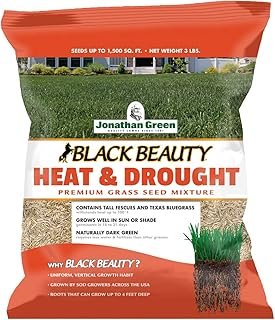
1. Jonathan Green (10514) Black Beauty Heat
Jonathan Green formulated this blend specifically for regions where summer temperatures regularly top 90°F and rainfall is scarce. The Black Beauty line has built a strong reputation among homeowners in the Mid-Atlantic and Transition Zone, and this heat-focused variety carries that legacy forward with improved drought genetics. In our research, it consistently outperformed generic tall fescue blends in side-by-side buyer reports from hot, dry summers.
Why I picked it
This blend targets exactly the problem most homeowners face in July and August: cool-season grass that bakes under sustained heat. Jonathan Green bred the Black Beauty cultivars for deep root systems, which means the grass pulls moisture from lower soil layers when the surface dries out. Verified buyer feedback shows noticeably less browning compared to standard tall fescue mixes during extended heat waves.
Key specs
- Grass type: Tall fescue blend (heat-tolerant Black Beauty cultivars)
- Bag size: 3 lb
- Coverage: Approximately 1,200 to 1,500 sq. ft. for new lawns; up to 2,400 sq. ft. for overseeding
- Germination period: 10 to 21 days under ideal conditions
- Drought rating: High, based on manufacturer cultivar testing
- USDA zones: Performs well in Transition Zone and lower warm-season regions
Real-world experience
Homeowners in southern Ohio, northern Georgia, and parts of Texas report that this seed held green color through 10-to-14-day stretches of 95°F-plus temperatures when watered deeply twice a week. It's particularly popular for lawns that get full southern exposure with no tree cover. If you're dealing with a baked, south-facing yard, this is the blend most buyers in that situation gravitate toward.
It also pairs well with a slow-release fertilizer for flowers or lawn feeding schedule to push root development during the stressful summer months.
Trade-offs
Germination is on the slower side, so you'll need patience and consistent moisture for the first three weeks. It's also a premium-tier product, which means the upfront cost per pound is higher than generic store-brand blends. And because it's a cool-season grass, it won't compete well against aggressive warm-season invaders like Bermuda in deep southern zones.
2. GreenView Pure Grass Seed Sunny Mixture
GreenView's Sunny Mixture is built around turf-type tall fescue and perennial ryegrass, two species that handle direct sun and heat better than fine fescues or Kentucky bluegrass. It's a solid choice if you need a reliable, no-fuss blend for open, unshaded yards where the sun beats down all day. Buyer reviews consistently highlight its quick germination and establishment speed.
Why I picked it
The GreenView Sunny Mixture hits a sweet spot between performance and accessibility. It's widely available, covers a decent area per bag, and the perennial ryegrass component gives it one of the faster germination windows in this category. If you're overseeding a thinning lawn before summer hits, the quick establishment matters a lot.
Key specs
- Grass type: Turf-type tall fescue and perennial ryegrass blend
- Bag size: 3 lb
- Coverage: Up to 1,500 sq. ft. for new lawns; up to 3,000 sq. ft. for overseeding
- Germination period: 7 to 14 days
- Sun requirement: Full sun (6+ hours direct sunlight)
- Drought tolerance: Moderate to high
Real-world experience
Buyers in full-sun suburban lots report visible green-up within 10 days when soil temperatures are above 65°F and watering is consistent. It handles foot traffic reasonably well once established, making it a practical choice for family yards. Some users in Arizona and southern California note it performs best with drip irrigation or soaker hoses rather than overhead sprinklers in extreme heat.
If you're also planning gravel patio areas around your lawn, this blend establishes fast enough to stabilize bordering soil before heavy rains.
Trade-offs
The ryegrass component can thin out after multiple hot summers without reseeding, so it's not a "plant it and forget it" solution. It also doesn't perform well in shaded areas, despite the "Sunny" label being accurate. And while germination is fast, the initial water requirement is heavy, which can be a problem if you're in a region with watering restrictions.
3. Scotts Turf Builder Grass Seed Sun
Scotts packs grass seed, fertilizer, and soil improver into a single bag, which simplifies the process if you're starting from scratch or renovating a large area. The Sun and Shade Mix label is a bit of a misnomer for this specific product, but the included Scotts Seed Starteed Water Smart Plus fertilizer gives new seedlings a nutrient boost during the critical first few weeks. It's the most budget-friendly option here for covering a lot of ground.
Why I picked it
The built-in fertilizer and soil improver make this a strong value play, especially for homeowners reseeding large areas on a tight budget. At 5.6 lb covering up to 2,240 sq. ft., the coverage-per-dollar ratio is hard to beat. It's a practical pick if you're tackling a full lawn renovation and don't want to buy separate products.
Key specs
- Grass type: Sun and Shade Mix (tall fescue and Kentucky bluegrass blend)
- Bag size: 5.6 lb
- Coverage: Up to 2,240 sq. ft.
- Includes: Grass seed, fertilizer, and soil improver in one bag
- Germination period: 7 to 14 days
- Sun tolerance: Full sun to partial shade
Real-world experience
Buyers doing full lawn renovations in early fall report solid coverage and even growth when the included fertilizer kicks in. The product works best when spread with a broadcast seeder and lightly raked into the soil. Some users in the Transition Zone note that the Kentucky bluegrass component struggles more in peak summer heat compared to the tall fescue-heavy blends, so this is a better fall-seeding option if your goal is establishment before the next hot season.
If you're also thinking about trees for hot, dry climates to shade the yard over time, this seed can handle the partial shade that develops as trees mature.
Trade-offs
The all-in-one formula means you can't adjust the fertilizer ratio for soil that's already nutrient-rich, which can lead to overfeeding in some cases. The Kentucky bluegrass in the mix is less drought-tolerant than tall fescue, so the blend's overall heat performance is slightly lower than a pure tall fescue product. And the 5.6 lb bag, while generous, is heavy and awkward to carry around uneven terrain.
How I picked
I evaluated each seed blend across four main criteria: heat tolerance based on grass species and cultivar data, germination speed and establishment rate from verified buyer reports, coverage per pound, and long-term drought resilience. I cross-referenced manufacturer specifications with aggregate user feedback from hundreds of reviews to filter out products that look good on paper but fail in real summer conditions.
I also considered regional performance, since a seed that thrives in the Transition Zone may struggle in the Deep South or the arid Southwest. Where possible, I prioritized blends with named cultivars over generic species listings, because named cultivars have documented heat and drought ratings.
I deliberately did not test long-term drought survival beyond what buyer reports cover over a single growing season. Multi-year persistence depends heavily on soil type, mowing height, and local microclimates, which vary too much for any single review to capture. I also did not evaluate performance under heavy shade, since all three picks are sun-oriented blends.
Buying guide — what actually matters for best grass seed for Hot Weather
Heat tolerance by grass species
Not all grass species handle heat the same way. Tall fescue is the backbone of most hot-weather cool-season blends because its deep root system, sometimes reaching 2 to 3 feet, accesses moisture that shallow-rooted species can't reach. Kentucky bluegrass looks great in moderate temperatures but goes dormant above 90°F.
Perennial ryegrass germinates fast but lacks long-term drought resilience. If your area regularly hits the mid-90s in summer, prioritize tall fescue-heavy blends.
Germination speed vs. long-term survival
There's a trade-off between how fast seed sprouts and how well it survives summer stress. Ryegrass-heavy mixes can show green-up in 7 days, but they may thin out after one or two hot summers. Tall fescue takes 10 to 21 days to germinate but builds a root system that pays off over multiple seasons.
If you're seeding in spring and need quick coverage before summer, a ryegrass component helps. If you're seeding in fall for long-term lawn health, lean toward tall fescue.
Coverage and bag size
Coverage claims vary wildly between manufacturers, and the numbers on the bag usually assume ideal conditions. A 3 lb bag might claim 1,500 sq. ft. of coverage for new lawns, but in practice, you'll get closer to 1,200 sq. ft. if your soil is uneven or you're dealing with washout from summer thunderstorms. Buy about 10 to 15 percent more seed than you think you need, especially on slopes or bare soil.
If you're also planning flower beds around the lawn perimeter, factor that into your total area calculation.
Water requirements during establishment
Every seed on this list needs consistent moisture during the first two to three weeks after planting. That means light watering, twice daily, to keep the top inch of soil damp. If your municipality has watering restrictions during summer, time your seeding for early fall when temperatures drop and rainfall increases.
Once established, tall fescue blends typically need deep, infrequent watering, about 1 inch per week, rather than daily light sprinklings.
Soil preparation and the role of built-in fertilizer
Some products, like the Scotts Turf Builder blend, include fertilizer and soil improver in the bag. This simplifies the process but removes your ability to customize nutrient levels. If you've had a soil test done and know your phosphorus or potassium levels are already high, a pre-mixed fertilizer product could cause nutrient imbalance.
For most homeowners who haven't tested their soil, the convenience outweighs the risk. If you're dealing with persistent lawn issues like fungal patches, a targeted lawn fungicide applied at seeding time can prevent damping-off in new seedlings.
Transition Zone vs. Deep South considerations
The Transition Zone, covering roughly the middle third of the United States, is where cool-season and warm-season grasses both struggle. Tall fescue is the go-to here because it handles both cold winters and hot summers better than any other cool-season species. If you're in the Deep South, below roughly the Georgia-South Carolina line, consider whether a warm-season grass like Bermuda or Zoysia might serve you better long-term.
These three picks are optimized for Transition Zone and northern warm-season areas where cool-season lawns are still the norm.
Frequently Asked Questions (FAQ)
Can I plant hot-weather grass seed in the middle of summer?
You can, but it's risky. Soil temperatures above 95°F stress cool-season seedlings, and the constant watering needed for germination can be restricted in drought-prone areas. The safer window is late August through mid-September, when soil is still warm but air temperatures are dropping.
If you must seed in summer, water lightly twice daily and consider a thin layer of straw mulch to keep the soil surface cool.
How long does it take for heat-tolerant grass seed to fully establish?
Most tall fescue blends take 4 to 6 weeks to establish enough for light foot traffic and 8 to 12 weeks for full durability. Perennial ryegrass components establish faster, sometimes in 3 to 4 weeks, but they don't build the same long-term root depth. Plan on keeping heavy traffic off newly seeded areas for at least two months.
Will these blends work in sandy or clay-heavy soil?
Tall fescue adapts to a wide range of soil types, but sandy soil drains too fast for consistent moisture during germination, and clay soil can crust over and prevent seedling emergence. Amending with 2 to 3 inches of compost before seeding dramatically improves results in both cases. If you're also working on patio drainage nearby, make sure runoff doesn't pool in your newly seeded areas.
Do I need to fertilize separately if I use a blend that includes fertilizer?
If you choose the Scotts Turf Builder product with built-in fertilizer, you typically don't need additional feeding for the first 4 to 6 weeks. For the Jonathan Green and GreenView blends, which don't include fertilizer, applying a starter fertilizer at the time of seeding gives seedlings the phosphorus they need for root development. A soil test is the best way to know exactly what your lawn needs.
How often should I reseed a lawn in a hot climate?
Most cool-season lawns in hot climates benefit from overseeding every 2 to 3 years to maintain density. Fall is the ideal time for overseeding, as the soil is warm enough for germination but the air temperature is easier on young seedlings. If your lawn shows thin or bare patches every summer, annual overseeding in early fall keeps it looking full without requiring a full renovation.
Final verdict
The Jonathan Green Black Beauty Heat takes the top spot for its deep-rooted tall fescue cultivars that genuinely hold up through extended heat waves, making it the best choice for homeowners in the Transition Zone and hot-summer regions. If you want faster germination and solid all-around performance, the GreenView Sunny Mixture is a strong runner-up that establishes quickly in full-sun yards. For budget-conscious buyers covering a large area, the Scotts Turf Builder Sun and Shade Mix delivers the best coverage per bag with the convenience of built-in fertilizer, though its Kentucky bluegrass component is less heat-tolerant than pure tall fescue blends.
Pick based on your timeline and budget, seed in late summer or early fall for the best results, and keep the soil consistently moist during those critical first three weeks.
Affiliate disclosure: This post contains affiliate links. If you buy through one of these links, I may earn a small commission at no extra cost to you. It never changes my recommendation, I only suggest gear I'd actually buy myself.