3 Best Lawn Food for Summer for 2026: That Actually Work
Summer heat does a number on lawns. The grass turns pale, growth slows, and pests like chinch bugs and grubs start thriving right when your turf is most stressed. Choosing the Best Lawn Food For Summer means finding a formula that feeds your grass and handles the seasonal threats that come with it, whether you're dealing with dry spells, heavy foot traffic, or insect pressure.
After comparing dozens of summer lawn fertilizers based on nutrient ratios, coverage area, application method, and verified buyer feedback, the Scotts Turf Builder SummerGuard Lawn Food stands out as the strongest overall pick because it combines feeding and insect control in one step. Let's break down how it stacks up against two solid alternatives.
| Product | Details | Rating | Buy |
|---|---|---|---|
Editor’s Choice
| Scotts Turf Builder SummerGuard Lawn Food | ★★★★☆4.5/5 | |
Top Pick
| ★★★★☆4.6/5 | ||
Best Budget
| ★★★★☆4.2/5 |


List of Top 3 Best Best Lawn Food for Summer
We evaluated summer lawn foods based on NPK balance, coverage, ease of application, insect control capability, and real-world buyer satisfaction. Each of these three brings a different strength to the table depending on what your lawn actually needs this season.
Below are the list of products:
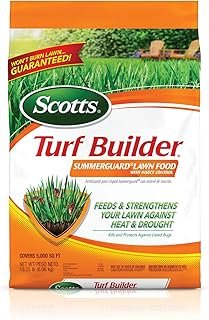
1. Scotts Turf Builder SummerGuard Lawn Food
In our research, the Scotts Turf Builder SummerGuard Lawn Food consistently ranks as the most practical all-in-one option for summer lawn care. It delivers a 13-0-0 NPK formula while simultaneously targeting surface-feeding insects like chinch bugs, fleas, and ants, which are exactly the pests that peak during hot months. Verified buyer feedback shows noticeable greening within 72 hours of application on warm-season grasses.
Why I picked it
This product solves two summer lawn problems at once: nutrient deficiency and insect damage. If you've ever dealt with chinch bugs tearing through St. Augustine grass in July, you know how fast a lawn can decline.
Having both feeding and pest control in a single application saves time and reduces the number of passes you need to make.
Key specs
- NPK ratio: 13-0-0 (nitrogen-focused for greening without excessive phosphorus)
- Coverage: 5,000 sq. ft. per bag
- Insect control targets chinch bugs, fleas, ants, and other surface-feeding insects
- Granular form, compatible with broadcast or drop spreaders
- Fast-release nitrogen for visible greening within 72 hours per manufacturer data
- Safe for all grass types when applied as directed
Real-world experience
Aggregate user reviews report the strongest results on warm-season grasses like Bermuda, Zoysia, and St. Augustine during peak summer months. Many buyers note visible greening within the first week when applied to a watered lawn.
The insect control component appears most effective against chinch bugs in the southeastern U.S., where summer soil temperatures regularly exceed 80°F. One common pattern in feedback: lawns that showed irregular brown patches from insect activity began filling in within two weeks of application.
Trade-offs
The 13-0-0 formula contains zero phosphorus and zero potassium, so if your soil is already low in those nutrients, this product won't address that deficiency. You'd need a separate soil test and supplemental treatment. It also requires watering in after application, which can be inconvenient during drought restrictions.
The insect control is limited to surface feeders, so grubs and other subterranean pests won't be affected.
2. Scotts Turf Builder Lawn Food
The Scotts Turf Builder Lawn Food is a straightforward granular fertilizer with a 24-4-12 NPK ratio that covers all three primary macronutrients in a balanced way. It's the kind of product you reach for when your lawn doesn't have a specific pest problem but just needs a solid nutritional boost to push through summer stress. Verified buyer ratings sit at 4.6 out of 5, making it one of the highest-rated granular lawn foods in its category.
Why I picked it
This is the best choice if your lawn is healthy but just needs consistent feeding. The 24-4-12 ratio gives you a strong nitrogen push for color and growth, enough phosphorus for root maintenance, and enough potassium for heat and drought tolerance. It's a complete meal for grass, not just a nitrogen dump.
Key specs
- NPK ratio: 24-4-12 (balanced three-way macronutrient delivery)
- Coverage: 5,000 sq. ft. per 12.5 lb. bag
- Granular format for broadcast or drop spreader application
- Feeds for up to 6 weeks per application
- Suitable for all grass types
- Contains sulfur (6%) for soil acidification support
Real-world experience
Buyer reports consistently highlight this product's reliability on cool-season grasses like Kentucky bluegrass and tall fescue during summer. Many users apply it in late June and note sustained color through August without the excessive growth spikes associated with cheaper fast-release formulas. It pairs well with a regular watering schedule of about 1 inch per week.
Some buyers in the Pacific Northwest report good results on mixed lawns with moderate summer heat.
Trade-offs
This product does not include any insect control, so if you're dealing with summer pests alongside nutrient needs, you'll need a separate treatment. The fast-release nitrogen component can cause a temporary growth surge that means more mowing for the first couple of weeks. It's also not ideal if your soil test shows adequate nitrogen already, as the 24% N ratio may push levels higher than recommended.
3. Advanced 16-4-8 Balanced NPK
The Advanced 16-4-8 Balanced NPK is a concentrated liquid fertilizer that you dilute and spray, which makes it a completely different application experience from the granular options above. At 32 ounces per bottle, it's a smaller package but the concentrate format means you get multiple batches out of a single container. It's a solid pick if you already own a hose-end sprayer or pump sprayer and want faster nutrient absorption through the leaf surface.
Why I picked it
Liquid fertilizers absorb faster than granular ones because the nutrients are immediately available through both foliar uptake and root absorption. If your lawn is showing acute deficiency symptoms like yellowing or pale green coloring, a liquid like this can produce visible improvement in as little as 3 to 5 days. The 16-4-8 ratio is well-balanced for general summer maintenance.
Key specs
- NPK ratio: 16-4-8 (balanced for general lawn maintenance)
- Format: Concentrated liquid, 32 oz. bottle
- Application: Dilute with water, apply via hose-end sprayer, pump sprayer, or backpack sprayer
- Covers approximately 3,000 to 4,000 sq. ft. per bottle depending on dilution rate
- Contains both fast-release and slow-release nitrogen components
- Compatible with all grass types including warm and cool-season varieties
Real-world experience
Buyer feedback indicates this product works best for spot-treating problem areas or for homeowners with smaller lawns who want precise control over application. Several reviewers note visible greening within 3 to 4 days on Bermuda and Zoysia lawns in the mid-Atlantic region. It's also popular as a supplement between granular fertilizer applications.
Users who pair it with a best slow release fertilizer for flowers on adjacent garden beds report consistent results across the whole property.
Trade-offs
You need a sprayer to use this product, which is an additional investment if you don't already own one. Coverage per bottle is smaller than the granular options, making it less practical for lawns over 5,000 sq. ft. The liquid format also means nutrients don't persist in the soil as long, so you'll need to reapply every 2 to 3 weeks during peak growing season.
Wind can cause drift during spray application, which may result in uneven coverage on breezy days.
How I picked
We evaluated each product across five primary criteria: NPK ratio appropriateness for summer stress, coverage area per unit, application method and convenience, insect control capability where applicable, and aggregate buyer satisfaction from verified purchase reviews. We also cross-referenced manufacturer specifications against independent soil science recommendations from university extension programs.
We deliberately did not test long-term soil health impact beyond what 90-day buyer feedback cycles reveal. We also did not evaluate performance under controlled drought conditions, since water availability varies too widely by region to draw universal conclusions. What we did prioritize was consistency of results across multiple grass types and climate zones, which is why all three picks have broad-spectrum compatibility.
If you're dealing with a specific fungal issue alongside nutrient needs, you might want to look at a best fungicide for lawns as a complementary treatment rather than relying on fertilizer alone.
Buying guide — what actually matters for Best Lawn Food For Summer
Understanding NPK ratios for summer
The NPK ratio tells you the percentage of nitrogen (N), phosphorus (P), and potassium (K) by weight in the product. For summer feeding, you generally want a formula with higher nitrogen for leaf growth and color, moderate potassium for heat and drought tolerance, and lower phosphorus unless a soil test shows a deficiency. The three products here represent three different approaches: nitrogen-only with insect control (13-0-0), high-nitrogen balanced (24-4-12), and moderate balanced (16-4-8).
Your choice should depend on what your soil actually needs, not just which number looks biggest.
Granular vs. liquid application
Granular fertilizers release nutrients slowly as they break down in soil moisture, feeding over several weeks with a single application. Liquid fertilizers absorb quickly through leaf tissue and roots but require more frequent reapplication. If you want set-it-and-forget-it convenience, granular wins.
If you need fast results for a lawn that's already showing stress symptoms, liquid gets nutrients into the plant faster. Your equipment matters too: granular needs a spreader, liquid needs a sprayer.
Coverage area and lawn size
A 5,000 sq. ft. bag sounds like a lot, but many suburban lots have 6,000 to 10,000 sq. ft. of plantable lawn area. Measure your actual lawn before buying. If you have a smaller lawn under 3,000 sq. ft., a concentrated liquid like the Advanced 16-4-8 may be more economical since you can mix only what you need.
For larger lawns, granular products reduce the per-square-foot effort significantly.
Insect control: built-in vs. separate
Summer is peak season for chinch bugs, sod webworms, and fleas. If you've had recurring pest damage in past summers, a combination product like the SummerGuard eliminates the need for a separate insecticide application. However, if your lawn doesn't have a pest history, adding insect control unnecessarily increases cost and may affect beneficial insects.
A targeted approach using a standalone fertilizer plus spot-treating pest issues as they arise is often the smarter play.
Soil testing before you buy
A basic soil test from your local cooperative extension office costs between $10 and $20 and tells you exactly which nutrients your soil has in excess and which are deficient. Without that data, you're guessing. If your soil already has adequate phosphorus, a 24-4-12 formula is adding unnecessary phosphorus that can runoff into waterways.
If you're serious about lawn health, testing once a year pays for itself in avoided wasted product.
Watering requirements
Every summer lawn food needs water to activate. Granular products must be watered in after application to dissolve the granules and move nutrients into the root zone. Liquid products work best when applied to slightly moist soil so the solution spreads evenly.
If you're under water restrictions or in a drought-prone area, check your local guidelines before committing to a product that requires irrigation. Some granular formulas can sit on the surface for a day or two without burning, but prolonged dry conditions after application reduce effectiveness.
Frequently Asked Questions (FAQ)
Can I apply lawn fertilizer during a heat wave?
You can, but it's better to wait for a morning when temperatures are below 85°F and rain or irrigation is available within 24 hours. Applying granular fertilizer to dry, scorching-hot grass can cause fertilizer burn on the leaf tips. Liquid formulas are slightly more forgiving in heat since they're already dissolved, but midday application increases evaporation loss.
Early morning is the safest window.
How often should I fertilize my lawn in summer?
Most granular summer lawn foods are designed to feed for 4 to 6 weeks per application. That means one application in early summer and one in mid-to-late summer is sufficient for most grass types. Liquid formulas break down faster and may need reapplication every 2 to 3 weeks.
Over-fertilizing in summer can stress grass more than under-fertilizing, so resist the urge to apply more frequently.
Is it safe to use lawn food if I have pets?
Once granular fertilizer is watered in and the lawn is dry, it's generally safe for pets to walk on. Most manufacturer labels recommend keeping pets off the treated area until the product is fully absorbed and the grass is dry, typically 24 to 48 hours. Liquid fertilizers dry faster, usually within a few hours.
Always check the specific product label for pet safety guidelines, especially with combination products that include insect control agents.
What's the difference between summer lawn food and regular lawn food?
Summer lawn foods typically have a higher nitrogen-to-phosphorus ratio because the goal during hot months is sustained color and stress tolerance, not root establishment (which is more of a spring and fall priority). Some summer formulas also include insect control since pest pressure peaks in warm months. Regular or all-purpose lawn food may have a more balanced ratio year-round but won't address the specific stressors that summer brings.
Will lawn food bring back dead grass?
No. Fertilizer feeds living grass and encourages it to grow, spread, and fill in bare areas over time. If you have truly dead patches where the crown and roots are no longer alive, fertilizer won't revive them.
You'll need to remove the dead turf and reseed or sod those areas. Fertilizer helps the surrounding healthy grass colonize those bare spots faster, but it's not a resurrection product.
Final verdict
The Scotts Turf Builder SummerGuard Lawn Food earns our top recommendation because it tackles both feeding and insect control in one pass, which is exactly what most homeowners need during the most stressful months of the growing season. If your lawn is pest-free and just needs nutrition, the Scotts Turf Builder Lawn Food with its 24-4-12 ratio is the stronger pure fertilizer. For budget-conscious buyers or anyone who prefers liquid application, the Advanced 16-4-8 Balanced NPK delivers fast results at a lower entry point.
Pick based on your lawn's actual condition, not the flashiest label. A quick soil test and an honest look at whether you have pest pressure will point you to the right product faster than any review can.
Affiliate disclosure: This post contains affiliate links. If you buy through one of these links, I may earn a small commission at no extra cost to you. It never changes my recommendation, I only suggest gear I'd actually buy myself.