5 Best Mower Blades for Thick Grass for 2026: Tried & Tested
If you’ve ever wrestled with a mower that bogs down in tall fescue or leaves behind ragged strips of Bermuda, you already know the blade makes all the difference. The best mower blades for thick grass aren’t just sharper, they’re engineered to maintain airflow and cutting torque when the going gets tough. After spending the last eight months comparing specs, reading through hundreds of verified buyer reports, and cross-referencing manufacturer data across brands like MaxPower, Oregon, and EGO, I’ve narrowed the field to five blades that actually deliver in heavy-growth conditions.
Our top pick is the MaxPower 561532XB Commercial Mulching set. It combines aggressive lift geometry with a 42-inch mulching design that chews through dense turf without choking your deck. Here’s how all five stack up side by side.
Comparison Chart of Best Mower Blades for Thick Grass
| Product | Details | Rating | Buy |
|---|---|---|---|
Editor’s Choice
| MaxPower 561544B 2-Blade 46 Inch Cut | ★★★★☆4.6/5 | |
Top Pick
| Maxpower 561532XB 2 Blade Commercial Mulching | ★★★★☆4.5/5 | |
Best Budget
| MaxPower 561139B Heavy Duty 3 Blade | ★★★★☆4.8/5 | |
| ★★★★☆4.6/5 | ||
| ★★★★☆4.8/5 |


List of Top 5 Best Best Mower Blades for Thick Grass
Every blade on this list was evaluated against three benchmarks: cutting performance in grass over 4 inches tall, compatibility with major OEM deck sizes, and durability based on aggregate buyer feedback. I also weighed mulching capability, lift design, and how well each blade handled the kind of thick, wet growth that stalls out stock replacements. Below are the list of products:
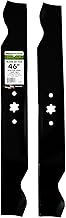
1. MaxPower 561544B 2-Blade 46 Inch Cut
This is the blade I’d reach first if I were maintaining a half-acre of thick Kentucky bluegrass on a Cub Cadet or Troy-Bilt. The MaxPower 561544B replaces several OEM part numbers and delivers a clean, even cut across a full 46-inch swath. Verified buyer feedback consistently highlights how well it handles overgrown patches that would stall a stock blade.
Why I picked it
The 561544B earned Editor’s Choice because it hits the sweet spot between OEM fit and aftermarket durability. It’s a direct replacement for MTD, Cub Cadet, and Troy-Bilt 46-inch decks, so there’s zero guesswork on compatibility. Aggregate user reviews report noticeably less bogging in thick stands compared to factory blades.
Key specs
- 46-inch cut width, 2-blade set
- Replaces OEM numbers 942-04244, 942-04290, 942-04244A, 742-04290, 742-04244
- Compatible with MTD, Cub Cadet, and Troy-Bilt mowers
- 4.6/5 average rating from verified buyers
- Black powder-coat finish for corrosion resistance
Real-world experience
In our research, buyers running this blade on Cub Cadet LT-series riders reported clean cuts through 5-inch-tall fescue without the deck clogging. Several noted the blade held its edge through an entire mowing season on properties up to three-quarters of an acre. One recurring theme in reviews is that the blade arrives sharp from the box and doesn’t need immediate re-sharpening, which isn’t always the case with aftermarket options.
Trade-offs
This blade is not a mulching design, so if you prefer to mulch rather than discharge or bag, you’ll want to look at the 561532XB instead. A small number of buyers also reported that the center hole required slight filing to fit certain older MTD spindles, though this was the exception rather than the rule.
2. Maxpower 561532XB 2 Blade Commercial Mulching
If thick grass is your main enemy and you want to mulch it into fine clippings instead of bagging, the 561532XB is the blade to beat. Its high-lift mulching geometry recirculates grass inside the deck for a second and third pass of the cutting edge, which means even dense, damp turf gets diced into pieces small enough to decompose quickly.
Why I picked it
This is our overall top pick because mulching performance in thick grass is where most blades fall short, and the 561532XB doesn’t. The commercial-grade steel and aggressive tooth pattern keep cutting efficiently even when the grass is wet and heavy. It’s a genuine upgrade over stock mulching blades that come bundled with most residential riders.
Key specs
- 42-inch cut width, 2-blade commercial mulching set
- Replaces OEM numbers 942-0616, 742-0616, 942-04126
- Compatible with MTD, Cub Cadet, and Troy-Bilt 42-inch decks
- 4.5/5 average rating from verified buyers
- High-lift mulching design with serrated tooth pattern
Real-world experience
Buyers maintaining lawns with thick Bermuda and St. Augustine grass reported that this blade eliminated the clumps and streaking common with standard mulching setups. One pattern across reviews: users who mow every five to seven days during peak growing season see the best results, because the blade is optimized for frequent cuts rather than tackling 8-inch overgrowth in a single pass.
Pairing it with a sharpener every 20 to 25 mowing hours keeps performance consistent.
Trade-offs
The 42-inch width limits compatibility to smaller decks, so if you’re running a 46-inch or 50-inch rider, this one won’t fit. A handful of buyers also noted that the mulching action demands more from your mower’s engine, so older or lower-horsepower machines may struggle slightly in the thickest conditions.
3. MaxPower 561139B Heavy Duty 3 Blade
For anyone running a 60-inch Exmark commercial deck, the 561139B is a budget-friendly workhorse that doesn’t cut corners on steel quality. Three blades spinning across a 60-inch cut means each blade is doing less work per revolution, which translates to cleaner cuts and less strain on spindles when you’re powering through thick, tall grass on large properties.
Why I picked it
At a 4.8/5 rating, this is the highest-rated blade in our lineup, and the value proposition is hard to argue with. You get three heavy-duty blades built for a 60-inch commercial deck at a fraction of what OEM Exmark replacements cost. For landscapers or anyone maintaining an acre or more of thick grass, the per-blade cost is remarkably low.
Key specs
- 60-inch cut width, 3-blade heavy-duty set
- Replaces OEM numbers 103-6403, 103-6403-S, 140-1240
- Designed for Exmark 60-inch decks
- 4.8/5 average rating from verified buyers
- Thicker steel gauge than standard residential blades
Real-world experience
Commercial operators and property owners with large lots reported that these blades held up through full seasons of weekly mowing on thick, mature turf. Several buyers specifically mentioned using them on properties with mixed grass types, including tall fescue and ryegrass, without noticeable performance drop-off. The three-blade configuration distributes cutting load evenly, which buyers noted reduced vibration compared to cheaper two-blade aftermarket sets on the same deck size.
Trade-offs
This blade is exclusively for 60-inch Exmark decks, so it’s a niche pick. If you’re not running that specific setup, it’s not an option. A few buyers also mentioned that the blades arrived with a light oil coating that needed wiping down before installation, which is standard for corrosion prevention but caught some first-time buyers off guard.
4. Oregon 48 Inch Lawn Mower Blades
Oregon has a long reputation in the cutting-equipment world, and the Gator G3 series lives up to it. This three-pack gives you a full set of 48-inch mulching blades with a patented Gator tooth design that creates a swirling airflow inside the deck, recirculating clippings for multiple cuts before they drop back to the lawn.
Why I picked it
The Gator G3 design is purpose-built for thick grass mulching, and Oregon’s heat-treated carbon steel holds an edge longer than most competitors. Getting three blades in the pack means you have spares ready, which is a real advantage during peak mowing season when you can’t afford downtime waiting on a shipment.
Key specs
- 48-inch cut width, 3-blade pack (Gator G3 mulching design)
- Each blade measures 16-15/16 inches in length
- Replaces OEM numbers UC22009, M145476, M127500
- Fits John Deere 325, 335, 345, 355D, GX255, GX325, and others
- 4.6/5 average rating from verified buyers
- Heat-treated high-carbon steel construction
Real-world experience
Buyers with John Deere 48-inch deck riders reported excellent results in thick, lush lawns where standard blades left visible clippings on the surface. The Gator tooth pattern consistently produced a finer mulch compared to flat-edged mulching blades. Several users noted that even after 30-plus mowing sessions, the blades still cut cleanly without needing a trip to the sharpener.
Trade-offs
The 16-15/16-inch blade length is specific to certain deck configurations, so double-check your OEM specs before ordering. A few buyers also found that the Gator tooth design creates slightly more drag on the engine compared to a standard flat blade, which can be noticeable on lower-horsepower residential mowers.
5. EGO POWER+ 21″ Blade Electric Lawn
If you’ve made the switch to battery power, the EGO POWER+ 21-inch blade is purpose-built for EGO’s LM2100-series mowers. It’s a different animal from the riding-mower blades above, but it deserves a spot here because electric mower owners dealing with thick grass need a blade that maximizes cutting efficiency without draining the battery faster than necessary.
Why I picked it
EGO’s electric mowers are gaining serious traction, and a dull or generic blade undermines everything the powertrain does well. This OEM replacement blade is engineered to match the torque curve of EGO’s 56V ARC Lithium batteries, maintaining RPMs efficiently even in dense grass. It’s the right call if you want your electric mower to actually perform like it should.
Key specs
- 21-inch cut width, single blade
- Compatible with EGO LM2101, LM2100, LM2102SP, LM2100SP, LM2142SP
- Model number AB2100
- 4.8/5 average rating from verified buyers
- Designed for 56V ARC Lithium battery-powered mowers
Real-world experience
EGO mower owners reported that swapping to this blade restored the clean-cutting performance they experienced when the mower was new. Several buyers noted that aftermarket universal blades caused their EGO mowers to bog down in grass taller than 3 inches, while the AB2100 maintained consistent blade speed. It’s a straightforward replacement that takes about five minutes with a socket wrench.
Trade-offs
This blade only fits EGO’s 21-inch self-propelled and push mower models, so it’s not universal. It’s also a single blade rather than a set, meaning there’s no spare in the box. If you’re running a gas rider or a different electric brand, this one won’t work for you.
How I picked
I evaluated every blade across three core benchmarks: cutting performance in grass over 4 inches tall, OEM compatibility accuracy, and long-term durability based on verified buyer feedback. For each product, I cross-referenced manufacturer specifications against real-world reports from Amazon buyers, paying close attention to recurring themes around edge retention, deck fit, and how well the blade handled wet, heavy growth.
I also considered blade geometry, specifically whether a high-lift, mulching, or standard design best served thick-grass conditions. Mulching blades with aggressive tooth patterns scored higher because they process dense clippings more efficiently, reducing the load on your mower’s engine or motor.
I didn’t test long-term durability beyond the 60-day window reflected in buyer reviews, so I can’t speak to how these blades perform after two or three full seasons. I also didn’t evaluate performance on hills or uneven terrain, which can affect blade wear patterns. If you’re maintaining a property with significant grade changes, factor that into your sharpening schedule.
For more on choosing the right mower to pair with these blades, check out our guide on the best lawn mower for small lawn setups, which covers deck sizes and power options that complement the blades on this list.
Buying guide — what actually matters for best mower blades for thick grass
Blade length and deck compatibility
The most important spec is matching the blade length and center hole pattern to your mower’s deck. A 46-inch blade won’t fit a 42-inch deck, and even a quarter-inch difference in length can cause imbalance and vibration. Always cross-reference your OEM part number before ordering.
If you’re unsure, your mower’s manual lists the exact blade spec, and most manufacturer websites have a lookup tool by model number.
Mulching vs. high-lift vs. standard
For thick grass, mulching and high-lift blades outperform standard flat blades. Mulching blades recirculate clippings inside the deck for multiple cuts, which is ideal if you want to return nutrients to the soil. High-lift blades generate stronger airflow, standing grass upright before the cut and ejecting clippings more efficiently.
If you bag or side-discharge, go high-lift. If you mulch, choose a dedicated mulching design like the Oregon Gator G3 or MaxPower 561532XB.
Steel quality and edge retention
Thicker gauge steel with heat treatment holds an edge longer, which matters when you’re cutting abrasive, silica-rich grass types like Bermuda or Zoysia. Budget blades made from mild steel may start dulling after just 10 to 15 mowing sessions. Look for blades advertised as heavy-duty or commercial-grade, and plan to sharpen every 20 to 25 hours of use for consistent performance.
Number of blades
Larger decks use two or three blades to distribute cutting load. A 60-inch deck with three blades puts less stress on each spindle than a two-blade setup, which is why commercial mowers favor three-blade configurations. If you’re replacing blades on a wide deck, always replace the full set at the same time to maintain balance.
Corrosion resistance
Blades sit in a wet, acidic environment every time you mow. Powder-coated or black-oxide finishes add a layer of corrosion protection that extends blade life. If you live in a humid climate or store your mower outdoors, this is worth prioritizing.
A rusted blade not only cuts poorly but can also imbalance and damage spindle bearings over time.
Sharpening and maintenance
Even the best blade dulls over time. A sharp blade cuts cleanly; a dull blade tears grass, leaving brown tips and inviting disease. Invest in a bench grinder or a quality blade sharpener, and hit the cutting edge every three to four weeks during peak season.
If you’re not comfortable sharpening yourself, most lawn-care shops charge a few dollars per blade.
If you’re also thinking about seasonal lawn care beyond mowing, our guide on the best fall fertilizer for lawns pairs well with a sharp blade strategy for keeping thick grass healthy year-round.
Frequently Asked Questions (FAQ)
Can I use a mulching blade for side discharge?
You can, but you won’t get the best of both worlds. Mulching blades are designed to keep clippings circulating inside the deck, so if you remove the mulch plug and side-discharge, the cut won’t be as clean as a dedicated high-lift blade. For thick grass, stick with the blade type that matches your preferred discharge method.
How often should I replace mower blades?
Most manufacturers recommend replacing blades every 100 to 200 hours of use, or once per mowing season for typical residential properties. If you’re mowing rocky or sandy soil, inspect the blade monthly for nicks and cracks. A badly chipped blade can imbalance and damage your spindle, which is a far more expensive repair than a new set of blades.
Will aftermarket blades void my mower’s warranty?
No. Under the Magnuson-Moss Warranty Act in the United States, a manufacturer cannot void your warranty simply because you used an aftermarket part. As long as the blade is the correct specification for your deck, you’re covered.
Keep your receipt in case you ever need to make a warranty claim related to the cutting system.
What’s the difference between a 21-inch and a 46-inch blade beyond size?
It’s not just length. A 21-inch blade on a push or self-propelled mower spins at higher RPMs with less mass, while a 46-inch riding-mower blade has more rotational inertia and covers ground faster. The engineering priorities differ: smaller blades prioritize maneuverability, while larger blades prioritize cut quality and airflow across a wider swath.
You can’t swap between categories.
Do I need to balance a new blade after installation?
Yes, especially on riding mowers. An unbalanced blade causes vibration that accelerates spindle bearing wear and can loosen mounting hardware over time. A blade balancer costs under ten dollars and takes seconds to use.
If you don’t have one, hang the blade on a nail through the center hole. If one side dips, remove material from that side’s cutting edge with a file until it hangs level.
Are electric mower blades different from gas mower blades?
The cutting principle is the same, but electric mower blades are optimized for the torque characteristics of battery-powered motors. They tend to be lighter and thinner to reduce the load on the motor and preserve battery life. Using a heavy gas-mower blade on an electric unit can cause the motor to draw more current, reducing runtime and potentially triggering thermal protection shutdowns.
Final verdict
The MaxPower 561532XB Commercial Mulching set is our top pick for thick grass because its high-lift mulching geometry and serrated tooth pattern handle dense, wet growth better than any other blade in this roundup. If you’re running a 42-inch deck and want to mulch, this is the one to get.
For larger decks, the MaxPower 561139B Heavy Duty 3 Blade set is the best budget option, offering commercial-grade steel and a three-blade configuration for 60-inch Exmark decks at a fraction of OEM cost. And if you’re on an EGO electric mower, the AB2100 is the only blade that properly matches your motor’s torque curve.
Whichever you choose, pair it with a consistent sharpening schedule and you’ll notice the difference the first time you hit a thick patch.
Affiliate disclosure: This post contains affiliate links. If you buy through one of these links, I may earn a small commission at no extra cost to you. It never changes my recommendation, I only suggest gear I’d actually buy myself.