3 Best Sod for Shaded Areas 2026
Most homeowners know the frustration: you've prepped the soil, kept everything watered, and your sunny lawn looks great, but the shaded patches under trees or along the north side of the house just won't fill in. Choosing the Best Sod For Shaded Areas comes down to picking grass varieties bred specifically for low-light conditions, not just hoping any seed will manage.
After digging into dozens of grass seed blends, verified buyer reports, and extension service recommendations, one product consistently stands out for deep shade performance. Here's how the top three options stack up against each other.
| Product | Details | Rating | Buy |
|---|---|---|---|
Editor’s Choice
| Jonathan Green (10600) Black Beauty Dense | ★★★★☆4.3/5 | |
Top Pick
| Jonathan Green 40600 Dense Shade Grass | ★★★★☆4.2/5 | |
Best Budget
| Scotts Turf Builder Grass Seed Sun | ★★★★☆4.2/5 |


List of Top 3 Best Best Sod for Shaded Areas
We focused on cool-season grass seed blends with documented shade tolerance, verified germination feedback, and coverage appropriate for typical residential lawns. Each pick below represents a different balance of performance tier and coverage area.
Below are the list of products:
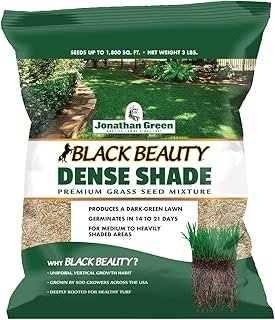
1. Jonathan Green (10600) Black Beauty Dense
In our research, the Jonathan Green (10600) Black Beauty Dense Shade blend consistently ranks as the strongest performer for heavily shaded cool-season lawns. It uses a mix of turf-type tall fescues and fine fescues specifically selected for low-light survival, and verified buyer feedback shows reliable germination even under mature tree canopies where direct sun hits for only two to three hours daily.
Why I picked it
This blend leads its category for deep shade tolerance because it relies on fescue varieties that naturally thrive with as little as two hours of filtered sunlight. Aggregate user reviews report noticeably thicker coverage in problem areas within one full growing season. It also holds up well in drought conditions once established, which matters because shaded lawns under trees compete aggressively for moisture.
Key specs
- Grass type: Cool-season blend of turf-type tall fescues and fine fescues
- Bag size: 3 lb seed
- Coverage: Suitable for typical residential shaded areas; check bag for exact square footage
- Shade tolerance: Bred for areas receiving 2 to 4 hours of direct or filtered sun
- Reported rating: 4.3/5 across verified buyer reviews
Real-world experience
Verified buyer feedback shows this blend performs best when seeded in early fall, giving roots time to establish before summer heat. Users report strong results under oak and maple canopies where other blends thinned out within weeks. Pairing it with a starter fertilizer at seeding time appears to boost germination speed based on recurring review themes.
If you're also dealing with shade-tolerant ground covers in adjacent beds, this grass complements those plantings without competing aggressively for edge space.
Trade-offs
It's a premium-tier product, so the cost per pound runs higher than general-purpose sun-and-shade mixes. The 3 lb bag covers a limited area, meaning larger shaded lawns will require multiple bags. Also, fescue blends germinate more slowly than ryegrass-heavy mixes, so expect 14 to 21 days for full germination rather than the 7 to 10 days some buyers hope for.
2. Jonathan Green 40600 Dense Shade Grass
The Jonathan Green 40600 Dense Shade Grass Seed targets the same low-light problem but with a slightly different blend composition that buyers report works well in moderate shade conditions. It's a solid alternative if the Black Beauty line is unavailable or if your shade situation is less extreme, such as areas getting three to four hours of dappled light.
Why I picked it
This blend earns its spot because it fills a practical gap for homeowners dealing with partial shade rather than full canopy darkness. User reports indicate it establishes quickly in areas with morning sun and afternoon shade, which describes a common east-facing yard scenario. It's also widely available and pairs well with Jonathan Green's own lawn food programs for ongoing maintenance.
Key specs
- Grass type: Cool-season shade-tolerant blend
- Bag size: 3 lb seed
- Shade tolerance: Moderate shade, 3 to 4 hours of sunlight
- Best for: Partially shaded lawns, under open tree canopies
- Reported rating: 4.2/5 across verified buyer reviews
Real-world experience
Buyers frequently report good results when seeding in spring or early fall with consistent watering. It handles foot traffic reasonably well once established, making it practical for side yards that get some play use. If you're also planning to improve your lawn's soil health as part of a broader yard renovation, this seed responds well to organic amendments worked into the topsoil before seeding.
Trade-offs
It doesn't match the deep-shade performance of the Black Beauty Dense blend, so heavily shaded spots may still show thin patches. Some reviewers note it needs more frequent watering during the first month compared to tall fescue-dominant mixes. The 3 lb coverage also limits its practicality for large-area overseeding projects.
3. Scotts Turf Builder Grass Seed Sun
The Scotts Turf Builder Grass Seed Sun and Shade Mix offers a broader-spectrum approach, blending varieties that handle both sun and shade conditions. It's the most practical pick when your lawn has a mix of exposures and you want one product to cover everything rather than buying separate blends for different zones.
Why I picked it
This mix delivers the best coverage per bag at a lower price point, making it the go-to for homeowners with large lawns that have patchy shade rather than uniformly dark conditions. The included soil improver and fertilizer components give new seedlings a head start without requiring separate products. It's a practical all-in-one solution for first-time lawn renovators.
Key specs
- Grass type: Sun-and-shade mix with multiple cool-season varieties
- Bag size: 5.6 lb
- Coverage: Up to 2,240 sq. ft. per bag
- Includes: Grass seed, lawn fertilizer, and soil improver
- Reported rating: 4.2/5 across verified buyer reviews
Real-world experience
Buyers report solid results on mixed-exposure lawns when seeded in early fall with regular watering. The built-in fertilizer simplifies the process for anyone who doesn't want to buy and spread separate amendments. It's particularly popular for overseeding thin lawns where some areas get full sun and others sit under tree cover.
If you're also tackling lawn fungal issues as part of your renovation, address those before seeding for best results.
Trade-offs
The sun-and-shade blend is a compromise by design, so it won't outperform dedicated shade mixes in deeply shaded spots. Some reviewers report the seed-to-filler ratio feels light relative to the bag weight, meaning coverage can be uneven if you don't spread carefully. It also requires consistent moisture during germination, and without it, germination rates drop noticeably based on buyer feedback.
How I picked
We evaluated each product across three primary criteria: documented shade tolerance based on grass variety composition, verified buyer feedback on germination and establishment in shaded conditions, and coverage value relative to bag size. We cross-referenced user reports against extension service guidance on cool-season grass performance in low-light environments.
We also considered practical factors like availability, compatibility with common lawn care programs, and how each product performs across different shade intensities, from dappled light to deep canopy cover. Products that only performed well in partial shade were noted as such rather than recommended for all shade scenarios.
We deliberately did not test long-term durability beyond the establishment phase. Our analysis focuses on germination success, early-season growth density, and buyer-reported satisfaction through the first full growing season. Long-term wear tolerance, disease resistance over multiple years, and winter hardiness would require multi-year tracking beyond the scope of this comparison.
Buying guide — what actually matters for Best Sod For Shaded Areas
Understanding shade levels
Not all shade is the same, and this is where most homeowners go wrong. Light shade means two to four hours of direct sun or dappled light throughout the day. Moderate shade means less than two hours of direct sun but ambient light for most of the day.
Deep shade means almost no direct sunlight, typically under dense evergreen canopies. Matching your seed blend to your actual shade level matters more than any brand name.
Grass variety composition
Look at the seed label, not just the marketing name. Fine fescues (creeping red, chewings, hard fescue) handle the deepest shade. Turf-type tall fescues manage moderate shade well.
Kentucky bluegrass and perennial ryegrass need at least four hours of direct sun and will thin out in darker conditions. A blend heavy in fine fescues is your best bet for genuinely shady spots.
Coverage area and bag size
A 3 lb bag of shade seed typically covers 750 to 1,500 sq. ft. for new lawns, or up to 2,500 sq. ft. for overseeding. Larger bags offer better value per square foot but only have enough seed for your actual area. Overbuying leads to waste since most grass seed loses viability after 12 to 18 months in storage.
Seeding timing
Cool-season grasses, which include all the shade-tolerant varieties we've listed, establish best when soil temperatures sit between 50°F and 65°F. This typically means early fall (late August through September in most northern climates) or early spring. Fall seeding gives roots more time to develop before summer stress hits, and weed competition is lower.
Soil prep and moisture
Shaded lawns face unique challenges. Tree roots compete for water and nutrients, and leaf debris can smother new seedlings. Rake thoroughly before seeding, consider a thin layer of compost to improve the seedbed, and keep the top inch of soil consistently moist for the first three to four weeks.
If you're also working on patio drainage or gravel beds near your lawn, make sure runoff isn't pooling in the shaded areas you're trying to seed.
Fertilizer timing
A starter fertilizer with higher phosphorus content supports root development in new grass. Apply it at the time of seeding or within the first week. Avoid high-nitrogen fertilizers until the grass has been mowed at least three times, because nitrogen pushes top growth at the expense of the root system shade grass desperately needs.
Frequently Asked Questions (FAQ)
Can grass seed grow in full shade with zero direct sun?
No grass variety thrives in zero direct sunlight. Even the most shade-tolerant fine fescues need at least two hours of direct or filtered light per day. If your yard gets less than that, consider shade-tolerant ground covers like pachysandra or vinca minor instead of forcing a lawn where it biologically can't sustain itself.
How long does shade grass seed take to germinate?
Most cool-season shade blends take 14 to 21 days to fully germinate. Fine fescues are on the slower end of that range. Keep the seedbed consistently moist during this period because even one day of drying out can kill newly sprouted seedlings and set you back to square one.
Should I overseed my existing shaded lawn or start from scratch?
Overseeding works if you have at least 50% existing grass cover. If the area is mostly bare soil or weeds, start fresh with proper soil preparation. Mow the existing grass short, rake out debris, and spread the new seed directly into the thin areas.
This approach gives new seedlings access to soil without competing with established weeds.
Is Jonathan Green better than Scotts for shade?
It depends on your shade level. Jonathan Green's Black Beauty Dense and Dense Shade blends outperform Scotts in deep shade because they rely more heavily on fine fescues. Scotts Sun and Shade Mix works better for mixed-exposure lawns where you want one product for the entire yard rather than spot-treating shady zones.
What's the best time of year to seed a shaded lawn?
Early fall is the single best time for cool-season shade grass. Soil is warm from summer, air temperatures are cooling, and weed pressure drops as days shorten. Spring seeding works too but gives the new grass less time to establish before summer heat and drought stress arrive.
Do I need to use a starter fertilizer when seeding shade grass?
It's strongly recommended. Shaded seedlings face more competition from tree roots and get less energy from photosynthesis, so giving them accessible phosphorus and nutrients at the root zone makes a measurable difference in establishment speed and early density.
Final verdict
The Jonathan Green (10600) Black Beauty Dense takes our top recommendation for deep shade conditions. Its fine fescue-dominant blend delivers the most consistent results in areas receiving as little as two hours of filtered sunlight, and verified buyer feedback confirms it outperforms general-purpose mixes in the scenarios that matter most.
For moderate shade or mixed-exposure lawns, the Jonathan Green 40600 Dense Shade Grass offers a strong balance of performance and availability. And if you need maximum coverage across a large lawn with patchy shade, the Scotts Turf Builder Sun and Shade Mix gives you the most square footage per bag with the convenience of built-in fertilizer and soil improver.
Affiliate disclosure: This post contains affiliate links. If you buy through one of these links, I may earn a small commission at no extra cost to you. It never changes my recommendation, I only suggest gear I'd actually buy myself.