How to Prevent Tree Borers (2026) — Beginner-Friendly Guide
You’ve got a tree that looks fine today, but you’ve heard the horror stories. A once healthy oak, maple, or fruit tree suddenly starts dropping branches. You peel back a strip of bark and find tunnels, sawdust, or little D-shaped holes.
That’s tree borers. And by the time you see those signs, it’s usually too late to save the tree.
So how to prevent tree borers before they ever get a foothold? That’s what we’re here to sort out. Most prevention efforts fail because people treat all borers the same, or they wait until the tree shows stress.
Borers are picky. They target weak trees, certain species, and specific life stages. Miss the timing or misidentify the pest, and your prevention becomes a waste of time and money.
As of 2026, university extension data shows that over 80% of borer infestations start in trees that were already struggling from drought, root damage, or poor planting depth. That’s the real root of the problem.
Quick Answer
Prevent tree borers by keeping your tree healthy. Water deeply during dry spells. Mulch properly, not in a volcano mound.
Wrap young trunks with breathable material. Remove wraps before fall. Apply systemic insecticide only when local borers are active.
Monitor for stress and exit holes yearly. Healthy trees rarely get borers.
First, Figure Out Which Borer You’re Dealing With
Not all borers are the same. The flatheaded or metallic wood borers (Buprestidae) attack stressed hardwoods like oak and maple. Roundheaded borers (Cerambycidae) target pines and fruit trees.
Clearwing moths look like wasps and go after peach, cherry, and dogwood. The right prevention depends on which one is common in your area.
Flatheaded vs Roundheaded vs Clearwing Borers – Why It Matters
Here’s the short version. Flatheaded borers lay eggs on sun-baked bark. Their larvae tunnel just under the bark and create flattened galleries.
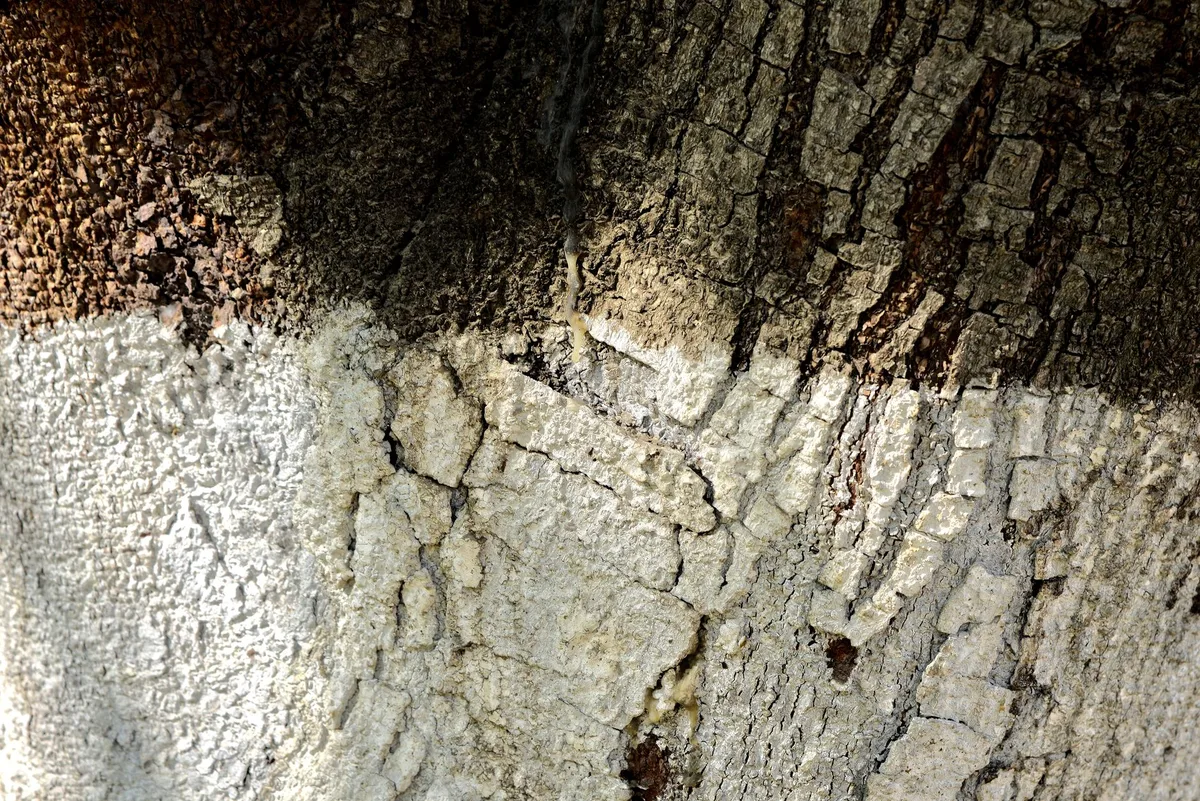
Roundheaded borers enter through wounds or cracks and chew deeper into the wood. Clearwing moth larvae burrow into the trunk near the soil line, often causing gummosis (that sticky sap you see oozing). Each type has a different emergence window and a different weak spot.
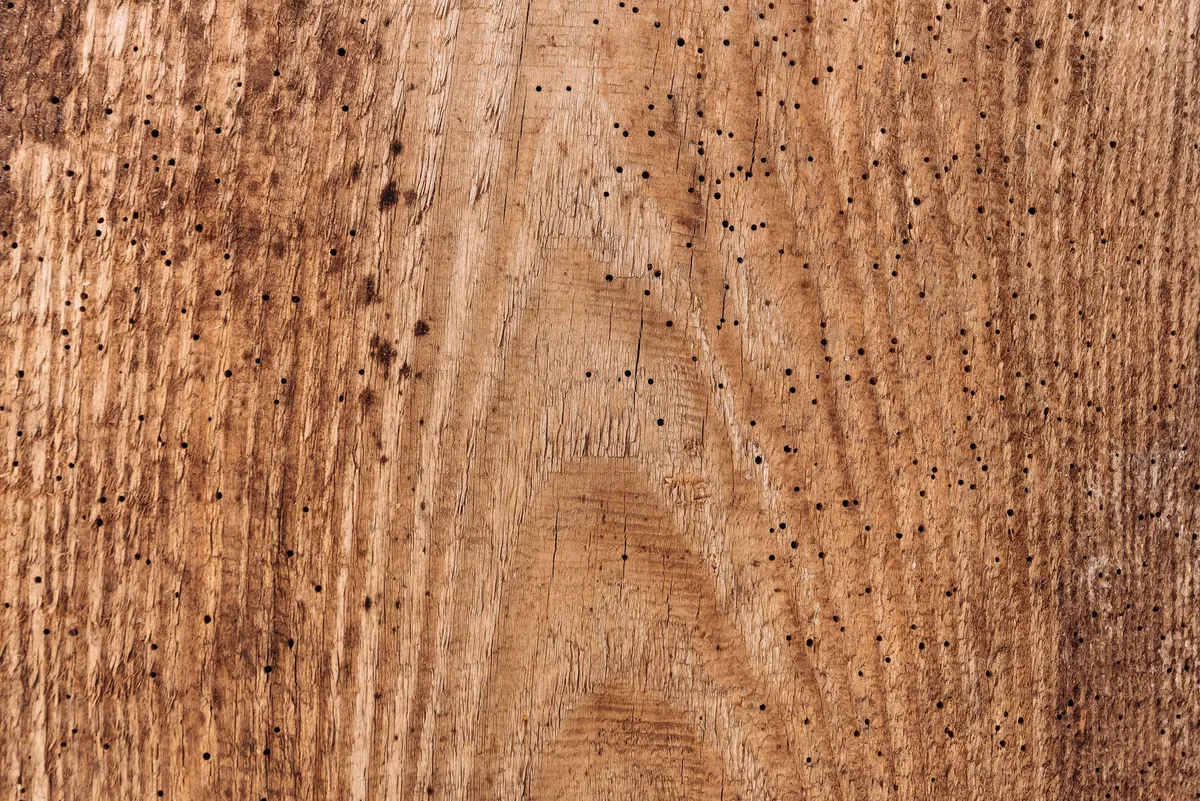
If you see D-shaped exit holes, that’s a flatheaded borer. Round holes mean roundheaded. If you find frass (fine sawdust) mixed with sap at the base, suspect clearwing moths.
Knowing which one you’re up against changes whether you wrap, spray, drench, or just improve watering. For example, clearwing moths are best controlled with pheromone traps and trunk sprays timed to adult emergence in early summer. Flatheaded borers are more vulnerable to preventive trunk wraps because they lay eggs on the bark surface.
The Trees Most at Risk by Region
Where you live matters. In the Midwest and Northeast, emerald ash borer has killed millions of ash trees. Pacific Northwest gardens deal with bronze birch borer.
In the South, peach tree borer is a constant battle for stone fruit growers. California sees eucalyptus longhorn borer in eucalyptus and sycamore borer in plane trees. If you have a susceptible species, you need a proactive plan from day one.
Start by checking your local extension service’s pest alert list. They’ll tell you which borers are active in your county.
Your First Decision Branch: Is the Tree Healthy or Stressed?
This is the single most important question in tree borer prevention. Borers are almost never the primary cause of a tree’s decline. They are opportunists that move in when a tree is already compromised.
A healthy, vigorous tree produces enough sap and chemical defenses to repel most borer larvae. A stressed tree cannot.
Why Stress Is the Number One Borer Magnet
Think of stress as an open invitation. Drought stress is the biggest factor. When a tree can’t get enough water, its natural resin flow drops.
That resin is what drowns borer eggs and young larvae. Root damage from construction, soil compaction, or improper planting also cuts off water uptake. Overpruning (removing more than 25% of the canopy in one season) forces the tree to regrow quickly, which lowers its defenses.
Even sunscald, cracked bark from intense winter sun, creates entry points for egg-laying adults.
Simple Tree Health Quick-Check
Walk around your tree and look for these signs of stress before you decide on prevention:
- Leaf size: smaller than usual or yellowing between veins
- Twig growth: less than 6 inches of new growth per year on a mature tree
- Bark cracks: vertical splits, especially on the south or west side
- Soil moisture: dry more than 2 inches down during the growing season
- Mulch depth: deeper than 4 inches or piled against the trunk (volcano mulching)
- Pruning history: large cuts or stubs from past removals
If two or more of these apply, your tree is in the high-stress category. Prevention must start with fixing those stress factors. Otherwise, no wrap or chemical will save it.
For trees in hot dry climates, choosing the right species from the start makes a huge difference, it’s easier to prevent borers when you pick a tree that naturally thrives in your conditions.
Decision Branch 1: New or Young Trees (Under 3 Years in Ground)
Young trees are the most vulnerable. Their bark is thin, their root system is still establishing, and they haven’t built up the chemical defenses of a mature tree. In our research, nursery and transplant stress is the leading cause of borers in young trees.
The good news is that this is also the easiest group to protect.
How to Wrap Without Trapping Moisture
Wrap is your first line of defense for young trees. But you have to do it right. The biggest mistake people make is wrapping too tightly or leaving the wrap on too long.
A proper wrap should be breathable. Use paper tree wrap, burlap, or a commercial synthetic wrap designed for trees. Do not use plastic sheeting or tar paper, those trap moisture against the bark and create a perfect environment for fungi and borers alike.
Here’s the step-by-step:
- Start at the base of the trunk, just above the root flare.
- Wrap upward in an overlapping spiral, keeping the material snug but not tight.
- At the top, secure the wrap loosely so air can still circulate. Do not tape it shut.
- The wrap should cover the lower 2, 3 feet of the trunk, that’s where borers lay eggs.
Critically, remove the wrap in late summer or early fall, before the rainy season begins. Leaving it on through winter traps moisture and invites bark rot. In regions with harsh winter sun, you can reapply a new wrap in late fall for sunscald protection, but use a breathable material and remove it again in spring.
If you prefer not to rewrap, white latex paint (diluted 50/50 with water) on the trunk provides the same sunscald protection without the moisture risk.
When to Repaint vs Rewrap
Paint is a low-maintenance alternative. Apply it to the south and west sides of the trunk, from the root flare up to the first branches. It reflects sunlight and prevents sunscald, which reduces bark cracking.
Paint lasts a full season. Touch it up if it flakes. Wrap is better for physical barrier against egg-laying adults, but only if you remember to remove it.
If you’re the kind of person who forgets, go with paint. Both work; choose based on your memory.
The Exact Removal Window Most People Miss
This is the part that gets skipped most often. Wrap removal should happen 6, 8 weeks after you put it on, or when the tree has started putting out new leaves and the risk of frost is past. In the northern half of the US, that usually means late April to early June for spring wrap, and again in late August for fall wrap.
Mark your calendar. Set a phone reminder. If you see the wrap getting wet from rain or irrigation, take it off early.
A wet wrap against bark is worse than no wrap at all.
For young fruit trees, especially peach and cherry, the same rules apply. But you also need to keep the area around the trunk clear of weeds and grass. Clearwing moths love to lay eggs at the base of a tree where it’s shaded by vegetation.
A weed-free 18-inch circle around the trunk, mulched with 2, 3 inches of wood chips (not touching the bark), goes a long way. Combine that with a painted trunk, and you’ve built a solid early prevention system.
Decision Branch 2: Established Trees (Mature, Stressed, or High-Value)
Mature trees have thicker bark and stronger natural defenses. But they are not immune. Stress from drought, soil compaction, or recent construction can drop their guard.
If your tree is mature but showing signs of stress from the quick-check earlier, you need a different strategy. Physical wraps are less effective on thick bark. You’ll lean more on cultural care and, if needed, targeted chemical prevention.
When Chemical Prevention Makes Sense
Chemicals are not your first move. They become the right move when three conditions are met. First, you have confirmed a specific borer species is active in your area.
Second, your tree is high value (shade, fruit, sentimental). Third, cultural fixes alone have not removed the stress. In our research, most university extension programs recommend chemical prevention only for trees that are already at risk or in areas with known outbreaks.
For example, if emerald ash borer is within 15 miles of your property and you have an ash tree, a preventive trunk injection with emamectin benzoate is standard practice.
Systemic vs Contact Insecticides – Which One, When, and How
| Option | How It Works | Best For | Duration | Application |
|---|---|---|---|---|
| Systemic (imidacloprid, dinotefuran) | Absorbed into tree’s vascular system | Larvae feeding under bark | 1–2 seasons | Soil drench or trunk injection |
| Contact (bifenthrin, permethrin) | Kills adults on contact | Stopping egg-laying adults | 2–4 weeks | Trunk spray directed at bark |
| Emamectin benzoate | Systemic, trunk-injected | High-value trees, EAB | 2–3 years | Trunk injection only |
Systemics are better for established infestations inside the tree. Contacts are better as a preventive barrier on the bark. If you are treating a mature stress-prone tree before any borers appear, a single trunk spray timed to adult emergence is usually enough.
If borers are already active in neighboring trees, go systemic. Always follow the label to the letter. Overapplication of neonicotinoids like imidacloprid can harm pollinators if applied during bloom or as a soil drench near flowering plants.
Beneficial Nematodes as a Biological Option
For clearwing moths and some roundheaded borers, beneficial nematodes (Steinernema feltiae and Heterorhabditis bacteriophora) can be applied as a soil drench around the root zone. These microscopic worms seek out borer larvae in the soil and inside the lower trunk. They are safe for pets, people, and pollinators.
The catch is timing and storage. Nematodes are live organisms. They need refrigeration, and they must be applied during cool, moist weather when the soil temperature is above 55°F.
You’ll need to reapply every 2 to 4 weeks during the adult emergence window. Aggregate reviews from growers show good success against peach tree borer when combined with trunk paint. For severe infestations, nematodes alone won’t cut it.
They work best as a preventive or early intervention.
Decision Branch 3: Fruit Trees (Peach, Apple, Cherry, Dogwood)
Fruit trees are a special case. Their thin bark, high sugar content in sap, and pruning wounds make them irresistible to borers. Peach tree borer and dogwood borer are the most common culprits.
Prevention here is more aggressive because a single borer can ruin a season’s crop or kill a young tree entirely.
Timing Is Everything – Adult Emergence Windows
For most fruit tree borers, adults emerge in late spring to early summer. In the southern US, that can be as early as April. In the north, June through July.
Use pheromone traps to catch the first adults in your specific location. Set them out 2 weeks before the expected emergence in your area. Once you catch the first moth, you have a 7 to 10 day window to apply a trunk spray or soil drench.
Miss that window, and the eggs have already been laid.
Soil Drench vs Trunk Spray for Fruit Trees
| Approach | How It Works | Best Timing | Drawback |
|---|---|---|---|
| Soil drench (imidacloprid) | Roots absorb, moves upward | At bud break or after petal fall | Can take 2–3 weeks to reach bark; not for blooming trees |
| Trunk spray (permethrin, bifenthrin) | Direct contact on bark | When first adult is caught | Needs repeat application every 2–3 weeks during emergence |
For peaches and cherries, a trunk spray is usually more reliable because you can time it precisely to adult activity. For apples, a soil drench at petal fall covers both borers and aphids. But never apply a systemic insecticide during bloom.
That kills bees.
Why Pruning Wounds Are an Open Door
Every pruning cut is a potential entry point. Fresh wounds emit volatile compounds that attract adult borers. That’s why you should prune fruit trees in late winter or early spring, then let the wound dry for a week before any borer activity starts.
Avoid pruning in May through July. If you must make a cut during the active season, cover the wound with a thin layer of pruning sealer (though most arborists now avoid sealers because they trap moisture; the better approach is to time pruning outside the borer flight window). For dogwood trees, borers often enter through lawn mower wounds at the base.
Keep a 3-foot grass-free circle around the trunk and use a string trimmer with caution.
The Step-by-Step Prevention Workflow for Any Tree
Here is the condensed workflow. Follow these steps in order.
- Select the right tree for your site. If you have a hot dry climate, choosing the right species from the start prevents stress later.
- Plant at the correct depth. The root flare must be visible above soil. Planting too deep is the top cause of stress.
- Water to prevent stress. Deep water weekly during dry spells. Water the root zone, not the trunk.
- Apply a physical barrier. Wrap young trunks or paint with diluted white latex.
- Monitor with sticky traps. Place one per tree at chest height. Check weekly during summer.
- Time any chemical treatment to adult emergence. Use trap catch data, not a calendar date.
- Remove wraps at the right moment. Before fall rains or when the tree is well leafed out.
- Inspect annually for early signs. Look for frass, gummosis, and exit holes each spring.
For mature trees, skip the wrap and focus on steps 1, 2, 3, and 6. For fruit trees, add step 5 and a weed-free root zone.
Common Mistakes That Actually Invite Borers
Many prevention attempts backfire. Here are the most common errors.
- Wrapping too tight. A tight wrap presses against the bark, cutting off gas exchange and trapping moisture. Borers love damp bark.
- Leaving wraps on through winter. This kills more young trees than borers do. Remove wraps promptly.
- Using wound paint on pruning cuts. Research from multiple university extensions shows that wound dressings do not prevent borers and can actually slow healing. Skip them.
- Overwatering or underwatering. Both stress trees. Stick to deep infrequent watering.
- Applying insecticide at the wrong life stage. If you spray for adults when larvae are already inside, you waste product. Know your target.
- Ignoring the root flare. Buried root flare is a silent stressor. Expose it if you see the trunk going straight into the ground like a telephone pole.
Signs Your Prevention Failed (And It’s Too Late)
Sometimes despite your best efforts, borers win. Here is what to look for.
- Frass at the base. Sawdust piles around the trunk mean larvae are actively feeding inside.
- Gummosis. Sap oozing from the trunk or branches, often mixed with frass, is a clear sign of clearwing moths.
- D-shaped or round exit holes. D-shaped holes are from flatheaded borers. Round holes from roundheaded. Both mean the borers have already emerged as adults and may have laid more eggs.
- Thinning canopy or branch dieback. This is a late-stage sign. By this point, the tree’s vascular system is compromised.
- Bark cracking or peeling. Lifting bark reveals galleries and tunnels underneath.
If you see these signs, consult a certified arborist. For high-value trees, trunk injection with emamectin benzoate can sometimes stop an active infestation if caught early enough. For most trees, removal is the only option once more than 30% of the canopy is dead.
The good news is that prevention works. Catch it before the exit holes appear, and you can keep your tree safe for decades.