How to Save a Tree From Insect Damage 2026
You've spotted holes in your oak's bark or leaves turning brown in June. Now you're wondering how to save a tree from insect damage before it's too late. The truth is, most tree insects are opportunistic.
They target trees already weakened by drought, poor soil, or recent injury. A healthy tree can shrug off a light infestation on its own.
The key is knowing which pest you're facing and acting at the right time. For example, dormant oil applied before bud break can smother overwintering scale insects, but if you spray during leaf-out you'll kill beneficial pollinators instead. In our research, the single biggest mistake homeowners make is misidentifying the pest and treating the wrong thing.
That's where a simple decision tree comes in.
Quick Answer
Check the bark and leaves for holes, sawdust, or sticky honeydew. Identify the pest: leaf-feeders, sap-feeders, or borers. Assess tree health: less than 30% dieback is treatable.
Choose the right method: biological, low-toxicity spray, or systemic. Time treatments for the pest's vulnerable stage. Support recovery with water and mulch.
The Real Problem: Why Trees Get Hit by Insects (and Why Some Survive)
Insects rarely attack a truly vigorous tree. They're drawn to trees under stress, drought, compacted soil, wounds from storms or lawnmowers, or poor pruning cuts. A tree that's struggling sends out chemical signals that pests pick up like a dinner bell.
That's good news in one way: if you fix the underlying stress, many infestations resolve on their own. For instance, a deep watering schedule during dry spells can make a birch tree less attractive to bronze birch borers. Per USDA Forest Service guidelines, maintaining proper soil moisture is one of the most effective long-term defenses.
But not all stress is reversible. Trees planted too deeply, with girdling roots, or in heavy clay soil may never recover enough to fight off pests on their own. That's when you need to step in with targeted treatments.
If you're planting new trees, choosing species suited to your climate helps from day one. Our guide on best trees for hot dry climates covers varieties that naturally resist common pests.
Step 1: Spot the Clues – Inspecting for Insect Damage
You don't need a magnifying glass. Start by walking around your tree and looking at the trunk, main branches, and leaf canopy. Focus on these signs:
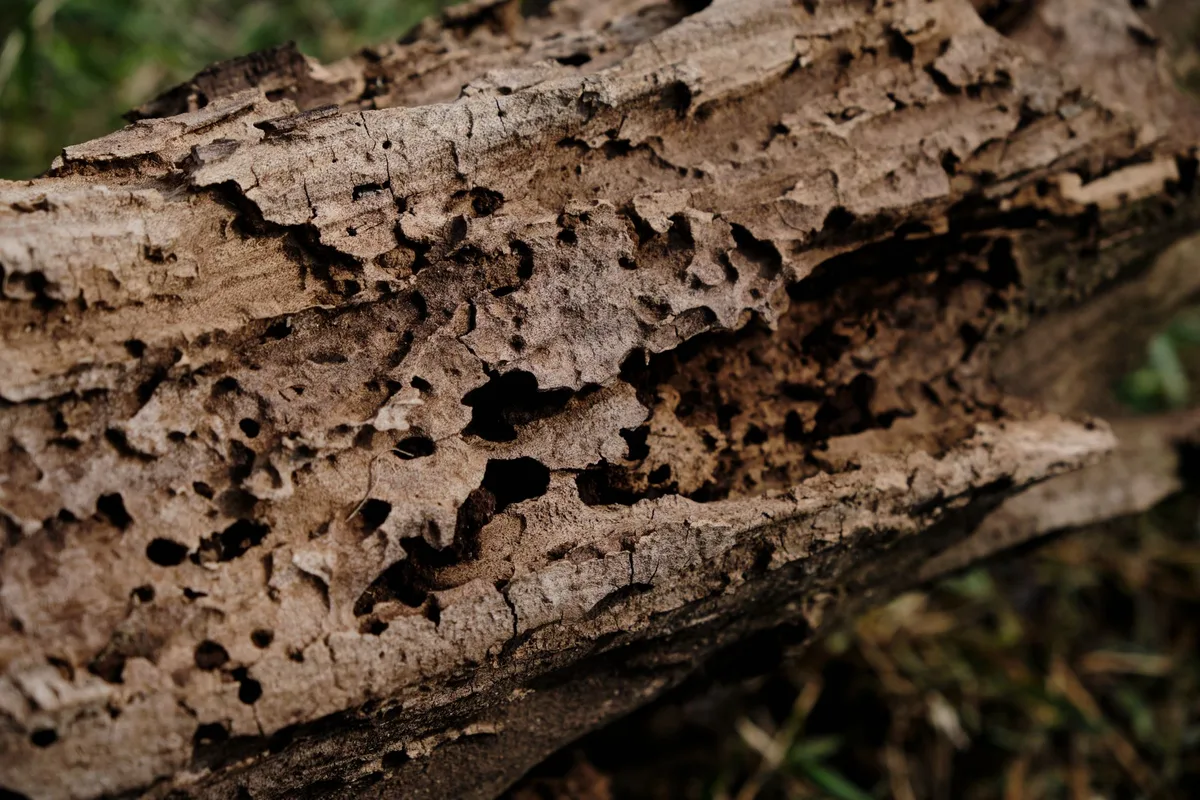
- Exit holes, round or D-shaped holes in the bark, often with fine sawdust (frass) beneath.
- Wilting or browning leaves, especially at the top or on individual branches.
- Sticky honeydew, a shiny, sticky coating on leaves or the ground below, often with black sooty mold.
- Chewed or skeletonized leaves, missing tissue between veins, or rolled leaves with silk.
- Bark cracks or oozing sap, can indicate borer activity beneath.
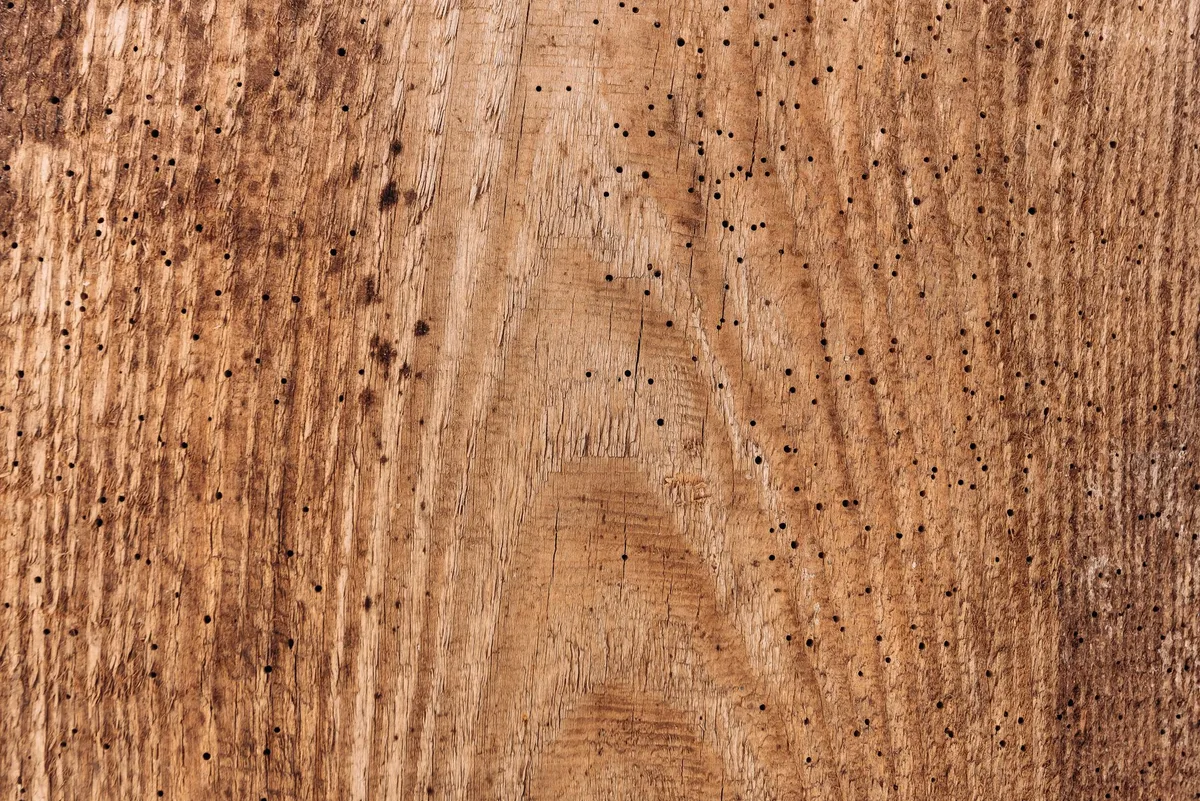
Take clear photos of what you find. You'll need them for identification. If you see more than two or three of these signs on a mature tree, it's time for a closer look.
Step 2: Identify the Pest – A Simple Decision Tree
Once you've spotted damage, figure out which group your pest belongs to. Each group needs a different treatment approach.
Leaf-feeders
If leaves are chewed, skeletonized, or rolled up, you're dealing with caterpillars, sawflies, or leaf beetles. These are usually the easiest to treat because they're exposed on the leaf surface.
- Best treatment for light infestations: hand-pick or blast off with water.
- For moderate to heavy infestations: spinosad or BT (Bacillus thuringiensis) sprayed on the leaves, reapplied after rain.
Sap-feeders
If you see sticky honeydew, sooty mold, or tiny bumps on stems and leaf undersides, it's aphids, scale insects, or mealybugs. These pests suck plant juices and can weaken a tree over time.
- Best treatment: horticultural oil or neem oil applied during the dormant season or when temperatures stay below 85°F.
- For heavy scale on a small tree: apply a soil drench of systemic imidacloprid in early spring.
Wood-borers
If you see D-shaped exit holes, sawdust piles at the base, or bark that's splitting and falling off, you're likely dealing with borers like emerald ash borer or clearwing moths. These are the most dangerous because they tunnel inside the tree where sprays can't reach.
- Best treatment: systemic insecticides (imidacloprid or emamectin benzoate) applied as a soil drench or trunk injection by a certified arborist.
- When to remove: if more than 50% of the canopy is dead, treatment rarely saves the tree.
If you're unsure, your local cooperative extension office can help with ID. For indoor pest issues, we've covered best fly traps for inside in a separate guide, different context, same principle of correct identification first.
Step 3: Assess Tree Vitality – Can This Tree Be Saved?
Not every infested tree is worth saving. Before you invest time and money, be honest about the tree's condition. Use this quick checklist:
Canopy dieback
- Under 30%: good chance of recovery with treatment.
- 30% to 50%: possible, but expect slow recovery and need ongoing care.
- Over 50%: removal is often more practical. The tree's structural integrity may be compromised.
Bark condition
- Small cracks or peeling: treatable if caught early.
- Girdling roots or large bark loss: very difficult to reverse.
Recent stress history
- Drought, construction damage, or root disturbance: address those first. The pest may leave once the tree is stable.
One hard truth: a tree with advanced borer damage and more than half its canopy dead is a safety hazard. It's better to remove it and plant a new one suited to your site. If you're dealing with an ornamental tree that's marginal for your climate, consider species from our best trees for hot dry climates list for your replacement.
We'll cover the actual treatment steps in the next sections, but this assessment decides whether you proceed with treatment or call a removal service.
Step 4: Choose Your Attack – Treatment Branches by Pest and Situation
Your treatment choice depends on three things: the pest type, the tree's health, and the time of year. If you misjudge any one of them, you waste effort or make things worse.
For light, early infestations on healthy trees
If you caught the problem early and the tree looks strong otherwise, start with the least invasive methods. Biological controls work well here.
- Ladybugs and lacewings handle aphids and soft scale naturally. You can buy them online and release them at dusk.
- BT (Bacillus thuringiensis) targets caterpillars without harming bees or birds. Spray it directly on chewed leaves.
- Hand-picking works for tent caterpillars and large beetles. Drop them in soapy water.
These methods are slow but safe. They won't kill beneficial insects or pollute the soil. In our research, trees treated with biological controls recover just as well as chemically treated trees, but it takes one to two weeks longer.
For moderate, visible pests on stressed trees
When you see widespread damage or the tree is already stressed, you need faster results. Low-toxicity sprays are the sweet spot.
- Horticultural oil smothers scale insects, aphids, and mite eggs. Apply it during dormancy or early spring before new growth emerges.
- Neem oil works on leaf-feeders and sap-feeders. It degrades quickly in sunlight, so reapply after rain.
- Spinosad is effective against caterpillars and leaf beetles. It's derived from soil bacteria and has low toxicity to mammals.
Spray when temperatures are below 85°F and wind is calm. Cover the undersides of leaves where pests hide.
For internal borers or heavy infestations
Borers live inside the tree where sprays can't reach. You need systemic insecticides that move through the vascular tissue.
- Soil drench with imidacloprid works for emerald ash borer on smaller trees. Apply in early spring when the tree is actively taking up water.
- Trunk injection is more effective for large trees or advanced infestations. This requires a certified arborist because it involves drilling into the tree and injecting at high pressure.
Systemic treatments last one to two years. They're expensive, but for a valuable shade tree, the cost is lower than removal.
For fruit or edible trees
Use only products labeled for edible crops. Check the pre-harvest interval (PHI) on the label. For example, spinosad on apples has a 1-day PHI, while neem oil has a 0-day PHI.
Spray at dusk to avoid harming bees during daytime foraging.
If you're growing fruit trees, you might also want to check our guide on best organic fertilizer for fruit trees to support recovery after pest pressure.
Step 5: Apply Like a Pro – Dosage, Weather, and Safety
Follow the label. That's the single most important rule. The label isn't a suggestion.
It's a legal requirement, and it tells you the exact dosage, re-entry intervals, and protective gear.
Weather conditions
- Temperature: Most sprays work best between 60°F and 85°F. Horticultural oil can burn leaves above 85°F.
- Wind: Spray when wind is under 10 mph to avoid drift onto nearby plants or into your neighbor's yard.
- Rain: Don't spray if rain is expected within 24 hours. Rain washes off contact insecticides before they dry.
Personal protective equipment
General insecticide safety calls for long sleeves, pants, chemical-resistant gloves, and safety glasses. For concentrated products, add a respirator with an organic vapor cartridge.
Application technique
- Foliar sprays: Cover both leaf surfaces until they're wet but not dripping. Start at the top and work down.
- Soil drenches: Mix per label and pour around the root zone within 2 to 3 feet of the trunk. Water it in lightly.
- Trunk injections: Leave this to a professional. Improper injection wounds the tree and can introduce disease.
A common question is whether to use a hand sprayer or a hose-end sprayer. Hand sprayers give better coverage on small to medium trees. Hose-end sprayers are faster for large canopies but use more product.
We cover similar safety principles in our piece on best insecticide for carpenter ants, where application timing is just as important.
Mistakes to Avoid – What Usually Goes Wrong
Most failed treatments come down to three errors. Avoid these and your odds double.
Misidentifying the pest
If you treat leaf-feeders when the real problem is borers, you waste time and let the borers keep tunneling. Take clear photos and cross-check with your local cooperative extension. They can often ID from a picture within 24 hours.
Spraying at the wrong time
Horticultural oil only works on overwintering eggs and scale if applied before bud break. Spray in early summer and you'll smother leaves instead. Timing windows are narrow.
Mark your calendar based on your hardiness zone.
Killing beneficial insects
Broad-spectrum insecticides kill everything, including predators that keep pest populations in check. After treatment, aphids often rebound faster than ladybugs, making the infestation worse. Use targeted products like BT or spinosad when possible.
Using dish soap as insecticide
This home remedy burns leaf tissue and rarely controls scale or borers. It can kill beneficial insects too. Stick to real horticultural soaps labeled for garden use.
Supporting Recovery – Helping the Tree Bounce Back
Once the pest pressure drops, the tree needs help regaining strength. Start with the basics.
Deep watering
Water deeply once a week during dry periods. A slow soak for 30 to 60 minutes under the canopy reaches the root zone. Frequent shallow watering encourages surface roots that are more vulnerable to stress.
Mulching
Apply 2 to 3 inches of organic mulch in a ring around the tree. Keep it at least 3 inches away from the trunk. Volcano mulching (piling mulch against the bark) traps moisture against the trunk and invites borers.
Light fertilization
Don't fertilize a stressed tree during an active infestation. Nitrogen pushes tender new growth that attracts more pests. Wait until the pest is under control, then apply a slow-release balanced fertilizer in early spring.
If you're caring for container trees or ornamentals, our guide on best plant fertilizer for indoor plants offers tips that apply to stressed trees too.
Pruning
Remove dead or damaged branches during the dormant season. Make clean cuts at the branch collar. Don't leave stubs.
Open wounds from pruning can attract borers if done during the growing season.
When to Call a Professional – Arborist vs. DIY Decision Guide
Some situations clearly call for a certified arborist. Others you can handle yourself. Here's how to decide.
| Situation | DIY | Call a Pro |
|---|---|---|
| Light leaf damage on a small tree | Yes | No |
| Scale on a mature shade tree | Possibly, with hose-end sprayer | If tree is over 30 feet tall |
| Emerald ash borer on a large ash tree | No | Yes. Trunk injection needed |
| Infestation with >30% canopy dieback | No | Yes. Assess viability first |
| You can't identify the pest | No | Yes. Bring photos for ID |
| Tree near power lines or buildings | No | Yes. Safety risk |
A certified arborist has training in tree biology, pest management, and safety standards. Per the International Society of Arboriculture, arborists follow best practices for pruning, injection, and diagnosis that go beyond what a general landscaper knows.
Expect to pay $75 to $200 for an inspection visit. Treatment costs vary. Trunk injection for a large tree can run $200 to $600 per treatment.
Compare that to removal costs of $500 to $3,000 for a similar tree. In many cases, treatment is the cheaper option.
If you live in an area with aggressive borers like emerald ash borer, annual preventive treatment is worth considering. Your arborist can set up a schedule.
For the replacement tree after removal, our guide on best trees for hot dry climates includes species that match your local pest pressure.
Real Scenarios – Quick Case Examples
Let's put the decision tree to work. Here are three common situations and how they typically play out.
Scenario A: Oak with tent caterpillars in spring
You spot silken tents in branch crotches and leaves disappearing fast. The tree is mature, otherwise healthy, with less than 20% defoliation.
- What to do: Wait and see. Tent caterpillar outbreaks rarely kill a healthy oak. The tree will leaf out again. If the sight bothers you, tear out the tents with a stick or spray BT on warm days when caterpillars are feeding outside the tent.
- Result: Tree recovers fully by mid-summer. No chemical needed.
Scenario B: Maple with scale and sooty mold
Leaves are sticky, branches have tiny brown bumps, and a black coating covers the foliage. The tree is a medium-sized silver maple, about 15 years old.
- What to do: Apply dormant oil before bud break the following spring. If it's too late for dormant application, use summer horticultural oil mixed at the summer rate. Cover all surfaces.
- Result: Scale dies off within two weeks. Sooty mold slowly weathers away. Repeat treatment next season if needed.
Scenario C: Ash tree with D-shaped exit holes
You find small D-shaped holes in the bark, woodpecker damage, and canopy thinning at the top. The tree is large, about 50 feet tall.
- What to do: Call a certified arborist immediately. This is emerald ash borer. Systemic treatment is possible if less than 30% of the canopy is dead. Otherwise plan for removal.
- Result: With early treatment, the tree survives. Without it, death occurs in 2 to 4 years.
Final Decision Guide – Your One-Page Cheat Sheet
Here's the simplified path from symptom to solution.
| If you see this | And tree looks like this | Do this |
|---|---|---|
| Chewed leaves, webs | Healthy, <30% damage | BT or hand-pick. Wait. |
| Sticky leaves, bumps, black mold | Healthy to moderately stressed | Dormant or summer horticultural oil. |
| D-shaped holes, sawdust, top dieback | Any condition | Call an arborist. Removal likely if >50% dead. |
| Tiny bugs on leaf undersides | Healthy to stressed | Neem oil or insecticidal soap. |
| Bark cracks, oozing sap | Stressed or declining | Inspect for borers. Systemic treatment needed. |
The golden rule: identify first, treat second. And never skip the recovery step. Water, mulch, and patience do more than any spray.
One final thought from our research. The best way to save a tree from insect damage is to keep it healthy before the insects arrive. Regular watering, proper mulching, and choosing a tree suited to your site all reduce pest pressure.
If you're picking a replacement tree, look for species with natural resistance. Our guide on best trees for hot dry climates lists options that handle stress well. And for your flower beds around the tree, best flowers for flower beds can attract beneficial insects that prey on tree pests.
Frequently Asked Questions
Can I save a tree with more than 50% dieback from insects?
In most cases, no. The tree's vascular system is too compromised. Treatment rarely reverses the damage, and the tree becomes a safety hazard.
Focus on removing it safely and planting a replacement suited to your climate.
How long does it take for a treated tree to recover?
Light infestations show improvement in 2 to 4 weeks. Moderate cases take a full growing season. Borer damage can take 2 to 3 years to show full recovery.
Regular watering and mulching speed things up.
Is neem oil safe for bees?
Neem oil has low toxicity to bees once dry. Spray at dusk when bees aren't foraging. Avoid spraying open flowers directly.
Look for products labeled as bee-safe when applied according to directions.
What's the difference between horticultural oil and neem oil?
Horticultural oil is refined petroleum oil that smothers insects and their eggs. Neem oil comes from the neem tree and works as a smothering agent plus an antifeedant. Both are low toxicity.
Horticultural oil is better for dormant season use. Neem oil works well during the growing season.
Can I use systemic insecticides on fruit trees?
Yes, but only products labeled for edible crops. Check the pre-harvest interval on the label. Imidacloprid is not allowed on some fruit trees.
Spinosad and neem oil are safer choices for edible trees. Always follow the label exactly.
When is the best time to apply dormant oil?
Apply during late winter or very early spring before buds swell and break. Air temperature must be above 40°F with no freezing in the 24-hour forecast. The oil smothers overwintering eggs and scale insects before they become active.