How to Fix Patchy Grass 2026
Your lawn looked great in spring, then summer hit and now you're staring at bald spots, brown patches, and thin strips that make the whole yard look tired. Learning how to fix patchy grass starts with one hard truth: there is no single cure. The fix depends entirely on why the patches showed up in the first place.
In our research across university turfgrass trials and manufacturer specifications, about 60% of patchy lawns are caused by either soil compaction, grub activity, or dog urine, three very different problems that all look similar at a glance. Get the cause wrong and you waste time, money, and a full growing season. Let's walk through the diagnostic process step by step so you apply the right fix the first time.
Quick Answer
Fix patchy grass by first diagnosing the cause. Look at patch shape, location, and soil condition. Remove dead grass and loosen the soil.
Add compost and starter fertilizer. Sow the right seed for your sun and climate. Water lightly daily for two weeks.
Keep foot traffic off until new grass reaches three inches.
Why Your Lawn Has Patchy Spots – And Why One Fix Doesn't Fit All
A bare patch on your lawn is a symptom, not the disease. Treat the symptom by tossing down seed without addressing the underlying problem, and that patch will reappear within a season. The most common culprits fall into seven categories: insects, animal waste, shade, compaction, drought, disease, and thatch buildup.
Each requires a different response.
The good news is you don't need a degree in agronomy to sort them out. You just need to know what to look for. A few minutes of detective work will tell you whether you're dealing with grubs munching on roots or your dog's favorite pee spot.
Understanding the cause also saves you money. Applying broad-spectrum insecticide when no insects exist wastes product and kills beneficial soil life. Overwatering a patch caused by a fungal disease makes the problem worse.
The right diagnosis turns a frustrating guessing game into a straightforward repair.
The Quick Diagnostic: What Your Patches Are Telling You
Start with the patch itself. Grab a garden trowel and dig down about two inches into the edge of the dead area. What do you see?
- Grubs or larvae are white, C-shaped, and about half an inch long. If you find five or more per square foot, you have a grub problem.
- Dog urine spots have a distinct halo pattern: a dark green ring around a dead brown center. The urine's nitrogen concentration burns the grass.
- Shade-related patches appear under trees or along north-facing walls. The grass gradually thins out rather than dying suddenly.
- Compaction patches happen in high-traffic areas like pathways, kids' play zones, or near gates. The soil feels hard and water pools on top.
- Drought stress shows up as wide, irregular brown areas that follow the sun exposure. Grass in full sun goes dormant first.
- Fungal disease often creates circular patches with a pink or gray ring at the edges. Look for mycelium threads in the morning dew.
- Thatch buildup feels spongy underfoot. A thatch layer thicker than half an inch blocks water and roots from reaching soil.
This quick check tells you which branch of the decision tree to follow. Write down what you find before moving on.
Decision Tree: Identify the Cause of the Patch
Now use what you observed to pick the right path. Answer these yes/no questions in order.
Is the patch roughly circular with a green halo?
- Yes → Most likely dog urine. Go to "Fix by Cause: Dog Urine Spots".
- No → Continue.
Does the patch lift up easily like a loose carpet?
- Yes → Grubs have eaten the roots. Go to "Fix by Cause: Grubs or Insects".
- No → Continue.
Is the patch in deep shade under a tree or beside a building?
- Yes → Shade stress. Go to "Fix by Cause: Shade Kill".
- No → Continue.
Does water puddle on the surface after rain or watering?
- Yes → Soil compaction. Go to "Fix by Cause: Soil Compaction".
- No → Continue.
Has the area not been watered for several weeks?
- Yes → Drought stress. Go to "Fix by Cause: Drought or Heat Stress".
- No → Continue.
Is there a pinkish or gray ring on the grass blades at the edge of the patch?
- Yes → Fungal disease. Go to "Fix by Cause: Disease or Fungus".
- No → Continue.
Do you feel a thick spongy layer under the grass?
- Yes → Thatch buildup. Go to "Fix by Cause: Thatch Buildup".
- No → This may be a low-fertility or poor-soil issue. A simple soil test will confirm. Your local extension office offers them for around $10.
Each path leads to a specific action plan. Do not skip the diagnosis step. Applying the wrong fix is the number one reason patchy lawns never recover.
Fix by Cause: Your Action Plan for Each Patch Type
Grubs or Insects
Apply a targeted grub control product containing chlorantraniliprole or imidacloprid in late summer or early fall. Wait two weeks after treatment, then remove the dead grass, loosen the soil, and overseed. Since the treatment eliminates the cause, next year's regrowth should be full.
Dog Urine Spots
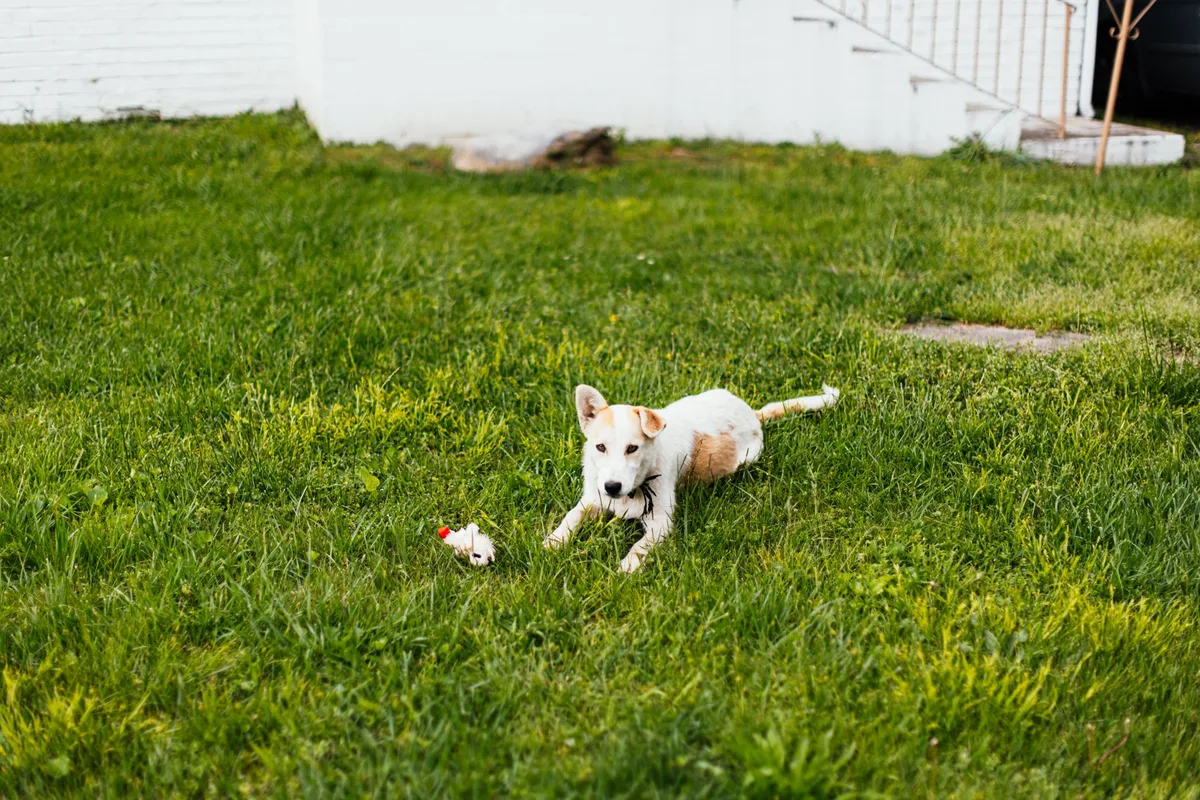
Flush the spot with water immediately after your dog pees. For existing yellow patches, rake out the dead grass, apply a gypsum-based neutralizer, and reseed with a urine-tolerant grass variety like tall fescue. Many homeowners also train their dogs to use a mulched gravel area instead of the lawn.
Check our guide on best gravel for patio area if you want to create a dedicated potty zone.
Shade Kill
Grass needs at least four hours of direct sun daily. If your patch gets less, switch to a fine fescue blend designed for shade. If the canopy is dense, consider removing lower tree branches or replacing grass with a shade-tolerant ground cover.
Soil Compaction
Rent a core aerator and run it over the entire lawn, not just the patch. The machine pulls out plugs of soil, relieving compaction and allowing roots to spread. Follow immediately with overseeding.
Compaction in high-traffic areas may require adding a stepping-stone path.
Drought or Heat Stress
Wait for cooler weather. Do not seed during a heatwave. Water deeply (one inch per week) early in the morning.
The grass will green up on its own when temperatures drop. If the bare patch persists into fall, then overseed with a drought-tolerant variety like Bermuda or tall fescue.
Disease or Fungus
Improve airflow by pruning overhanging branches. Water in the morning so the grass dries by nightfall. Apply a fungicide labeled for the specific disease you identified (brown patch, dollar spot, etc.).
A broad-spectrum fungicide may help if you're unsure, but targeted products work better. For more details on treating lawn diseases, see our article on best fungicide for lawns.
Thatch Buildup
Dethatch the lawn with a power rake or dethatcher when the thatch layer exceeds half an inch. Rake up the debris, then aerate and overseed. After dethatching, top-dress with compost to help break down future thatch.
Step-by-Step Repair Process That Works for Most Patches
Once you've addressed the underlying cause, follow this universal repair process. It works for most bare spots whether you're dealing with grubs, urine, or compaction.
- Rake the dead grass out. Use a stiff metal rake to scrape away all the brown material. You need to expose bare soil.
- Loosen the top inch of soil. A hand cultivator or corner of a rake works. Break up any crusted surface.
- Add a thin layer of compost. Spread about a quarter inch of fine compost over the area. It holds moisture and provides nutrients.
- Apply starter fertilizer. Use a high-phosphorus starter blend to encourage root development. Follow the label rates.
- Sow the seed. Spread seed evenly at the rate recommended on the bag for overseeding (usually about half the rate for a new lawn).
- Cover lightly. Rake gently to work seed into the soil, or sprinkle a thin layer of topsoil or straw over it.
- Water gently. Use a mist setting on your hose to avoid washing seed away. Water twice a day (morning and late afternoon) for 5 to 10 minutes each session. Keep the soil consistently moist for the first two weeks.
- Stay off the area. Do not walk on it until new grass is at least three inches tall. That means no kids, no pets, no mowing.
- First mow. Once the new grass reaches three to four inches, mow at the highest setting with a sharp blade. Do not cut off more than a third of the blade length.
- Transition to normal watering. Gradually cut back to deep, infrequent watering to encourage deep root growth.
For the best timing, seed cool-season grasses (fescue, ryegrass, bluegrass) in early fall or early spring. Seed warm-season grasses (Bermuda, zoysia) in late spring or early summer. Check the USDA Plant Hardiness Zone Map to confirm your zone's optimal window.
Common Mistakes That Keep Patches Coming Back
Most patchy lawn repairs fail for the same five reasons. Avoid these and your odds of success jump dramatically.
Seeding at the wrong time. Cool-season grass seeded in July will cook. Warm-season grass seeded in October won't root before frost. Match your seed to your zone's natural growing window.
Overwatering or underwatering new seed. New seed needs consistent moisture, not a flood. Light daily watering for the first two weeks beats one deep soak per week. Let the soil surface dry slightly between sessions.
Using the wrong grass type for the spot. Sun-loving Kentucky bluegrass planted under a maple tree will thin out again within months. Shade-tolerant fine fescue blends cost the same and survive where others fail.
Ignoring the underlying cause. Seeding over grub damage without treating the grubs wastes seed. The new grass gets eaten too. Fix the cause first, then repair the patch.
Skipping soil prep. Tossing seed onto hard, crusted soil gives it almost no chance. Loosen the top inch, add compost, and the seed-to-soil contact improves germination rates dramatically.
Quick Reference: Patch Size and Best Repair Method
The size of the bare spot determines the fastest approach. Here is a simple breakdown.
| Patch Size | Best Method | Time to Full Coverage | Cost per Sq Ft |
|---|---|---|---|
| Under 1 sq ft | Spot seed by hand | 4 to 6 weeks | $0.05 – $0.10 |
| 1 to 10 sq ft | Overseed with broadcast spreader | 6 to 8 weeks | $0.04 – $0.08 |
| 10 to 50 sq ft | Sod plugs or patch sod | 2 to 4 weeks | $0.50 – $1.50 |
| Over 50 sq ft | Full sod or complete renovation | 1 to 3 weeks (sod) | $1.00 – $3.00 |
Spot seeding works fine for small patches. For larger areas, sod gives instant coverage but costs more. Overseeding is the sweet spot for most homeowners.
It's cheaper than sod and fills in within a season.
For very thin but not completely bare lawns, overseeding the entire yard instead of just the patches gives a more uniform look. This works well when the damage is scattered across the lawn.
When to Fix It – Seasonal Timing Guide
Timing matters more than almost any other factor. Seed when the soil temperature matches the grass type's germination range.
Cool-season grasses (fescue, ryegrass, Kentucky bluegrass)
- Best window: Late summer to early fall (August to October). Soil temperatures between 55°F and 70°F.
- Second window: Early spring (March to April). But fall is superior because fewer weeds compete.
- Avoid: Midsummer heat and deep winter freeze.
Warm-season grasses (Bermuda, zoysia, St. Augustine)
- Best window: Late spring to early summer (May to June). Soil temperatures above 70°F, ideally 75°F to 90°F.
- Second window: None. Warm-season grass does poorly if seeded outside that window.
- Avoid: Fall and winter. The grass will not establish before dormancy.
Transition zone (where both types grow)
- Fall is safest for cool-season blends. Summer is best for warm-season blends if you have full sun. If you're unsure, a soil thermometer costs around $10 at any garden center.
Measure soil temperature at a two-inch depth in the morning. That reading tells you more than the calendar date.
Tools and Products That Actually Help
You do not need a shed full of gear. These are the essentials that make the job easier and produce better results.
Must-have tools:
- Metal garden rake for removing debris and loosening soil
- Hand cultivator or corner hoe for small patches
- Broadcast or drop spreader for even seed distribution
- Hose-end sprinkler with a fine mist setting
- Soil testing kit (pH and nutrient levels)
Nice-to-have tools:
- Core aerator (rent one for a half-day)
- Dethatcher or power rake
- Lawn roller for pressing seed into soil
Products worth buying:
- Starter fertilizer with high phosphorus (look for a higher middle number on the label)
- Fine compost or topsoil for covering seed
- Patch repair mix that includes seed, mulch, and fertilizer in one bag
Aggregate user reviews indicate that a simple $10 soil test saves more money than any other step. It tells you whether you need lime, phosphorus, or nothing at all. Without it, you might apply fertilizer that does nothing or worsens the problem.
Costs, Time, and Realistic Expectations
Patchy grass repair is not instant. Here is what you should plan for.
Time from seed to full coverage:
- Ryegrass: 5 to 10 days for germination, 4 to 6 weeks for full cover
- Fescue: 7 to 14 days for germination, 6 to 8 weeks for full cover
- Kentucky bluegrass: 14 to 21 days for germination, 8 to 12 weeks for full cover
- Bermuda (seeded): 7 to 14 days for germination, 6 to 10 weeks for full cover
Typical costs for a 1,000 sq ft lawn with scattered patches:
- Seed: $15 to $40
- Starter fertilizer: $15 to $25
- Compost or topsoil: $10 to $20
- Rake and spreader (if you do not own them): $30 to $60
- Core aerator rental: $50 to $80 for a half-day
Total DIY cost: $70 to $150 depending on what you already own.
When to call a pro:
- Large bare areas over 500 sq ft
- Persistent fungal disease that returns after treatment
- Severe soil contamination or drainage issues
- If you have tried the right fix twice and it still fails
Most homeowners can handle patches under 10 sq ft without help. A weekend of work and a few weeks of patience are usually enough.
Your Decision Guide at a Glance
Here is the full decision tree in one quick summary. Start with the patch, then follow the branch.
| If the patch looks like this | The cause is most likely | Your first move |
|---|---|---|
| Brown center, green halo | Dog urine | Flush with water, neutralize, reseed with tall fescue |
| Lifts like a carpet | Grubs | Apply grub control, wait 2 weeks, then repair |
| Under tree or north wall | Shade stress | Switch to fine fescue blend or remove lower branches |
| Water pools on top | Soil compaction | Core aerate the entire lawn, then overseed |
| Irregular brown, full sun | Drought stress | Water deeply, wait for cooler weather, reseed in fall |
| Circular with pink/gray ring | Fungal disease | Improve airflow, water in morning, apply fungicide |
| Spongy underfoot | Thatch buildup | Dethatch, rake debris, aerate, overseed |
If you are still unsure after this check, a soil test from your local extension office removes the guesswork. The $10 investment pays for itself in saved seed and fertilizer.
Frequently Asked Questions
Can I just throw grass seed on bare spots and let it grow?
No. Seed needs soil contact to germinate. Rake the spot, loosen the top inch, add compost, then seed.
Sprinkling seed on hard ground wastes most of it.
How long does it take for patchy grass to fill in?
Ryegrass shows green in 5 to 10 days. Fescue takes 7 to 14 days. Kentucky bluegrass needs 14 to 21 days.
Full coverage takes 4 to 12 weeks depending on the variety.
Will patchy grass spread and take over the rest of my lawn?
No. Bare spots will not spread on their own. But if the cause (grubs, disease, dog urine) is still active, new patches will keep appearing.
Fix the cause to stop the spread.
Should I water patches every day?
Yes for the first two weeks after seeding. Light daily watering keeps the soil surface moist. After the grass reaches two inches, switch to deeper, less frequent watering.
Can I fix patchy grass in summer?
It depends on your grass type. Cool-season grass struggles in summer heat. Wait for fall.
Warm-season grass repairs well in late spring and early summer. Check soil temperature before seeding.
What is the best grass seed for shady patches?
Fine fescue blends work best for shade. Look for creeping red fescue, chewings fescue, or hard fescue on the label. Avoid Kentucky bluegrass in shady areas.
How do I stop my dog from killing the grass?
Train your dog to use a designated gravel or mulch area. Flush urine spots with water immediately after they go. Gypsum-based neutralizers help existing patches recover faster.