Guide to Common Aphids Mistakes 2026: Everything You Need
You've probably noticed the aphids too late, sprayed at the wrong time, or watched them come roaring back a week after treatment. Common aphids mistakes don't just waste time and money. They turn a manageable pest into a recurring nightmare that damages your plants and wipes out the beneficial insects keeping your garden balanced.
Aphids reproduce fast, with a single female producing 40 to 60 offspring in warm weather and a new generation maturing every 7 to 10 days. That speed means small errors compound quickly, and most gardeners repeat the same handful of mistakes without realizing why their treatments fail.
Quick Answer
The biggest aphid mistakes include waiting too long to treat, spraying in full sun, ignoring leaf undersides, treating only once, and killing beneficial insects with broad-spectrum products. Most failures stem from poor timing or incomplete coverage. Root aphids and ant-tended colonies require different strategies.
Effective control demands repeat applications 5 to 7 days apart and monitoring after treatment.
Why Aphid Mistakes Cost You More Than the Infestation Itself
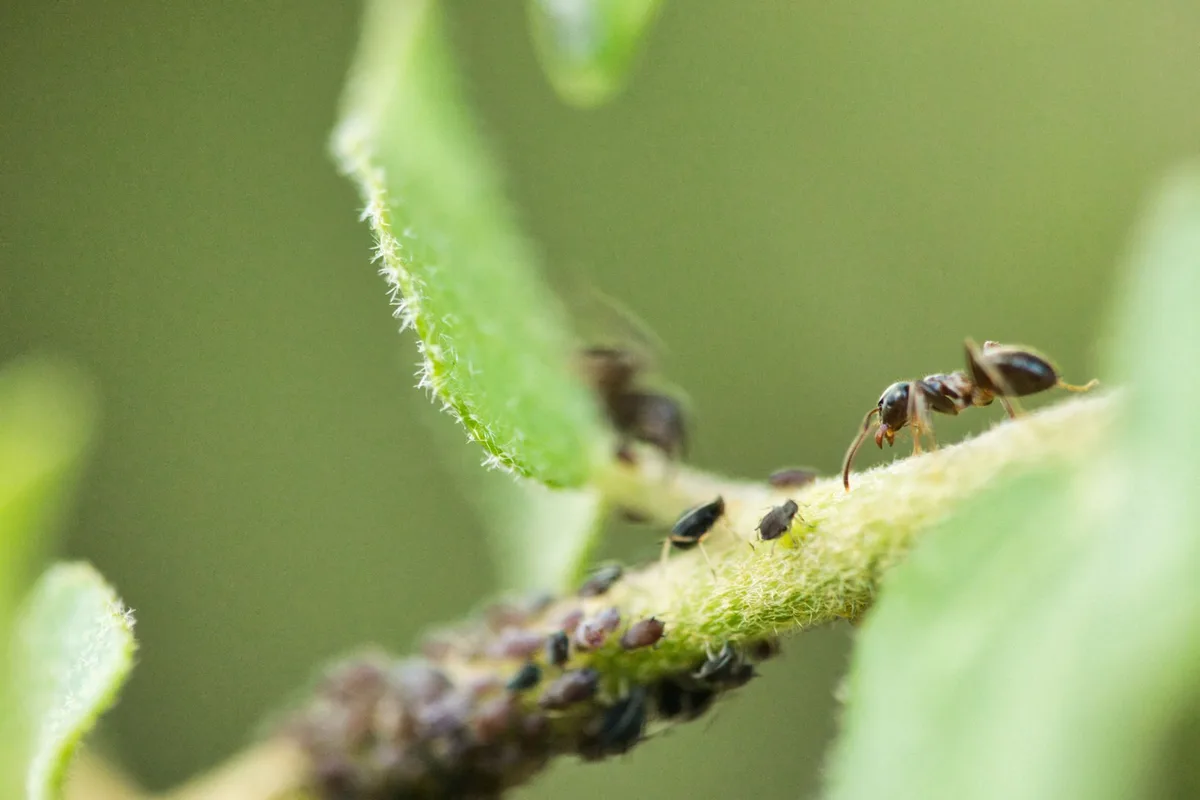
Aphid damage goes beyond the visible curling leaves and sticky honeydew. When you spray incorrectly, you can burn plant tissue, kill off natural predators, and create a cycle where aphids bounce back harder because nothing's left to eat them. The mistake costs you more than the original problem.
Broad-spectrum insecticides wipe out ladybugs, lacewings, and parasitic wasps. These beneficial insects eat hundreds of aphids per day. Once they're gone, your garden loses its free pest control, and you're stuck spraying every few weeks instead of letting nature handle it.
Poor application timing also matters. Spraying during midday heat causes phytotoxicity on many plants, especially when you're using oils or soaps. The leaves develop brown spots, margins curl, and growth slows.
You've traded aphid damage for chemical burn.
Incomplete treatment leaves hidden colonies alive. Aphids cluster on leaf undersides, in curled new growth, and along stems. If your spray doesn't reach them, they rebuild the population in days.
You'll see the same sticky mess and distorted leaves within a week, and you'll wonder why nothing works.
The Single Biggest Mistake: Waiting Until You See Visible Damage
Most gardeners don't inspect their plants until something looks wrong. By the time leaves curl, turn yellow, or drip honeydew, the aphid colony is already mature and reproducing at full speed. Early-stage infestations are invisible from a distance, but they're far easier to control.
Aphids feed on phloem sap using piercing-sucking mouthparts. A small cluster of 10 or 20 aphids won't cause obvious symptoms for a week or more. During that time, each female is producing dozens of live young.
When you finally notice the problem, you're dealing with hundreds of aphids across multiple generations.
Check your plants every three to five days during the growing season. Focus on new growth, flower buds, and the undersides of young leaves. Those are the preferred feeding sites.
Use a hand lens if you need a closer look, especially for small species like the green peach aphid.
If you catch aphids early, a strong spray from the garden hose often knocks them off before they establish. That's a zero-cost, zero-chemical solution that works when the population is still small. Once colonies mature, water spray alone won't cut it, and you'll need soap, oil, or biological controls.
Waiting also allows aphids to spread plant viruses. Many aphid species act as vectors for diseases that stunt growth, yellow leaves, or kill plants outright. The virus transmission happens within seconds of feeding, so controlling aphids early protects your plants from infections that no spray can reverse.
Set a reminder on your phone or calendar to inspect your best plants for a bedroom, vegetable beds, and ornamentals twice a week. That habit alone prevents most severe infestations and keeps treatment simple.
Mistake #1: Spraying at the Wrong Time of Day (And Killing Your Plants in the Process)
Timing your spray application wrong can do more harm than the aphids themselves. Insecticidal soap and horticultural oils work by coating the aphid's body and suffocating it, but those same products can damage plant tissue if applied during the heat of the day.
When temperatures climb above 80°F and the sun is intense, oils and soaps heat up on the leaf surface. The combination of heat, sunlight, and the spray residue causes phytotoxicity. You'll see brown or bleached spots on leaves, scorched margins, and sometimes complete leaf drop on sensitive plants like Japanese maples, ferns, and certain best flowers for flower beds.
The best application window is early morning or late evening. Spray when temperatures are between 60 and 75°F, and the sun is low or down. That gives the product time to work and dry without concentrating heat on the foliage.
Avoid spraying in windy conditions, too. Wind reduces coverage, blows the spray off target, and wastes product. If you're treating a large area, wait for a calm morning.
You'll get better coverage on leaf undersides and save money on reapplication.
Humidity also plays a role. High humidity slows drying time, which can be good or bad depending on the product. Insecticidal soap works best when it stays wet for a few minutes, giving it time to penetrate the aphid's cuticle.
But if conditions are too humid and the plant stays wet for hours, you risk fungal issues on top of the aphid problem.
Never apply any spray when rain is forecast within 24 hours. Rain washes off contact sprays before they do their job, and you're back to square one. Check the weather, plan your application, and give the product time to work.
Mistake #2: Only Treating What You Can See—Ignoring Leaf Undersides and New Growth
Aphids don't sit out in the open. They congregate on the undersides of leaves, inside curled foliage, and along tender new shoots where the sap flow is richest. If you spray only the tops of leaves, you're missing the bulk of the colony.
Contact insecticides and soaps only work when they hit the aphid directly. There's no residual effect once the spray dries. That means coverage is everything.
You need to angle your sprayer to reach underneath every leaf, especially on the lower and middle parts of the plant where aphids tend to cluster first.
Use a pump sprayer or hose-end sprayer with an adjustable nozzle. Tilt the wand upward and spray from below the plant, hitting the leaf undersides. Work systematically from bottom to top, making sure you're not just misting the canopy.
Walk around the plant and treat from multiple angles.
Pay extra attention to new growth. Aphids prefer young, succulent tissue because it's easier to pierce and the sap is nutrient-rich. Check the tips of branches, unfurling leaves, and flower buds.
These are the hotspots where colonies establish and reproduce fastest.
If leaves are tightly curled, you may need to remove heavily infested shoots entirely. Aphids hiding inside a curled leaf are nearly impossible to reach with spray. Prune those sections, bag them, and discard them in the trash, not the compost pile.
That reduces the population immediately and makes your spray more effective on the remaining aphids.
Repeat coverage is critical. Even if you do a thorough job, eggs and nymphs hatch over the next week. That's why you'll see the 5 to 7 day reapplication interval on most organic aphid treatments.
One spray rarely kills every stage of the aphid lifecycle.
Mistake #3: Using Dish Soap Instead of Insecticidal Soap
It sounds like a harmless swap, but dish soap is not the same as insecticidal soap. Dish detergents are formulated to cut grease and often contain degreasers, fragrances, and surfactants that can damage plant tissue. Insecticidal soap is specially formulated to be effective against soft-bodied insects while remaining safe for most plants.
Dish soap concentrations are hard to control. Most homemade recipes call for a few drops per quart, but "a few drops" varies widely. Too much soap increases the risk of phytotoxicity, especially on plants with delicate foliage or waxy coatings.
You'll see leaf tip burn, yellowing, or even defoliation if the concentration is too strong.
Commercial insecticidal soap is standardized at 1 to 2 percent potassium salts of fatty acids. That's the active ingredient that disrupts the aphid's cell membranes. It's tested for safety on a wide range of plants, and manufacturers list which species are sensitive.
You won't get that assurance from a bottle of Dawn or Palmolive.
If you've already sprayed with dish soap and you're not seeing damage, you got lucky. But don't count on it working every time. Some plants tolerate it, others don't.
Japanese maples, sweet peas, portulaca, and many succulents are particularly sensitive to soap sprays, whether commercial or homemade.
Insecticidal soap is inexpensive and widely available at garden centers and online. It's worth the small investment to avoid damaging your plants. Follow the label directions for dilution, apply during cooler parts of the day, and test on a single leaf before treating the whole plant if you're using it on a sensitive species.
Some gardeners also add a drop of soap to neem oil or horticultural oil sprays as a surfactant. That's fine if you're using insecticidal soap, but dish soap in an oil mixture can create an emulsion that's too harsh. Stick with products designed for plant use, and you'll avoid most of the common pitfalls.
Mistake #4: Treating Once and Assuming You're Done
Most gardeners spray once, see the aphids disappear, and move on. That's the mistake. Contact sprays kill the aphids they touch, but they don't stop eggs from hatching or nymphs from maturing over the next week.
Within days, the colony rebuilds as if you never treated at all.
Aphids have overlapping generations. When you spray, you're hitting adults, nymphs, and some larvae. But eggs laid before treatment, or aphids that were hidden inside curled leaves, survive.
Those survivors reproduce immediately, and you're back where you started.
Most organic treatments require two to three applications spaced 5 to 7 days apart. That timing targets the new generation as it hatches but before it reaches reproductive maturity. If you skip the second and third sprays, you've wasted the first one.
Why Aphid Reproduction Timing Demands Repeat Applications
Aphids reproduce through parthenogenesis, meaning females give live birth to more females without mating. In warm weather, a new generation matures in 7 to 10 days. Each female produces 40 to 60 offspring during her lifespan.
That exponential growth means a few survivors can rebuild a full colony in under two weeks.
Your first spray knocks down the visible population. The second spray, applied 5 to 7 days later, catches the next wave before they reproduce. A third application, another week out, mops up any stragglers.
That three-spray cycle breaks the reproduction curve and gives you lasting control.
Skipping follow-up sprays is why so many gardeners think organic treatments don't work. They do, but only if you complete the cycle. It's not the product that failed.
It's the application schedule.
The 5 to 7 Day Rule Most Gardeners Skip
The 5 to 7 day interval isn't arbitrary. It's based on aphid development time at typical growing temperatures. If you wait longer than 7 days between sprays, the new generation matures and starts reproducing.
You're chasing the problem instead of stopping it.
If temperatures are unusually warm, shorten the interval to 5 days. Heat accelerates aphid development. In cooler weather, you can stretch it to 7 days, but don't go longer.
Mark your calendar or set a phone reminder so you don't forget the follow-up.
Monitor the plant between sprays. If you see new aphids appearing before the scheduled reapplication, treat early. The schedule is a guideline, not a hard rule.
Your goal is to hit each new generation before it reproduces, and that requires flexibility based on what you're seeing.
Mistake #5: Nuking Beneficial Insects Along With the Aphids
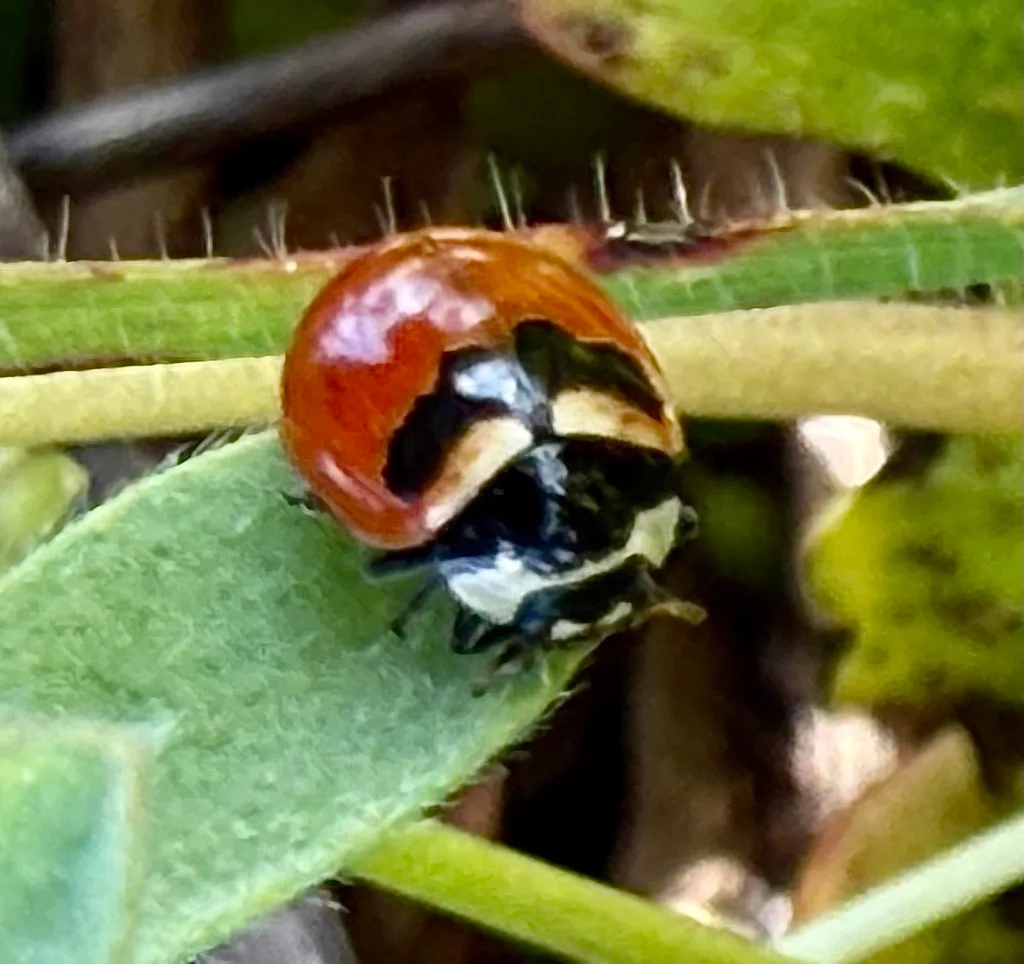
Broad-spectrum insecticides kill everything they touch. That includes ladybugs, lacewings, hoverfly larvae, and parasitic wasps. These beneficial insects are your best long-term defense against aphids, and wiping them out with a chemical spray turns a one-time problem into a recurring cycle.
A single ladybug larva eats 300 to 400 aphids before it pupates. Adult ladybugs consume 50 to 60 aphids per day. Lacewing larvae are equally voracious.
When you spray a broad-spectrum pyrethroid or systemic insecticide, you're killing the predators that would have controlled the aphids naturally.
Once beneficials are gone, aphids recolonize faster than the predators can return. Aphids reproduce in days. Beneficial insects take weeks to reestablish.
You end up spraying every few weeks instead of letting nature do the work.
Which Products Kill Ladybugs and Lacewings (And When to Use Them Anyway)
Pyrethroids, carbamates, and organophosphates are highly toxic to beneficial insects. Even some organic products, like spinosad and pyrethrin, kill beneficials if applied when they're active. Neem oil and insecticidal soap are less harmful to beneficials once they dry, but they'll still kill ladybugs and lacewings if you spray them directly.
Systemic insecticides like imidacloprid move through the plant's vascular system. They kill aphids as they feed, but they also poison any predator that eats an aphid. That residual toxicity can last weeks, and it's particularly dangerous to bees if you apply systemics to blooming plants.
If you're facing a severe infestation and you need a fast knockdown, a broad-spectrum product may be your only option. But use it as a last resort, apply it carefully, and wait at least two weeks before releasing or relying on beneficial insects. Check the product label for reentry intervals and pollinator warnings.
The Right Sequence: Chemical Treatment vs Releasing Biocontrols
If you've already sprayed a broad-spectrum insecticide, don't release ladybugs or lacewings right away. Wait for the residual activity to fade. That's typically 7 to 14 days for contact sprays, longer for systemics.
Releasing predators into a freshly sprayed garden just kills them before they can do anything useful.
If you're planning to use biological controls, start with them before reaching for chemicals. Hose off the aphids with a strong water spray to reduce the population, then release ladybugs or lacewings. They'll handle the cleanup if the infestation isn't too far gone.
For ongoing control, plant flowers that attract beneficial insects. Best flowers for shade hanging baskets like alyssum, lobelia, and fuchsia provide nectar and pollen for adult predators. That keeps them in your garden and ready to attack the next aphid colony before it gets out of hand.
Mistake #6: Ignoring the Ants Farming Your Aphid Colony
Ants and aphids have a mutualistic relationship. Ants feed on the honeydew aphids secrete, and in return, they protect the aphids from predators. If you see ants marching up and down your plant stems, you've got an aphid problem even if you haven't spotted the aphids yet.
Ants actively defend aphid colonies. They'll attack ladybugs, lacewings, and parasitic wasps that try to feed on the aphids. They also move aphids to new feeding sites when one area gets overcrowded.
That means ants are spreading the infestation faster than it would spread on its own.
Controlling ants is often the key to controlling aphids. Break the ant trail, and the aphid colony loses its protection. Beneficial insects can move in and do their job without getting swarmed.
Apply a sticky barrier like Tanglefoot around the base of plant stems or tree trunks. That blocks ants from climbing up. You can also use ant baits near the base of the plant to reduce the ant population.
Boric acid baits work well for this, but keep them away from kids and pets.
If the plant is in the ground, check for ant nests nearby. Ants often build colonies close to their aphid "herds." Treat the nest with a targeted ant bait or drench, and the farming stops. Once the ants are gone, predatory insects can clean up the aphids without interference.
Don't ignore the ants and focus only on the aphids. If you spray the aphids but leave the ants untouched, the ants will just move a few surviving aphids to a new spot, and the cycle starts over. Address both problems, or you'll be treating the same plant every few weeks.
Mistake #7: Misidentifying Your Aphid Type and Using the Wrong Approach
Not all aphids behave the same way. Most species feed on foliage and stems, but root aphids live underground and attack plant roots. If you're spraying the leaves and the plant keeps declining, you might be dealing with a root aphid infestation that your foliar spray will never touch.
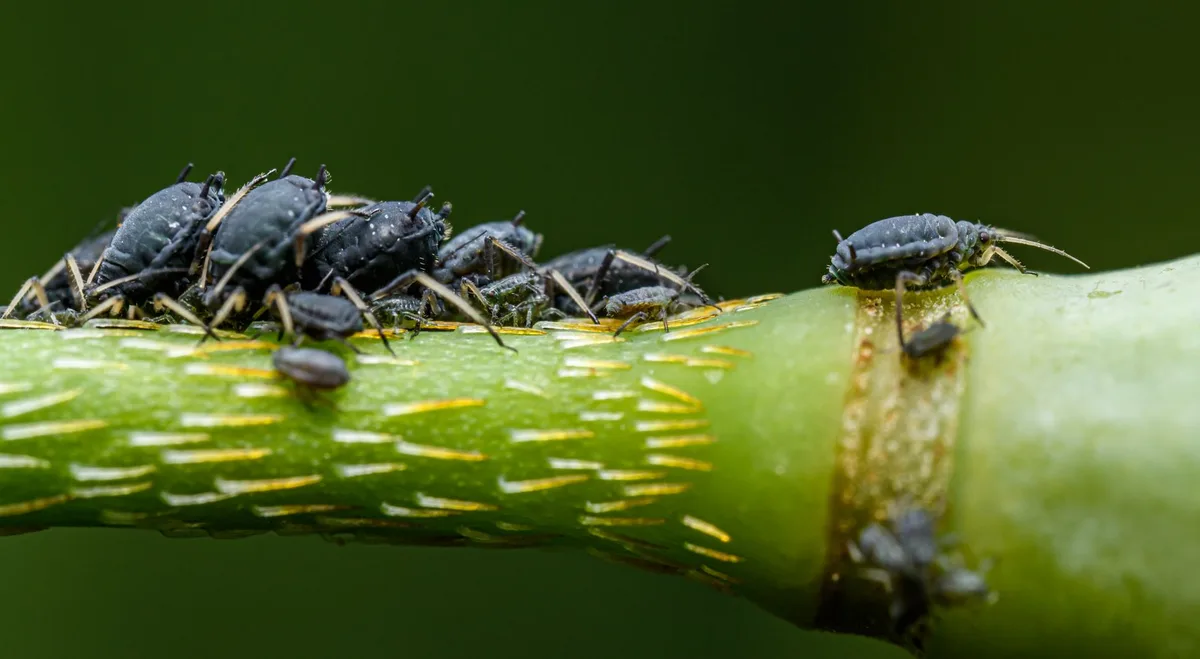
Green peach aphids, black bean aphids, and rose aphids are easy to spot. They cluster on new growth and leaf undersides. Root aphids are harder to detect.
You'll see stunted growth, wilting, and yellowing without any visible pests above ground. When you pull the plant up, you'll find white, waxy aphids clinging to the roots.
Root aphids require soil drenches or systemic treatments. Foliar sprays won't reach them. Use a product labeled for soil application, or apply beneficial nematodes that target root-feeding pests.
Reapply as directed, and monitor for improvement over the next few weeks.
Woolly aphids are another special case. They're covered in a white, waxy coating that repels water-based sprays. Insecticidal soap and neem oil don't penetrate the wax effectively.
Horticultural oil works better, or you can use a systemic insecticide if the infestation is severe.
Knowing what you're dealing with matters. If you're not sure, take a sample to your local extension office or snap a clear photo and post it to an identification forum. Once you know the species, you can choose the right treatment and stop wasting time on methods that won't work.
Root Aphids vs Foliar Aphids: Why Your Spray Isn't Working
Root aphids are often mistaken for nutrient deficiencies or fungal root rot. The symptoms overlap, and most gardeners don't think to check the roots. If you're treating with best plant fertilizer for indoor plants and the plant still looks weak, dig around the base and inspect the root zone.
Root aphids are pale gray, yellow, or white. They cluster near the crown and along feeder roots. They're often accompanied by ants, which farm them just like foliar aphids.
If you see ants around the base of a wilting plant, suspect root aphids.
Treat with a soil drench of insecticidal soap or neem oil, or apply imidacloprid as a systemic drench if you're dealing with a heavy infestation. Water the product in thoroughly so it reaches the root zone. Repeat every 7 to 10 days until the plant recovers and new growth appears healthy.
Mistake #8: Over-Fertilizing With Nitrogen and Creating Aphid Magnets
High nitrogen fertilizer produces lush, tender growth that aphids love. That soft tissue is easier to pierce and packed with amino acids. If you're feeding your plants heavily and seeing repeated aphid outbreaks, you're creating the problem.
Cut back on nitrogen during peak aphid season. Switch to a balanced or low-nitrogen fertilizer, especially for ornamentals and vegetables. Let plants grow at a moderate pace instead of pushing them with heavy feeding.
Mistake #9: Skipping the Test Spray on Sensitive Plants
Always test any spray on a single leaf before treating the whole plant. Wait 24 to 48 hours and check for discoloration, spotting, or wilting. If the test leaf looks fine, proceed with the full application.
Which Plants Show Phytotoxicity Fast
Japanese maples, ferns, succulents, and many flowering annuals are sensitive to oils and soaps. Blue-gray foliage plants often show damage because the waxy coating reacts with sprays. If you're treating something you've never sprayed before, test first.
Mistake #10: Not Monitoring After Treatment
Check your plants three, seven, and fourteen days after treatment. Look for new aphids, sticky residue, or curling leaves. Early detection of a rebound lets you reapply before the population explodes again.
The Decision Tree: Which Treatment Method Based on Your Situation
Early Infestation + Beneficial Insects Present
Use water spray or insecticidal soap. Avoid broad-spectrum products. Release more ladybugs if needed.
Heavy Infestation + No Beneficials
Use neem oil or a contact pyrethrin spray. Follow up every 5 to 7 days. Consider systemics for extreme cases.
Indoor Plants or Edibles Close to Harvest
Stick with insecticidal soap or water spray. Check pre-harvest intervals on any product you use.
Greenhouse or Hydroponic Setup
Release parasitic wasps or lacewings. Monitor daily. Use soap sprays only as needed.
When to Escalate: Moving from Water Spray to Systemics
Start with the least toxic option. If water spray and soap fail after two cycles, move to neem oil. If neem oil doesn't work, consider a systemic like imidacloprid for ornamentals or fruit trees outside the bloom period.
How to Build an Aphid Monitoring Routine That Actually Prevents Outbreaks
Inspect plants twice a week during the growing season. Check new growth, leaf undersides, and stems. Use yellow sticky traps near best grow light for seedlings setups to catch winged aphids early.
Keep notes on which plants get hit first so you can focus monitoring there next season.
Frequently Asked Questions
Can I use higher concentrations to kill aphids faster?
No. Higher concentrations increase the risk of phytotoxicity without improving kill rates. Insecticidal soap and neem oil work by contact, not by dose.
Follow label directions exactly, and focus on thorough coverage instead of stronger mixes.
How do I know if I killed beneficial insects by mistake?
Check for dead ladybugs, lacewings, or wasps near treated plants within a few hours of spraying. If you see them, you've likely hit them with the spray. Wait two weeks before releasing new beneficials, and switch to a less toxic product next time.
Do I need to rinse insecticidal soap off my plants?
Not usually. Most plants tolerate dried soap residue without issue. If you're treating sensitive species like ferns or Japanese maples, rinse gently with plain water an hour after application to reduce the chance of leaf burn.
Why do aphids keep coming back after I spray?
You're either missing follow-up applications, not covering leaf undersides, or dealing with ants that are reintroducing aphids. Treat every 5 to 7 days for three cycles, spray from multiple angles, and control any ant activity around the plant.
Is neem oil or insecticidal soap better for aphids?
Both work. Soap acts faster and rinses off easily. Neem oil has mild residual activity and also disrupts aphid molting.
Use soap for light infestations and neem for moderate to heavy pressure. Avoid using either in temperatures above 80°F.
Can I spray aphids in the middle of summer heat?
Only in early morning or late evening when temperatures drop below 80°F. Midday spraying in heat causes phytotoxicity, especially with oils and soaps. Wait for cooler conditions or risk damaging your plants worse than the aphids ever could.