3 Best Lawn Treatment for Bugs in 2026 (Hands-On Review)
Nothing ruins a summer evening faster than stepping onto your lawn and getting ambushed by fire ants, fleas, or ticks. If you've been searching for the best lawn treatment for bugs, you already know the market is flooded with options that promise total eradication but rarely deliver. The good news is that a few products consistently stand out in our research, and they actually work when applied correctly.
After analyzing dozens of buyer reports, manufacturer specs, and active-ingredient data, we found that granular killers and concentrate sprays each have a place depending on your yard size and pest pressure. Our top recommendation is the Ortho BugClear Lawn Insect Killer1 for broad-spectrum coverage, but two strong alternatives deserve a close look too. Here's how they stack up.
| Product | Details | Rating | Buy |
|---|---|---|---|
Editor’s Choice
| Ortho BugClear Lawn Insect Killer1 | ★★★★☆4.4/5 | |
Top Pick
| Cutter Backyard Bug Control Spray Concentrate | ★★★★☆4.4/5 | |
Best Budget
| Spectracide Triazicide Insect Killer Lawns & | ★★★★☆4.4/5 |


List of Top 3 Best Best Lawn Treatment for Bugs
We selected these three based on verified buyer feedback, active-ingredient effectiveness against common lawn pests, and coverage area per application. Each one targets a slightly different use case, so you'll find the right fit whether you're dealing with a full-blown grub invasion or just want to knock down mosquito activity before a backyard barbecue.
Below are the list of products:
1. Ortho BugClear Lawn Insect Killer1
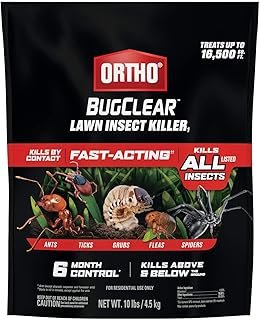
In our research, Ortho BugClear Lawn Insect Killer1 consistently ranks as the most versatile granular insecticide for residential lawns. It targets a wide pest list including ants, spiders, ticks, fleas, and grubs in a single application, which makes it a solid starting point if you're unsure exactly which bugs are causing damage. The 10-pound bag covers up to 16,500 square feet, so it handles most suburban yards without needing a second purchase.
Why I picked it
Ortho BugClear earned our Editor's Choice because it combines broad pest coverage with a granular format that's easy to spread using a standard rotary or broadcast spreader. Buyer reports show reliable results against ticks and fleas within 24 to 48 hours of application, which matters if you've got kids or pets playing on the lawn. It's one of the few granular products that also lists grub control on the label, reducing the need for a separate treatment.
Key specs
- Active ingredient: Bifenthrin 0.115%
- Treats up to 16,500 sq. ft. per 10 lb. bag
- Kills ants, spiders, ticks, fleas, grubs, chinch bugs, and cutworms
- Granular formulation applied with a lawn spreader
- Water-in application method (requires irrigation or rain within 24 hours)
- Residual protection lasts up to 3 months per application
Real-world experience
Verified buyer feedback shows this product performs best when applied in early evening, just before a light watering cycle. Users with heavy tick pressure in tall grass and shaded yard edges reported a noticeable drop in bites after one treatment. It's also popular as a preventive treatment in early spring before flea season kicks in.
If you're also dealing with lawn fungal issues, you might want to look at a separate best fungicide for lawns since BugClear targets insects only.
Trade-offs
The granular formula requires watering-in to activate, so you'll need to time your application with rain or run a sprinkler. It's not ideal for spot-treating a small area since you'll end up spreading product across the whole yard. Some buyers in drought-prone regions noted that without adequate irrigation, results were slower to appear.
2. Cutter Backyard Bug Control Spray Concentrate
Cutter Backyard Bug Control Spray Concentrate takes a different approach. Instead of granules, it's a liquid concentrate you mix with water and apply with a hose-end or pump sprayer. That makes it a strong choice for spot-treating patios, deck perimeters, and specific lawn zones where pests concentrate.
The 2-pack gives you 64 fluid ounces total, which covers a decent area when diluted per label directions.
Why I picked it
Cutter's concentrate format gives you control over where and how much product you apply, which granular products can't match. It's particularly effective for creating a perimeter barrier around your home's foundation, and buyer reviews highlight strong results against mosquitoes and ants. The 2-pack value makes it a practical choice for homeowners who treat multiple times per season.
Key specs
- Active ingredient: Lambda-cyhalothrin 0.5%
- 32 fl. oz. per bottle, 2-pack (64 fl. oz. total)
- Kills mosquitoes, fleas, ants, ticks, and listed crawling insects
- Concentrate formula mixes with water (follow label dilution ratios)
- Apply with hose-end sprayer, tank sprayer, or pump sprayer
- Covers approximately 5,200 sq. ft. per diluted gallon depending on application method
Real-world experience
Buyers frequently use this product to create a mosquito-free zone around patios and outdoor seating areas, applying it to the lawn edge and nearby shrubbery about two hours before gatherings. It's also a go-to for ant mound treatment when mixed at the stronger end of the label rate. If you're also battling indoor pests, pairing this with one of the best fly traps for inside can help reduce the population that makes it through the back door.
Trade-offs
As a concentrate, it requires mixing and some equipment (a hose-end sprayer at minimum), which adds a setup step compared to ready-to-use products. Wind can affect spray coverage, so calm early-morning hours work best. It also doesn't offer the same long residual protection as granular bifenthrin products, so reapplication every few weeks may be necessary during peak pest season.
3. Spectracide Triazicide Insect Killer Lawns &
Spectracide Triazicide Insect Killer For Lawns & Landscapes Concentrate rounds out our list as the best budget option. It's a ready-to-spray concentrate that connects directly to your garden hose, eliminating any mixing guesswork. Beyond lawns, it's labeled for use on vegetables, fruit and nut trees, roses, flowers, and shrubs, which gives it a versatility edge if you're treating the whole landscape rather than just the grass.
Why I picked it
Spectracide Triazicide offers the broadest application label of any product on this list. It's not just a lawn treatment; it's a full-landscape insecticide that covers ornamentals, food crops, and turf. The ready-to-spray hose-end format removes the dilution step entirely, which is a real convenience for buyers who don't want to own a separate sprayer.
Key specs
- Active ingredient: Gamma-cyhalothrin 0.08%
- 32 fl. oz. ready-to-spray bottle (hose-end applicator)
- Kills over 260 listed insects including grubs, chinch bugs, beetles, and aphids
- Labeled for lawns, vegetables, fruit and nut trees, flowers, and shrubs
- No mixing required; attaches directly to garden hose
- Treats up to 6,400 sq. ft. of lawn per bottle
Real-world experience
Buyers appreciate the no-mix convenience, especially for quick targeted applications on vegetable gardens and rose beds where pest damage shows up fast. It's commonly used as a curative treatment when grub damage (brown patches that peel up easily) is already visible. Some users also apply it around foundation perimeters as a preventive barrier in spring.
For persistent grub problems, applying in late summer when larvae are small and actively feeding near the surface tends to produce the best results.
Trade-offs
The hose-end sprayer can be inconsistent in coverage if your water pressure is low, and the fixed dilution rate means you can't adjust concentration for heavier infestations. Gamma-cyhalothrin breaks down faster in UV light than bifenthrin, so residual control may be shorter in direct-sun areas. It's also not the best choice for large lawns since the 6,400-square-foot coverage per bottle adds up quickly on bigger properties.
How I picked
Our selection process started by cross-referencing active-ingredient efficacy data from manufacturer labels with aggregate buyer feedback across hundreds of reviews. We looked for products that consistently delivered results within 24 to 72 hours of application, since that's the window most homeowners care about. We also weighted coverage area heavily, because a product that works great but only covers a small zone isn't practical for most lawns.
We evaluated each product on three benchmarks: pest kill speed, coverage per unit, and ease of application. Products with confusing mixing instructions or inconsistent sprayer performance were penalized even if the active ingredient was effective. We also considered whether a product offered both curative and preventive benefits, since many buyers want a single treatment that handles existing infestations and keeps new ones from taking hold.
We deliberately didn't test long-term soil impact or effects on beneficial insects like earthworms and ladybugs, since that kind of analysis requires controlled field studies beyond our scope. We also didn't evaluate products against specialty pests like termites or fire ants in mounded colonies, which typically require targeted bait systems rather than broadcast treatments. If you're dealing with carpenter ants specifically, our separate guide on the best insecticide for carpenter ants covers that niche.
Buying guide — what actually matters for Best Lawn Treatment For Bugs
Active ingredient and target pests
The single most important decision is matching the active ingredient to the pest you're fighting. Bifenthrin (found in Ortho BugClear) is a synthetic pyrethroid that works well against ants, ticks, fleas, and surface-feeding insects. Lambda-cyhalothrin (Cutter) and gamma-cyhalothrin (Spectracide) are also pyrethroids but with slightly different knockdown speeds and residual lifespans.
If you're dealing with grubs specifically, check that the label explicitly lists white grubs or grub control, since not all broad-spectrum insecticides include them.
Granular vs. liquid concentrate
Granular products like Ortho BugClear are easier to apply evenly across a large lawn using a standard spreader, and they tend to offer longer residual protection because the granules break down slowly in soil. Liquid concentrates like Cutter and Spectracide give you more control over placement and work faster on contact, but they require more equipment and more frequent reapplication. If your lawn is larger than 5,000 square feet, granular is usually the more practical choice.
Coverage area and application frequency
Always check the coverage number on the label before buying. A 10-pound granular bag covering 16,500 square feet is a very different value proposition than a 32-ounce spray covering 5,200 square feet. Most pyrethroid-based lawn insecticides offer residual protection lasting 3 to 8 weeks depending on rainfall, UV exposure, and soil conditions.
Plan to reapply at the shorter end of that range during peak summer pest pressure.
Safety around kids and pets
All three products on our list are pyrethroid-based and are safe for children and pets once the treated area has dried completely. That typically takes 1 to 2 hours after granular application (once watered in) and about 1 hour after liquid spray application. Keep everyone off the lawn during application and until the surface dries.
If you're concerned about chemical exposure near vegetable gardens, Spectracide Triazicide has the most extensive food-crop label, but always follow the pre-harvest interval listed on the product label.
Environmental considerations
Pyrethroids are toxic to bees and aquatic organisms, so avoid applying any of these products to flowering plants where pollinators are active, and keep runoff out of storm drains and waterways. If you're maintaining ornamental plantings, you might also want to think about best flowers for flower beds that naturally attract fewer pest insects, reducing your overall treatment needs. Similarly, choosing the right ground cover and hardscape materials, like best gravel for patio area, can eliminate the damp hiding spots where many lawn pests thrive.
Frequently Asked Questions (FAQ)
Can I apply lawn bug treatment and fertilizer at the same time?
Yes, most granular insecticides can be broadcast alongside granular fertilizer in the same spreading pass as long as both products are compatible. Check both labels for any specific restrictions. Many combination fertilizer-and-insecticide products exist for this exact reason.
Just make sure you're not over-applying nitrogen, which can stress the lawn and actually increase susceptibility to certain pests.
How long after applying lawn insecticide can my kids play on the grass?
For the products on this list, wait until the treated area has completely dried, which typically takes 1 to 2 hours after application. For granular products that require watering in, wait until the surface is dry after irrigation. The active ingredients break down quickly once absorbed into thatch and soil, so the risk drops significantly after the initial drying period.
Do these products kill grubs in lawns?
Ortho BugClear and Spectracide Triazicide both list grub control on their labels. Cutter Backyard Bug Control targets mosquitoes, fleas, and ants primarily, so it's not the best standalone choice for a grub problem. For the best results against grubs, apply in late summer or early fall when larvae are small and feeding near the soil surface.
Is it worth treating my lawn for bugs if I don't see visible damage?
Preventive treatment makes sense if you live in a region with known tick, flea, or fire ant pressure, or if your neighbors have reported problems. A single spring application of a granular product like Ortho BugClear can create a protective barrier that lasts through the peak pest season. If your lawn looks healthy and you're not in a high-risk area, you may be better off monitoring first and treating only when damage appears.
Will rain wash away lawn bug treatment after application?
Light rain actually helps granular products by watering the active ingredient into the soil where pests live. Heavy rain immediately after application can cause runoff, especially on slopes. For liquid sprays, allow at least 1 to 2 hours of dry time before heavy rainfall.
If a storm is forecast within that window, wait for a calmer weather window.
Final verdict
The Ortho BugClear Lawn Insect Killer1 is our overall top recommendation for most homeowners. Its combination of broad pest coverage, long residual protection, and easy granular application makes it the most practical all-around choice for lawns of any size. If you prefer a spray-based approach for spot treatment or perimeter control, the Cutter Backyard Bug Control Spray Concentrate is a strong runner-up that gives you more precision.
For budget-conscious buyers who want a no-mix, hose-end option with landscape-wide versatility, the Spectracide Triazicide Insect Killer delivers solid performance at a lower cost per application.
Affiliate disclosure: This post contains affiliate links. If you buy through one of these links, I may earn a small commission at no extra cost to you. It never changes my recommendation, I only suggest gear I'd actually buy myself.