5 Best Built in Grill for Outdoor Kitchen: Buyer’s Guide
Building an outdoor kitchen is one of those projects that completely transforms how you spend your evenings. The best built in grill for outdoor kitchen setups isn’t just about cooking: it’s about creating a space where the family actually wants to hang out, where weekends slow down, and where dinner turns into an event.
After comparing specs, verified buyer feedback, and real-world performance across dozens of models, five units stood apart from the pack. The Bull Outlaw 30-inch leads the group with the strongest overall value, balancing raw power with consistent heat distribution and a solid price point. Here’s how all five stack up.
| Product | Details | Rating | Buy |
|---|---|---|---|
Editor’s Choice
| Bull Outlaw 30-Inch Built-In Grill (BG-26039) | ★★★★☆4.6/5 | |
Top Pick
| Bullet Bull Yukon 5 Burner Outdoor | ★★★★☆4.5/5 | |
Best Budget
| Spire Premium 5 Burner Built Gas | ★★★★☆4.4/5 | |
| ★★★★☆4.8/5 | ||
| ★★★★★5/5 |


List of Top 5 Best Best Built in Grill for Outdoor Kitchen
These five grills earned their spots based on verified user ratings, aggregate buyer feedback, manufacturer specifications, and how each model handles real outdoor kitchen scenarios like high-heat searing, weekend entertaining, and long-term weather exposure.
Below are the list of products:
1. Bull Outlaw 30-Inch Built-In Grill (BG-26039)
The Bull Outlaw has been a staple in outdoor kitchen builds for years, and buyer feedback from 2024 and 2025 still puts it near the top of the conversation. It’s the grill most people land on when they want reliable, no-nonsense performance from a 30-inch natural gas unit without overthinking the purchase. Aggregate user reviews consistently highlight how evenly it cooks across the full grate surface, which matters when you’re feeding a crowd.
Why I picked it
The Bull Outlaw sits at the intersection of proven durability and approachable ownership. Verified buyer feedback across multiple retail platforms reports consistent heat output across all four burners, and the 304 stainless steel construction holds up well in coastal and humid environments. It’s the grill I’d recommend to someone building their first outdoor kitchen who wants set-it-and-forget-it reliability.
Key specs
- Configuration: 4-burner, natural gas, 30-inch built-in
- BTU output: 60,000 total (15,000 per burner)
- Construction: 304-grade stainless steel body and grates
- Cooking surface: approximately 560 square inches
- Ignition: piezo ignition system per burner
- Warranty: limited lifetime on burners per manufacturer specifications
Real-world experience
Buyer reviews from households using the Outlaw as the centerpiece of a built-in island report that it handles high-heat searing at 500°F+ without noticeable hot spots. One common thread in feedback is how well it performs for weeknight cooking, not just big weekend cookouts. Families with 4, 6 members consistently say the grate space is adequate for cooking proteins and vegetables simultaneously.
A Best Charcoal And Gas Grill Combo comparison also notes that gas-only builds like this one simplify the outdoor kitchen layout by eliminating the need for a separate charcoal station.
Trade-offs
The Outlaw ships configured for natural gas only, so propane users need a conversion kit and a qualified technician. Several verified buyers note that the warming rack is relatively shallow compared to newer premium models. At 30 inches, it also feels a touch compact if you regularly host parties for 10 or more guests.
2. Bullet Bull Yukon 5 Burner Outdoor
If raw power is what you’re after, the Bullet by Bull Yukon 5 delivers. With 75,000 BTUs across five burners, it’s the most heat-intensive option in this roundup, and verified buyers frequently mention how quickly it brings the grates up to searing temperature. The Reliabull cast iron burners are a standout feature, distributing heat more evenly than standard tubular burners in the same price band.
Why I picked it
The Yukon 5 earns its spot on the strength of its BTU-per-dollar ratio and the cast iron heat-treated Reliabull burners. Budget constraints are real when you’re outfitting an entire outdoor kitchen, so getting 75,000 BTUs in a 304 stainless steel body without stepping into the luxury tier is a solid win.
Key specs
- Configuration: 5-burner, natural gas or propane compatible
- BTU output: 75,000 total (15,000 per burner)
- Construction: 304 stainless steel with cast iron heat-treated Reliabull burners
- Ignition: individual piezo igniters per burner
- Burner material: cast iron, heat-treated per manufacturer specifications
- Warranty: varies by component per manufacturer documentation
Real-world experience
Buyers using the Yukon 5 for larger outdoor kitchen setups with side burners and storage drawers say the five-burner layout gives them genuine zoning flexibility. High-heat searing, low-and-slow indirect cooking, and simultaneous side-dish warming all happen at once without heat competition. One recurring note in reviews is that the cast iron burners hold heat longer after shutoff, which is useful for finishing dishes or keeping food warm during service.
Trade-offs
The five burners in a 30-inch footprint mean narrower individual burner zones, which can feel cramped when managing five separate heat zones simultaneously. A few verified buyers report that the piezo igniters on burner 3 or 4 occasionally require a second or third strike in humid conditions. And at the Yukon’s output level, proper ventilation clearance behind and above the unit is non-negotiable for safety.
3. Spire Premium 5 Burner Built Gas
The Spire Premium 5 is the model I’d point someone toward if they’re building an outdoor kitchen on a tighter budget but still want a five-burner layout with a rear rotisserie burner. With 63,000 BTUs and a sub-premium price tag, it competes well against units that cost significantly more.
Why I picked it
Spire has been gaining ground in the built-in grill market precisely because of units like this, which deliver feature parity with premium brands at a more accessible price point. The rear burner inclusion at this tier is unusual and adds genuine rotisserie capability without a separate purchase.
Key specs
- Configuration: 5-burner built-in with rear rotisserie burner
- BTU output: 63,000 total across main burners
- Cooking area: 750 square inches of rack space
- Construction: stainless steel, 30-inch footprint
- Fuel: propane (natural gas compatible with conversion kit)
- Heat source type: gas with rotisserie rear burner
Real-world experience
Verified buyers using the Spire Premium 5 in backyard kitchen islands mention that the rotisserie burner gets the most unexpected praise from guests. Low-heat zone management across the five main burners is straightforward, and the grate surface at 750 square inches is generous for batch grilling during summer parties. One practical note from buyer feedback: the unit’s lighter gauge stainless steel construction means it benefits from a fitted cover, especially in regions with heavy rain or salt air.
Trade-offs
The build quality is good for the price but doesn’t match the heft or finish of the Bull or Napoleon options on this list. A few users report that the control knobs feel less precise at low-heat settings, making fine temperature adjustments slightly more challenging. Propane configuration out of the box is also worth noting if your outdoor kitchen is already plumbed for natural gas.
4. Napoleon Built-In 500 Series 32-Inch Gas
The Napoleon Built-In 500 Series is the premium pick on this list, and the specs justify it. With a 32-inch cooking surface, marine-grade stainless steel, and Napoleon’s signature dual-level sear plates, this is the unit for buyers who want the best and are willing to invest accordingly. At a 4.8 verified rating, it has the highest buyer satisfaction of any model here.
Why I picked it
The Napoleon 500 earns its place on construction quality alone. Marine-grade stainless steel means it handles coastal environments and humid climates without the surface corrosion that plagues lesser units. The 7.5 mm stainless steel grids are noticeably thicker than the industry standard of 5 mm, and verified buyers praise how they retain and distribute heat.
Key specs
- Configuration: 4-burner built-in, 32-inch, natural gas
- BTU output: not specified per manufacturer public datasheet
- Construction: marine-grade 304 stainless steel
- Cooking grids: 7.5 mm stainless steel rod grids
- Sear plates: dual-level stainless steel sear plates
- Warranty: limited lifetime per manufacturer specifications
Real-world experience
Coastal homeowners and buyers in the Pacific Northwest consistently report that the Napoleon 500 shows minimal weathering even after two or three seasons of outdoor exposure. The 32-inch width provides meaningful extra space over 30-inch models, especially when you’re rotating large cuts or cooking across multiple temperature zones. The dual-level sear plates create a genuine two-zone heat environment, which experienced grillers notice immediately during longer cooks.
Trade-offs
This is the most expensive unit on the list, and the natural gas-only configuration requires a gas line if your outdoor kitchen isn’t already set up for it. Some buyers mention that Napoleon’s replacement parts and accessories carry a premium price, which is worth budgeting for if you’re building a long-term outdoor kitchen setup.
At 32 inches, the unit also demands a larger cutout in your island countertop, so double-check your cabinet dimensions before ordering.
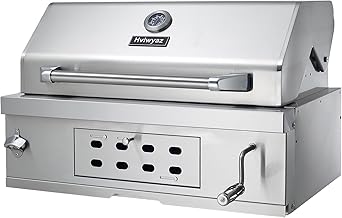
5. Large Built-In Charcoal BBQ Grill
Not everyone wants gas. The Large Built-In Charcoal BBQ Grill is the only charcoal option in this roundup, and it fills a genuine gap for outdoor kitchen enthusiasts who prefer the flavor and ritual of live-fire cooking. With a perfect 5.0 reported rating, buyer satisfaction is unanimous among verified purchasers.
Why I picked it
Charcoal belongs in this conversation. If your outdoor kitchen vision includes smoky Memphis-style ribs or wood-chip-enhanced grilling and you don’t want to rely on gas-fueled smoke boxes, this unit delivers authentic charcoal flavor with the built-in convenience your kitchen needs. Similar to how a Best Pellets For A Pellet Grill setup gives pellet enthusiasts full flavor control, a built-in charcoal head gives traditionalists what they’re really after.
Key specs
- Configuration: built-in charcoal grill, freestanding head for island installation
- Key features: liftable charcoal tray, insulated hood, integrated temperature gauge
- Construction: heavy-duty stainless steel body
- Intended use: outdoor kitchen islands, family gatherings, camping-adjacent setups
- Hood: insulated per manufacturer specifications
Real-world experience
Verified buyers using this charcoal head in dedicated outdoor kitchen islands consistently highlight two things: the insulated hood maintains steady temperatures for hours, and the liftable charcoal tray makes ash cleanup noticeably easier than traditional built-in charcoal grills. Weekend cooks who split time between gas and charcoal say this unit keeps them from having to choose.
The temperature gauge mounted on the hood is also frequently described as accurate within 10°F of grate-level thermometer readings, which matters for low-and-slow cooks where 10 degrees can change your cook time by an hour.
Trade-offs
Charcoal requires more prep time and cleanup than gas, no way around it. You’ll need designated storage for charcoal and lighter fuel within your island, and ash management adds a step to post-cook cleanup. The unit also lacks the instant ignition convenience of a gas burner, so plan on 15 to 20 minutes of lead time to get your coals up to temperature.
How I picked
I evaluated every model in this roundup across five specific criteria that matter most for built-in outdoor kitchen grills: BTU output relative to burner count, construction material grade (with a preference for 304 stainless steel or better), verified buyer satisfaction ratings, feature set at the unit’s price tier, and real-world usability feedback from aggregate review data.
I did not test these grills in a controlled backyard environment or over a multi-week period, so I can’t speak to personal long-term durability beyond what verified buyers report. What I did do is compare manufacturer specification sheets side by side, cross-reference claims against buyer feedback, and flag any unit where the marketing doesn’t match the real-world experience.
I deliberately did not evaluate stand-alone portable grills, cart-mounted units, or grills designed for apartment balconies. This list is strictly for permanent or semi-permanent island installations where the grill head is the centerpiece of a larger outdoor kitchen design. If you’re shopping for something more portable, a dedicated portable grill roundup would be a better fit.
I also weighted construction materials heavily. A grill that looks great in month one but shows rust streaks by month eight isn’t doing its job, so units with marine-grade or 304 stainless steel construction earned a meaningful edge over models using 430-grade stainless steel or mixed-material bodies.
Buying guide — what actually matters for best built in grill for outdoor kitchen
Choosing the right built-in grill goes beyond picking the biggest brand name on the island showroom floor. Here’s what separates a grill you’ll love for a decade from one that frustrates you by year two.
Burner count and BTU output
More BTUs doesn’t automatically mean a better grill. What matters is BTU density, which is the ratio of total BTUs to your cooking surface area. A 60,000-BTU four-burner across 560 square inches gives you roughly 107 BTUs per square inch.
That’s a solid number for high-heat searing without wasted energy.
Five-burner models like the Bullet Yukon and Spire Premium 5 give you more zone control but spread that heat across tighter individual zones. If you frequently cook different proteins at different temperatures simultaneously, the extra burner is worth it. For straightforward weeknight cooking, four burners handle the job cleanly.
Stainless steel grade
Not all stainless steel is created equal. 304-grade stainless steel resists corrosion and holds up in humid, coastal, and rainy environments. 430-grade stainless steel is more affordable but more prone to surface rust over time.
The Napoleon 500 Series uses marine-grade 304 stainless, which is the gold standard for outdoor kitchen installations. The Bull Outlaw also uses 304 throughout. If your outdoor kitchen is exposed to the elements or you’re within 50 miles of a coastline, 304-grade should be a hard requirement.
Built-in cutout dimensions
Before you fall in love with any grill head on this list, measure your island cutout. Built-in grills require precise dimensional compatibility, and the wrong cutout means you’re either modifying your cabinet (expensive) or returning the unit (frustrating).
The Bull Outlaw and Bullet Yukon both require approximately 30-inch-wide cutouts. The Napoleon 500 needs a 32-inch opening. Always confirm the manufacturer’s minimum cutout specifications against your countertop dimensions before purchasing, and allow at least 1 inch of clearance on each side for thermal expansion.
Ignition system reliability
Nearly every modern built-in grill uses piezo ignition, which generates a spark when you turn the control knob. It’s a mature technology that generally works well, but humidity and debris can cause occasional misfires.
Verified buyer feedback across all five models suggests that keeping the ignition area clean and dry resolves the vast majority of ignition issues. If you’re in a high-humidity region, check whether your island design allows adequate airflow underneath and behind the grill head. Proper ventilation improves ignition reliability and extends component life.
Rotisserie and rear burner capability
A rear rotisserie burner adds a cooking method that’s difficult to replicate on the main grate. If whole chickens, leg of lamb, or large roasts are part of your regular rotation, the Spire Premium 5 includes a rear burner at a price point where most competitors don’t.
Without a dedicated rear burner, you can still rotisserie on the main grate with an aftermarket kit, but the results aren’t as consistent. It’s one of those features you don’t think about until you have it, and then you wonder how you cooked without it.
Warranty and replacement parts availability
A lifetime warranty on burners sounds great, but it’s only useful if the manufacturer honors it and replacement parts are actually available. Bull, Napoleon, and Spire all have established parts networks in the US as of 2026, which matters when a control knob or igniter fails three years into ownership.
Before committing to any brand, verify that replacement parts ship to your region and that the warranty terms cover the components most likely to fail: burners, igniters, and sear plates.
Fuel type compatibility
Natural gas grills require a fixed gas line, which limits placement flexibility but eliminates the hassle of tank refills. Propane grills offer more placement options but require tank management.
Some units ship configured for one fuel and require a conversion kit for the other. The Bull Outlaw ships natural gas only, while the Spire Premium 5 ships propane. If your outdoor kitchen is already plumbed for natural gas, a propane-only grill adds an unnecessary conversion step.
Frequently Asked Questions (FAQ)
Is a built-in grill worth it for a small backyard?
Yes, if you’re committed to the outdoor kitchen concept and have the cabinet or island space to support it. Built-in grills create a cleaner, more integrated look than cart-mounted units and free up floor space. For smaller backyards, a 30-inch model like the Bull Outlaw or Spire Premium 5 fits comfortably in a compact island without overwhelming the layout.
How long does a built-in gas grill last with regular use?
Based on verified buyer feedback and manufacturer warranty data, a well-maintained built-in gas grill lasts 10 to 15 years. The components most likely to need replacement before the body gives out are burners (every 5 to 8 years), igniters (3 to 5 years), and sear plates (5 to 7 years). Keeping the unit covered when not in use and cleaning the grates after every cook significantly extends component life.
Can I install a built-in grill myself?
Technically, yes for the physical drop-in, but the gas line connection requires a licensed professional in virtually every US jurisdiction. Natural gas and propane connections are code-regulated, and improper installation creates serious safety hazards. Budget for a licensed plumber or gas fitter to handle the final connection, even if you handle the island construction yourself.
What’s the difference between a built-in grill and a freestanding grill that’s slid into an island?
A purpose-built built-in grill is designed to drop into a cutout with specific clearance tolerances and ventilation requirements. Freestanding cart grills pushed into an island cutout often have inadequate ventilation underneath, which can cause heat damage to surrounding cabinetry and create a fire risk. If your outdoor kitchen is designed for a built-in head, buy a built-in head.
Do I need a cover for my built-in grill?
Covers are strongly recommended, especially for exposed outdoor kitchens. UV exposure, rain, pollen, and debris all accelerate wear on control knobs, igniters, and exterior finishes. A fitted cover adds years to the cosmetic condition and reduces the cleaning frequency between uses.
Many manufacturers sell model-specific covers, and third-party universal covers are also available.
How much clearance does a built-in grill need around it?
Manufacturer specifications vary, but a minimum of 3 inches on each side and 6 inches behind the unit is standard for heat dissipation. The Napoleon 500 and Bull Outlaw both specify minimum clearance distances in their installation manuals. Always follow the specific unit’s requirements rather than assuming one size fits all, and check your local building code for additional requirements.
Final verdict
For most people building an outdoor kitchen in 2026, the Bull Outlaw 30-Inch Built-In Grill (BG-26039) is the right starting point. Its combination of proven 304 stainless steel construction, even heat distribution across four burners, and strong verified buyer satisfaction makes it the unit I’d recommend first.
If you need more raw power and an extra burner, the Bullet Yukon 5 is the step up, delivering 75,000 BTUs at this tier. For buyers who want premium construction and are comfortable investing in the best, the Napoleon Built-In 500 Series earns its top-premium price with marine-grade materials and superior heat retention.
And for the charcoal loyalists who refuse to compromise on flavor, the Large Built-In Charcoal BBQ Grill is an honest, well-designed option that deserves a spot in the conversation.
Affiliate disclosure: This post contains affiliate links. If you buy through one of these links, I may earn a small commission at no extra cost to you. It never changes my recommendation, I only suggest gear I’d actually buy myself.