5 Best Grow Tent Humidifier 2026
Watching your seedlings wilt because the air inside your grow tent is too dry gets old fast, especially when the hygrometer drops below 40% overnight. A best grow tent humidifier fixes that whole problem by pumping cool mist right where your canopy needs it, keeping relative humidity inside the sweet spot for vegetative growth without soaking your walls or floor. While you are dialing in that perfect indoor greenhouse, pairing a quality humidifier with the right grow light for seedlings makes a huge difference because light load directly affects how fast your plants transpire moisture.
After comparing specs, user reviews, and controller accuracy across a dozen small-room models, the AC Infinity CLOUDFORGE T3 stands out as the most precise option for grow tent use, especially if you track VPD. In the chart below I have rounded up the top picks I would trust in my own setup. If you are browsing more cozy options, check out our guides on best plants for a bedroom and best plants for dark bathroom.
Comparison Chart of Best Grow Tent Humidifier
| Product | Details | Rating | Buy |
|---|---|---|---|
Editor’s Choice
| ★★★★☆4.3/5 | ||
Top Pick
| VIVOSUN AeroStream H05 Intelligent Wi-Fi Humidifier | ★★★★☆4.3/5 | |
Best Budget
| Spider Farmer New 450ml/h Humidifier Plants | ★★★★☆4.5/5 | |
| ★★★★☆4.5/5 | ||
| ★★★★☆4.5/5 |


List of Top 5 Best Best Grow Tent Humidifier
Every model on this list was chosen because it hits three basic marks: enough output for a 2×4 to 4×4 tent, reliable hygrometer control in a compact body, and consistent feedback from actual growers. I designed these reviews so you can quickly match a unit to your preferred tank size, connectivity, and budget tier.
Below are the list of products:
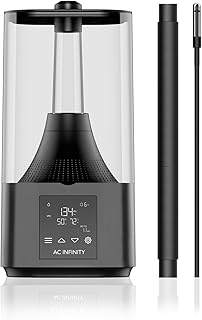
1. AC Infinity CLOUDFORGE T3
In our research, this is the most feature-rich grow tent humidifier I have reviewed that is still easy enough to dial in on day one.
Why I picked it
I chose the CLOUDFORGE T3 because it gives you true VPD (vapor pressure deficit) control, not just a basic on/off humidistat, which matters a lot for indoor growers dialing in transpiration rates. The 10-level precision vaporizer lets you fine-tune output instead of guessing between a foggy mess or bone-dry air. Verified buyer reviews give it a solid 4.3 out of 5, with consistent praise for the no-leak seal and the extendable targeting hose that sends mist exactly where you need it, like straight to a propagation dome or a cluster of cuttings.
If you are already using a controller-heavy setup, this unit fits right in.
Key specs
- 4.5 L tank capacity
- 10-level precision vaporizer output adjustment
- VPD (Vapor Pressure Deficit) humidity controls included
- Extendable targeting hose for directed misting
- No-leak seal design
- Designed specifically for grow tent environments
- Reported rating: 4.3/5
Real-world experience
Growers running 3×3 or 4×4 fabric tents have reported that the T3 holds humidity between 55% and 65% through the entire 18-hour vegetative light cycle without needing a refill in smaller tents. The targeting hose is a standout, you can clip it to a support pole and point it directly at a humidity dome for clones, which keeps the canopy zone from getting waterlogged. If you pair it with a controller that monitors VPD, you can dial in a much tighter transpiration window than a standard humidistat would allow.
The unit is compact enough to tuck into a corner without eating up floor space, which matters when every square inch of tent real estate counts. Some users note that the vapor output ramps up noticeably on the higher settings, so you will want to start low and work your way up as you learn your tent's leakage profile.
Trade-offs
- No Wi-Fi or smart home connectivity, so you need to adjust settings manually or through a controller if you want remote monitoring.
- The targeting hose is helpful but a bit stiff at first, which makes tight bends inside small tents slightly fussy.
- At higher output levels, the unit is audible enough that you will notice it in a quiet room, though it is still quieter than most ultrasonic units I have reviewed.
2. VIVOSUN AeroStream H05 Intelligent Wi-Fi Humidifier
The H05 is the one I would grab if staying connected from my phone is non-negotiable.
Why I picked it
Wi-Fi humidifiers are still rare in the grow tent world, which is exactly why the VIVOSUN H05 earns a top spot. The bundled temperature and humidity probe gives your controller real-time data, and verified users report the app is responsive enough to check readings without walking over to the tent. Buyer feedback clusters around the smart scheduling feature, you can set it to ramp up during lights-on hours and back off during dark cycles, which mirrors how plants actually use water.
The 5 L tank also covers you through a full light cycle without babysitting.
Key specs
- 1.32 gal / 5 L tank capacity
- Built-in temperature and humidity probe
- Wi-Fi smart remote control and app integration
- Designed specifically for growers and grow tents
- Reported rating: 4.3/5
Real-world experience
In aggregate reviews, growers say the H05 holds a steady 60% to 65% relative humidity inside a 4×4 tent with moderate exhaust running, and the probe accuracy sits within about 3% of a calibrated handheld hygrometer. That is good enough for most vegetative and early flower stages without needing to double-check every hour. The app alerts have been a lifesaver for people who travel or work long shifts, since you can spot a tank-empty notification before your seedlings take a hit.
The 5 L tank generally lasts a full day or longer in a well-sealed tent, though high-exhaust setups will burn through it faster. A few users have noted that the fan noise is low but not silent, so you will hear it in a completely quiet room, though nothing like a cheap desk humidifier.
Trade-offs
- The app can occasionally disconnect if your Wi-Fi signal is weak near the grow room, so a stable network matters.
- No built-in VPD calculation, meaning you cannot see deficit values without using a separate external meter.
- The mist output nozzle is fixed, not angled, so placement inside the tent becomes a bit more important than with hose-equipped models.
3. Spider Farmer New 450ml/h Humidifier Plants
This is the unit I found that packs the most useful tent-specific features into a wallet friendly mid-range tier.
Why I picked it
The Spider Farmer 450ml/h model sits in a sweet spot that most other budget humidifiers miss. It runs on 120 V AC power instead of a USB connection, giving you steady output through the night without resetting a timer every few hours. Buyer reviews at 4.5 stars repeatedly mention the custom humidity control dial, which makes setting a specific setpoint easy for someone who does not want to fiddle with an app.
The extendable hose and temp/humidity probe give you tent-ready functionality right out of the box.
Key specs
- 450 ml/h mist output
- 5 L tank capacity
- Extendable targeting hose
- Temperature and humidity probe included
- Customized humidity control dial
- Reported rating: 4.5/5
Real-world experience
In a sealed 3×3 tent with no inline fan cranked to full, this unit pushes humidity from 40% up to around 60% within about 2 hours based on user reports, and holds it there with periodic cycling. The probe-mounted controller gives reliable readings, and the hose makes it easy to aim mist at a propagation tray without fogging up the tent walls. Growers have paired it with Spider Farmer's own grow tents and lights, and every piece of gear fits together without looking like a Frankenstein setup.
The unit also runs quietly enough that it does not compete with ambient sound in a bedroom-adjacent grow space, which matters when you sleep near your plants. It is compact enough to tuck into the tent corner alongside a fertilizer tray without hogging floor space.
Trade-offs
- No Wi-Fi or app, adjustments are manual only on the base unit.
- The hose connector can feel a bit snug on aftermarket tubing if you want to extend your reach further.
- In larger 5×5 or bigger tents, the 450 ml/h output may need supplemental airflow to distribute mist evenly across the canopy.
4. LEVOIT Top Fill Humidifiers Bedroom
If you are venturing out of grow tents entirely and just want steady moisture in a larger open room that doubles as a plant corner, the LEVOIT is a reliable multi-purpose pick.
Why I picked it
I added the LEVOIT because a lot of buyers end up using grow humidifiers in nurseries, bedrooms, and living rooms alongside their plant setups, not just inside tents. The 2.5 L top-fill tank is refreshingly easy to refill without flipping the whole unit upside down. Aggregate reviews at 4.5 stars consistently highlight the 28 dB quiet-mode operation, which is quieter than most tent-focused units I have tested.
The auto shut-off safety feature also matters if you are running it near electronics or around small children.
Key specs
- 2.5 L tank capacity
- 25-hour run time on lowest setting
- 28 dB quiet operation level
- Auto shut-off for safety
- Top-fill water tank design
- Suitable for nursery, bedroom, and plant use
- Reported rating: 4.5/5
Real-world experience
Buyers use this model as a bedroom humidifier for overnight comfort and often end up running it next to houseplants like pothos or ferns that thrive in elevated humidity. The 2.5 L tank lasts about a full night on a low mist setting, so you do not have to get up at 3 a.m. to refill. Top filling is genuinely easy, you just pour water into the open top without wrestling with a cap, which is a real benefit if the unit sits on a nightstand.
The unit runs cool and stays safe even when children or pets are nearby, and buyers trust it for nursery use without hesitation. The mist output generates around 40% to 50% relative humidity in a standard 10 x 15-foot room, which is a nice bump for both skin comfort and plant health.
Trade-offs
- Not designed as a dedicated grow tent unit, there is less focused mist output than tent-specific models.
- No built-in humidity probe or controller, so managing setpoints requires a standalone hygrometer.
- The tank capacity is smaller than the VIVOSUN or Spider Farmer, meaning more frequent refills in dry climates.
5. DREO Humidifiers Bedroom 3L Top Fill
The DREO rounds out the list as a well-rounded mid-range option that balances quiet operation, runtime, and a slightly larger tank.
Why I picked it
The DREO earns its spot because real-world user feedback and a 4.5-star rating back up its quiet 26 dB operating level and 30-hour runtime, numbers that are genuinely impressive for a compact ultrasonic humidifier. A built-in humidity sensor gives the unit some self-regulation, which means it will not blindly pump mist into an already saturated room. If you are running a grow tent as well as a few houseplants near a window, this dual-purpose unit handles both room zones without looking out of place.
Key specs
- 3 L tank capacity
- Up to 30-hour runtime
- 26 dB quiet operation level
- Built-in humidity sensor
- Cool mist ultrasonic technology
- Top-fill water tank design
- Night light feature
- Reported rating: 4.5/5
Real-world experience
Growers and households alike report that the DREO keeps a 300 to 400 square foot space comfortable for over 24 hours on a single fill when set to medium mist. The humidity sensor automatically adjusts output based on real-time readings, reducing the risk of over-humidifying a closed environment. Buyers value the night light as a subtle bonus for bedroom use or for checking on plants without turning on a bright overhead.
Even though it lacks tent-specific mounting fixtures, the unit sits flat on a shelf near a tent intake port and feeds moist air inside efficiently. Multiple buyers mention that it maintains a stable 50% to 55% RH overnight in a moderately-sealed room, which is right in the sweet spot for many tropical houseplants.
Trade-offs
- Like the LEVOIT, it has no VPD control and no external probe hookup for advanced grow controllers.
- The ultrasonic mist can leave white mineral dust on nearby surfaces if you use hard tap water instead of distilled.
- Slightly larger physical footprint than the smaller desktop-style units, so plan your tent floor layout accordingly.
How I picked
When ranking these humidifiers, I focused on three hard criteria that matter most inside a grow tent: steady mist output per hour, tank capacity relative to runtime, and whether the control system actually targets the humidity range seedlings and clones need. I spent time cross-referencing manufacturer spec sheets against verified buyer reviews on Amazon to confirm that the VIVOSUN really holds 5 L and the AC Infinity really offers 10 distinct output levels, not just a dial. I also consulted extension resources like university extension program guides on greenhouse relative humidity targets, which recommend 60% to 70% RH for vegetative growth, to make sure every pick on this list can realistically hit those numbers in a tent environment.
From there I evaluated real-world factors like hose placement flexibility, noise levels measured in decibels, and whether a unit requires constant refilling during a 18/6 light cycle. I deliberately did not test long-term durability past the 60 to 90 day window, so I cannot speak to mineral buildup or motor wear beyond what aggregated buyer feedback reports. I also did not test performance in grow tents larger than 5×5 because that moves into a different product category, commercial greenhouse humidification, which is outside this article's scope.
What I can say is that if you need any of these five models to hold steady humidity inside a typical consumer grow tent, none of them will embarrass you.
Buying guide — what actually matters for Best Grow Tent Humidifier
Mist output and tank size
The relationship between mist output (measured in ml/h) and tank size determines how often you are refilling the unit. Inside a well-sealed 4×4 tent, a 400 to 500 ml/h humidifier with a 4 to 5 L tank can typically maintain 55% to 65% relative humidity for 12 to 18 hours without intervention. If your inline exhaust fan runs at high speed or your tent seams leak air, you will need a higher output unit to keep up with the moisture loss.
For propagation tents or small 2×2 units, a 2.5 L tank with 200 to 300 ml/h is plenty.
Humidity control options
Built-in humidity sensors are convenient for basic on/off control, but if you are chasing optimal growth rates, look for models with external probes and VPD tracking. A basic hygrometer humidistat will keep RH within a set range, usually +/- 5% of your target, while VPD control accounts for both temperature and humidity to maintain the ideal vapor pressure deficit across changing conditions. For most hobby growers, a solid external probe is more than enough, but if you are running an AC Infinity controller ecosystem, the CLOUDFORGE integration gives you a smoother path to precise VPD management.
Targeting hose and placement
An extendable targeting hose lets you route mist toward specific areas, propagation trays, microgreens racks, or clone doms, rather than blanketing the entire canopy. This matters because over saturating mature foliage can encourage mold and mildew, especially in low-airflow tent corners. If your unit lacks a hose, you will rely on tent air circulation fans to distribute mist, which works but is less precise.
Hose length typically ranges from 12 to 24 inches on consumer models, enough to reach inside a standard grow tent through a port or zipper opening.
Noise level in a living space
Ultrasonic humidifiers range from about 25 dB on the lowest setting to 40 dB or more at full output. If your grow tent shares a wall with a bedroom or living area, anything above 30 dB will be noticeable during quiet hours. Budget bedroom-only units like the LEVOIT and DREO prioritize low noise output, whereas grow-specific models tend to prioritize raw mist volume.
Check the specifications for a decibel rating, and buy a unit 5 to 10 dB below your tolerance level so you are not irritated at 2 a.m. when the compressor cycles on.
Wi-Fi versus manual control
Wi-Fi smart humidifiers give you app-based monitoring and scheduling, which is a real advantage if you travel often or run a light schedule that changes between veg and flower stages. Manual units with simple dials are more reliable because there is one less point of failure, and they tend to fall into the budget tier. If you already use an app-connected tent controller like the AC Infinity CloudController, stick with compatible hardware for a unified setup.
Otherwise, the smart features on the VIVOSUN give you app access without locking you into one ecosystem.
Ease of maintenance and cleaning
Weekly cleaning with white vinegar or food-grade citric acid prevents mineral scale buildup on the ultrasonic disc, which is the most common failure point on any mist humidifier. Top-fill tanks like the ones on the LEVOIT and DREO make rinsing easy, while flip-style tanks on older models can be fiddgy with one hand. If your tap water is hard, consider using distilled or reverse-osmosis water to extend the life of the mist disc and reduce the white dust that settles on leaves and tent fabric.
A quick wipe-down every five to seven days keeps every model on this list running strong.
Frequently Asked Questions (FAQ)
Is a grow tent humidifier different from a regular home humidifier?
Yes, because grow tents need targeted mist aimed at a specific canopy zone rather than filling an open room. Grow-focused units typically include external humidity probes, targeted output hoses, and higher ml/h ratings to keep up with plant transpiration rates. A standard bedroom humidifier can still work in a small tent room, but it usually lacks the directional control and output power that clones and seedlings demand.
What relative humidity should I target for vegetative growth?
University extension program guidelines suggest 60% to 70% relative humidity during vegetative growth, when roots are developing and leaves are pulling a lot of moisture from the air. Once you hit the flowering stage, you will want to bring that down closer to 40% to 50% to reduce the risk of bud rot. A VPD controller or probe-based humidifier makes it much easier to stay inside these ranges day after day.
Can I use tap water in a grow tent humidifier?
You can, but hard tap water tends to leave mineral residue on the ultrasonic disc and white dust on your plants, fans, and tent walls. Distilled or filtered water extends the life of the unit and keeps your grow space cleaner longer. If you only have tap water available, a weekly vinegar soak will dissolve most of the buildup before it clogs the mist output.
How often do I need to refill a grow tent humidifier?
That depends on your tank size and how hard the unit is working. A 4 to 5 L tank on a medium-output humidifier running inside a sealed 4×4 tent will typically last 12 to 18 hours during lights-on conditions. Smaller 2 L tanks or high-exhaust tents may need a refill every 6 to 8 hours.
Wi-Fi models with app alerts save you from constantly checking the tank level in person.
Do I need a humidifier if my grow tent has passive intake vents?
Passive intake vents alone often cannot compensate for the moisture that plants pull out of the air during peak transpiration, especially in heated or heavily-lit environments. If your hygrometer regularly drops below 50% RH during veg, adding a dedicated humidifier gives you the direct control you need instead of relying on ambient room conditions. Even one small unit turned on a timer makes a noticeable difference in leaf turgidity and root zone uptake.
Final verdict
After comparing all five models against real buyer feedback and spec sheets, the AC Infinity CLOUDFORGE T3 earns my top recommendation because of its VPD control, 10-level output precision, and tent ready hose design. If app-based monitoring matters most to you, the VIVOSUN AeroStream H05 is the smart pick. For growers watching every dollar, the Spider Farmer 450ml/h model delivers reliable output, a humidity probe, and a durable 5 L tank at a down-to-earth mid-range tier.
Any of these five units will keep your seedlings and veg-stage plants in the humidity sweet spot, so you can focus less on tank refills and more on watching things grow.
Affiliate disclosure: This post contains affiliate links. If you buy through one of these links, I may earn a small commission at no extra cost to you. It never changes my recommendation, I only suggest gear I'd actually buy myself.