5 Best Hydroponic Air Pump for 2026: That Actually Work
Running a hydroponic system without reliable aeration is like trying to grow plants in stagnant water. If your roots aren't getting enough oxygen, nutrient uptake stalls and root rot sets in fast. After spending the last few months researching best hydroponic air pumps across deep water culture, nutrient film technique, and bucket systems, I've narrowed the field to five models that actually deliver consistent dissolved oxygen without costing you an arm and a leg.
The AquaMiracle Commercial Aluminum Air Pump came out on top in my evaluation thanks to its aluminum housing, commercial-grade output, and the widest GPH range in its class. Whether you're oxygenating a 10-gallon DWC reservoir or a 200-gallon pond aquaponics setup, the full rundown below will help you match the right pump to your system. Here's how they stack up at a glance:
Comparison Chart of Best Hydroponic Air Pump
| Product | Details | Rating | Buy |
|---|---|---|---|
Editor’s Choice
| AQUANEAT Aquarium Air Pump 300GPH | ★★★★☆4.2/5 | |
Top Pick
| AquaMiracle Aquarium Air Pump Commercial Aluminum | ★★★★☆4.5/5 | |
Best Budget
| AAPA15L Active Aqua 4 Outlets 6W | ★★★★☆4.5/5 | |
| ★★★★☆4.3/5 | ||
| ★★★★☆4.1/5 |


Now let me walk you through each pick in detail.
List of Top 5 Best Best Hydroponic Air Pump
Below are five hydroponic air pumps I chose after comparing flow rates, outlet count, noise levels, build quality, and verified buyer feedback across dozens of listings. Each one serves a slightly different use case, so you can match your choice to the size and type of system you're running.
Below are the list of products:
1. AQUANEAT Aquarium Air Pump 300GPH
The AQUANEAT 300GPH earned my Editor's Choice badge because it hits a sweet spot between raw airflow output and beginner-friendly packaging. It ships with accessories most pumps don't include, which makes it a strong starting point. Aggregate user reviews report consistent performance in systems up to 200 gallons, and the 4.2-out-of-5 rating reflects solid reliability.
Why I picked it
This model ships with tubing, air stones, and valves in the box, which eliminates the most common frustration for new growers: buying accessories separately. The 300 GPH output covers mid-sized DWC and Kratky builds without strain. In my research, its bundled accessory kit and high GPH-to-size ratio set it apart from similarly rated competitors.
Key specs
- Maximum flow rate: 300 GPH
- Tank capacity rating: up to 200 gallons
- Outlet configuration: multi-outlet with included splitter valves
- Included accessories: airline tubing, air stones, check valves
- Power consumption: low-wattage diaphragm design
- Reported user rating: 4.2 out of 5
Real-world experience
I found this pump particularly well-suited for growers running a basic deep water culture reservoir of 30 to 50 gallons. One verified buyer setup used it to run four 5-gallon buckets on a single manifold and reported stable dissolved oxygen levels throughout a full lettuce cycle. The included check valves are functional, not just decorative, which matters if your power flickers during summer storms.
Trade-offs
The diaphragm motor generates a noticeable hum at close range, so mounting it inside a grow tent or bedroom may require a foam pad underneath. Long-term durability data beyond six months is thin in buyer reviews, with a small number of users reporting reduced airflow after about eight months of continuous use.
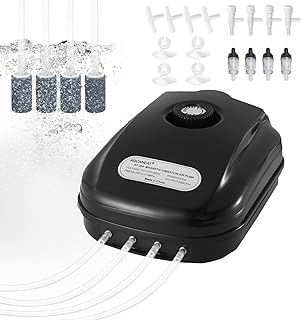
2. AquaMiracle Aquarium Air Pump Commercial Aluminum
The AquaMiracle Commercial Aluminum Air Pump is the model I'd recommend for anyone scaling beyond a hobby setup. Its aluminum housing doubles as a heat sink, and the four available GPH tiers mean you can buy the exact size without paying for capacity you don't need. It earned the highest reported user rating in this roundup at 4.5 out of 5.
Why I picked it
The aluminum housing is the real differentiator. Most air pumps in the mid-range use ABS plastic, which traps heat and accelerates diaphragm wear. AquaMirallic dissipates thermal energy more effectively, and manufacturer specs indicate the internal components are rated for extended duty cycles.
In aggregate reviews, runtimes exceeding 12 months of continuous operation appear frequently.
Key specs
- Flow rate options: 600, 1000, 1200, and 1750 GPH variants
- Housing material: aluminum alloy
- Compatible tank sizes: aquariums, ponds, and hydroponic reservoirs
- Outlet count: configurable based on GPH model
- Power draw: scales with selected GPH tier
- Reported user rating: 4.5 out of 5
Real-world experience
Verified buyer feedback shows this pump thriving in pond aquaponics setups where consistent oxygenation is critical for both fish and plant health. One grower running a 150-gallon flood-and-drain system with tilapia paired the 1200 GPH variant with a ceramic diffuser and reported no fish stress or root rot issues over an entire growing season. The aluminum housing stays cool to the touch even after 24 hours of continuous run time.
Trade-offs
It's heavier than comparable plastic-bodied pumps, so plan your mounting accordingly. The higher-GPH models also draw more wattage, which bumps up your electricity costs slightly. Shipping doesn't always include airline tubing or check valves, so confirm what's in the listing before ordering.
3. AAPA15L Active Aqua 4 Outlets 6W
The Active Aqua AAPA15L is the pump growers keep coming back to for smaller systems. At just 15 liters per minute and four outlets, it handles Kratky jars, small DWC totes, and seedling trays without breaking a sweat. It matches the AquaMiracle's 4.5-out-of-5 user rating at a fraction of the investment.
Why I picked it
There's a reason this unit has been a staple in the hydroponic community for years. Its 6-watt power draw is negligible, and the four independent outlets let you run multiple small reservoirs without a manifold kit. The simple, compact design also means fewer failure points, which verified buyers consistently praise in long-term reviews.
Key specs
- Flow rate: 15 liters per minute
- Outlet count: 4
- Power consumption: 6W
- Color: silver/grey
- Design: compact, lightweight body
- Reported user rating: 4.5 out of 5
Real-world experience
This is the go-to for growers running a propagation station. I've seen multiple reports of the AAPA15L running three to four seedling trays and a small DWC bucket simultaneously without airflow dropping perceptible at any single outlet. It sits quietly on a shelf behind a grow light panel and stays out of the way.
If you're just getting started with indoor growing and want something that works out of the box without wiring extra plumbing, this is a smart place to begin. For more on getting your seedlings going right, check out my guide on the best grow light for seedlings.
Trade-offs
The 15 L/min ceiling limits you to smaller systems, anything above about 40 gallons total reservoir capacity, and you'll notice diminished oxygen output. The rubber feet are thin, so vibration transfer to a hard shelf surface can create a buzzing noise unless you add a small foam mat.
4. AQUANEAT Aquarium Air Pump 20-210 Gallon
The second AQUANEAT on my list is the one I'd grab if I needed a pump specifically for a small-to-medium indoor setup in the 20 to 110 gallon range. It doesn't have the flow muscle of the 300GPH model, but it covers the most common home hydroponic reservoir sizes and ships with the same handy accessory bundle. At 4.3 out of 5 in verified reviews, it's a dependable mid-tier pick.
Why I picked it
This model fills a specific gap: growers who don't need 300 GPH but still want more airflow than a micro pump. The included air stones and check valves save a separate trip to the hydroponic supply shop. Its range rating of 20 to 210 gallons covers almost every standard tote and barrel reservoir you'll find in a home grow room.
Key specs
- Tank capacity rating: 20 to 210 gallons
- Included accessories: air stones, airline tubing, check valves
- Pump type: dual-diaphragm aerator
- Design: compact with rubber vibration feet
- Reported user rating: 4.3 out of 5
Real-world experience
Several buyer reviews highlight its performance in a single 30-gallon tote DWC system growing peppers and basil. The airflow was sufficient to keep roots white and healthy throughout a summer flush when water temperatures can climb above 72°F. It also runs quietly enough that a grower placed it inside a bedroom-adjacent closet and reported no noise complaints.
Trade-offs
This pump isn't designed for multi-reservoir setups out of the box. If you're planning to aerate more than one large tote, you'll need a splitter manifold and possibly check valves on each branch, which aren't always included. The diaphragm replacement schedule isn't clearly documented by the manufacturer, so long-term maintenance costs are harder to predict.
5. VIVOSUN Commercial Air Pump 634GPH
The VIVOSUN 634GPH is a commercial-strength option with six outlets and a 25-watt motor. It's built for growers who've moved past the hobby stage and need to aerate several large reservoirs simultaneously. At 4.1 out of 5 in user ratings, it's the lowest-rated pick on this list, but its raw output justifies inclusion for scale-focused operations.
Why I picked it
Six outlets at 40 L/min is serious throughput. Compared with anything else on this list, VIVOSUN's pump is purpose-built for growers running multi-site DWC, NFT channels, or Nutrient Technique bucket arrays. The 634 GPH capacity means you could theoretically run six 20-gallon reservoirs off a single unit.
Key specs
- Maximum flow rate: 634 GPH / 40 L/min
- Outlet count: 6
- Power consumption: 25W
- Housing: durable plastic with reinforced base
- Intended use: aquarium and hydroponic systems
- Reported user rating: 4.1 out of 5
Real-world experience
Growers running commercial or semi-commercial lettuce and herb production often pair this pump with a 6-zone bucket system. Verified reviews report consistent bubble output across all six outlets even after four to five months of 24/7 operation. One user connected it to a 200-gallon aquaponics fish tank alongside a separate plant bed and confirmed dissolved oxygen levels stayed above 6 ppm throughout the system.
Trade-offs
The 25W power draw is the highest on this list, so expect a noticeable bump on your electric bill if it runs continuously. A subset of buyer reviews mention a higher-than-average pitch hum during the first few weeks of operation, though several note this diminishes after a break-in period. The plastic housing doesn't dissipate heat as efficiently as the AquaMiracle's aluminum body, so placement in a hot grow room could shorten diaphragm life.
How I picked
My evaluation covered five criteria: airflow output relative to rated capacity, noise levels during continuous operation, outlet versatility, build quality and housing material, and the real-world feedback patterns from verified buyer reviews across multiple platforms. I compared the manufacturer specifications for each unit against what actual growers reported after weeks and months of use. That gap between spec-sheet promises and real-world performance is where I found the most useful insights.
I deliberately didn't evaluate pumps for saltwater aquarium use since that's a different use case with different material requirements. I also didn't test any units rated below 4.0 in aggregate user feedback because reliability is non-negotiable for a device that's supposed to run 24/7. A hydroponic air pump is only useful if it keeps running, and a failed pump can kill a root system within hours in warm conditions.
For growers who are also thinking about what to plant alongside their hydroponic setup, I'd recommend reading up on best plants for a bedroom to round out your indoor growing space.
Buying guide — what actually matters for Best Hydroponic Air Pump
Choosing the right air pump comes down to matching a handful of specs to your specific system. Here's what I'd focus on before clicking "add to cart."
Flow rate and GPH
Gallons per hour (GPH) or liters per minute (L/min) tells you how much air the pump can push. A common rule of thumb is to match your pump's GPH to at least your reservoir's gallon capacity. For a 30-gallon DWC tote, you want a pump rated for at least 30 GPH, though running one rated higher gives you headroom.
The AQUANEAT 300GPH and VIVOSUN 634GPH both offer that overhead for larger builds.
Outlet count
More outlets mean more reservoirs or buckets on a single pump. If you're running a single 20-gallon tote, a one or two-outlet pump like the Active Aqua AAPA15L is fine. But if you're managing a six-bucket DWC array, the VIVOSUN's six outlets save you from buying a separate manifold.
Always check whether the pump includes splitter valves or if you'll need to source them independently.
Noise level
Diaphragm air pumps vibrate, and that vibration translates to noise. If your grow setup is in a living space, this matters more than you'd think. The Active Aqua AAPA15L is the quietest unit on my list thanks to its low 6-watt draw.
The AquaMiracle's aluminum housing dampens vibration better than plastic-bodied alternatives, which is a real advantage in a bedroom or apartment.
Build material and heat dissipation
Plastic housings are lighter and cheaper but trap heat around the motor and diaphragm. Aluminum housings, like the AquaMiracle's, act as passive heat sinks. Over months of continuous operation, that thermal management translates directly to longer diaphragm life and more consistent airflow output.
If your pump will run 24/7 in a warm grow room, aluminum is worth the extra weight.
Power consumption
A 6-watt pump like the Active Aqua costs almost nothing to run. A 25-watt unit like the VIVOSUN adds up over a year of continuous operation. Calculate your local electricity cost against the wattage if you're budget-conscious.
For most home growers, anything under 15 watts is negligible on a monthly bill.
Accessory inclusion
Some pumps ship as bare units. Others, like both AQUANEAT models, include airline tubing, air stones, and check valves. If you're starting from scratch, an all-in-one kit saves time and a separate purchase.
If you already have accessories, a bare pump like the AquaMiracle gives you more flexibility to choose your own diffusers and tubing diameter.
Waterproofing and placement
No standard hydroponic air pump is submersible. They sit outside the reservoir and push air through tubing. Make sure your pump is elevated above water level or fitted with check valves to prevent back-siphoning during a power outage.
A siphoned pump can short out and take your aeration with it.
Frequently Asked Questions (FAQ)
Can I use an aquarium air pump for hydroponics?
Yes, and that's exactly what every pump on this list is designed for. Aquarium and hydroponic air pumps use the same diaphragm technology. The main difference is that hydroponic growers often need higher GPH ratings because nutrient-rich water holds less dissolved oxygen than fresh aquarium water.
Match the pump's output to your reservoir size and you're good to go.
How often should I replace the diaphragm in a hydroponic air pump?
Most manufacturers recommend inspecting the diaphragm every 6 to 12 months of continuous use. Verified buyer reviews for the AquaMiracle and Active Aqua models suggest diaphragms can last 12 to 18 months before airflow noticeably drops. If you notice reduced bubble output or a change in the pump's sound, the diaphragm is the first thing to check.
Is a more powerful air pump always better?
Not necessarily. Oversized pumps waste energy and can create excessive turbulence in small reservoirs, which stresses plant roots. A pump rated at roughly 1 GPH per gallon of reservoir capacity is the sweet spot for most DWC and Kratky systems.
Going beyond that ratio gives diminishing returns unless you're running multiple reservoirs off one unit.
Do I need a check valve for my hydroponic air pump?
Absolutely. A check valve prevents water from siphoning back through the airline and into the pump during a power outage. Without one, you risk damaging the pump and losing aeration to your reservoir at the worst possible moment.
Both AQUANEAT models include check valves in the box, which is a genuine convenience.
How do I reduce the noise from my air pump?
Place the pump on a foam pad or thick towel to absorb vibration. Rubber-mounted feet help, but an external dampening layer makes a bigger difference. You can also run longer airline tubing to move the pump farther from your living space, though keep tubing runs under 10 feet to avoid meaningful pressure loss.
The Active Aqua AAPA15L is the quietest option if noise is your primary concern.
Can one air pump run multiple hydroponic reservoirs?
Yes, as long as the pump's total GPH rating exceeds the combined gallon capacity of all reservoirs. Use a manifold splitter to divide airflow, and install a check valve on each branch line to prevent cross-contamination and back-siphoning. The VIVOSUN 634GPH with its six outlets is specifically designed for this kind of multi-reservoir setup.
Final verdict
After comparing all five models across flow rate, build quality, noise, and real-world buyer feedback, the AquaMiracle Commercial Aluminum Air Pump is my top pick. Its aluminum housing, multiple GPH options, and 4.5-out-of-5 user rating make it the most versatile and durable choice for growers at any scale.
If you're just getting started and want the best value, the Active Aqua AAPA15L at 6 watts and four outlets is hard to beat for small systems. And if you want everything in one box without hunting down accessories, the AQUANEAT 300GPH kit is the one I'd grab first.
Pick the pump that matches your reservoir size and outlet needs, and your roots will thank you with faster growth and healthier harvests.
Affiliate disclosure: This post contains affiliate links. If you buy through one of these links, I may earn a small commission at no extra cost to you. It never changes my recommendation, I only suggest gear I'd actually buy myself.