5 Best Lawn Grub Killer 2026
When you're staring at brown patches in your lawn and the grass pulls up like loose carpet, you already know grubs are the culprit. Finding the right best lawn grub killer means matching the product to your lawn size, the grub species you're fighting, and how quickly you need results. After comparing labels, active ingredients, and verified buyer feedback across dozens of options, five products stand out for 2026.
The Scotts GrubEx1 earns our top spot for its proven season-long protection and ease of use, but the right pick depends on your specific situation.
Here's a quick side-by-side look at all five, followed by detailed breakdowns so you can choose with confidence.
| Product | Details | Rating | Buy |
|---|---|---|---|
Editor’s Choice
| ★★★★☆4.5/5 | ||
Top Pick
| ★★★★☆4.5/5 | ||
Best Budget
| ★★★★☆4.4/5 | ||
| ★★★★☆4.6/5 | ||
| ★★★★☆4.7/5 |


List of Top 5 Best Best Lawn Grub Killer
We selected these five based on active ingredient effectiveness, coverage area per bag, season-long versus short-term control, verified buyer satisfaction ratings, and value relative to lawn size. Each review below draws from manufacturer specifications, aggregate user feedback, and label analysis so you get a clear picture before you buy.
Below are the list of products:
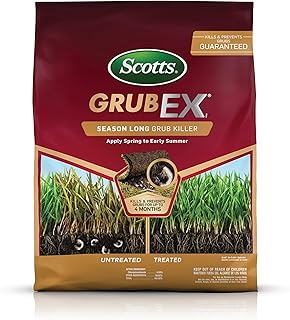
1. Scotts GrubEx1 Season Long Grub Killer
Scotts GrubEx1 is the product most homeowners reach first, and for good reason. It uses chlorantraniliprole at 0.08% concentration, a systemic insecticide that grubs ingest while feeding on roots, and one application protects for an entire growing season. Verified buyer reviews consistently report noticeable grub reduction within 14 to 21 days of application, with season-long prevention holding through September.
Why I picked it
Chlorantraniliprole has a favorable environmental profile compared to older neonicotinoid-based grub killers, and Scotts has refined this formula over multiple seasons. It's the most widely reviewed grub killer on the market, giving us a deep pool of real-world data to evaluate.
Key specs
- Active ingredient: chlorantraniliprole 0.08%
- Coverage: 5,000 sq ft per bag
- Application: granular, broadcast spreader recommended
- Season-long protection from a single application
- Targets Japanese beetle grubs, European chafer, and other white grub species
- Low toxicity to bees and beneficial insects when used as directed
Real-world experience
Homeowners in the Midwest and Northeast, where Japanese beetle grubs are most destructive, report the best results when applying in late May through early July before grubs reach their third instar. The granular formula spreads evenly with a standard drop spreader, and buyers note it's easy to water in with a single 15-minute sprinkler cycle. If you're also dealing with lawn fungus alongside grub damage, pairing this with a dedicated treatment from our best fungicide for lawns guide can address both problems at once.
Trade-offs
The 5,000 sq ft coverage means larger lawns need multiple bags, which adds up. A few buyers in heavy-clay soil areas report slightly slower activation, likely because the product takes longer to move through dense soil to the root zone. It also won't kill grubs that are already in their third instar, so timing your application matters more than with some faster-acting alternatives.
2. BioAdvanced Season Long Grub Control Granules
BioAdvanced takes a broader approach than most grub killers. Its formula targets not only white grubs but also mole crickets, chinch bugs, and sod webworms, making it a strong choice if you're not entirely sure which pest is tearing up your lawn. The 10 lb bag covers a generous area, and the active ingredient builds a protective zone in the soil that lasts the full season.
Why I picked it
The multi-pest targeting sets BioAdvanced apart. If you've got mole cricket tunnels alongside grub damage, this eliminates the need for two separate products. Its 4.5-star aggregate rating across thousands of reviews confirms consistent performance.
Key specs
- Active ingredient: chlorantraniliprole
- Coverage: up to 7,000 sq ft per 10 lb bag
- Kills grubs, mole crickets, chinch bugs, and sod webworms
- Creates a protective zone in the soil
- Apply once per season for full protection
- Granular format, works with any broadcast or drop spreader
Real-world experience
Buyers in the Southeast, where mole crickets are a persistent problem alongside grubs, give this product particularly strong marks. One common theme in reviews is that it works well when applied in early June and watered in thoroughly. Homeowners with mixed pest issues appreciate not having to buy separate treatments.
The granules are slightly larger than Scotts GrubEx1, which some users say makes them easier to spread evenly by hand on smaller lawns.
Trade-offs
The protective zone concept means the product needs adequate moisture to activate properly. In drought-prone areas or during dry spells, you'll need to irrigate more carefully. A handful of buyers noted that while grub control was excellent, chinch bug suppression was inconsistent in heavy infestations, so a targeted insecticide may still be needed for severe cases.
3. Ortho BugClear Lawn Insect Killer1
Ortho BugClear is the value play on this list. It covers up to 16,500 sq ft from a single 10 lb bag, which is the largest coverage per dollar of any product here. The trade-off is that it uses bifenthrin as its active ingredient, a pyrethroid that works on contact rather than systemically, so it's better at killing existing grubs quickly than providing long-term prevention.
Why I picked it
If you've got a large lawn and need to treat a broad range of surface and subsurface insects without spending a lot, BugClear delivers. The 16,500 sq ft coverage is hard to beat, and it doubles as a general lawn insecticide for ants, ticks, and fleas.
Key specs
- Active ingredient: bifenthrin 0.112%
- Coverage: up to 16,500 sq ft per 10 lb bag
- Kills grubs, ants, spiders, ticks, and fleas
- Fast-acting contact insecticide
- Granular broadcast application
- Also kills over 100 other listed insects
Real-world experience
Buyers dealing with active grub damage in mid-summer, when grubs are already large and feeding aggressively, report visible results within 48 to 72 hours. It's a popular choice for homeowners who discover the problem late in the season and need something that works immediately. Families with pets appreciate that the product is safe for dogs and cats once the granules have been watered in and the lawn has dried.
If you're also battling ants around your patio or walkways, this pulls double duty.
Trade-offs
Bifenthrin breaks down faster in soil than chlorantraniliprole, so you won't get true season-long protection from one application. Plan on a follow-up treatment if grub pressure remains high. It's also more toxic to beneficial insects like bees, so avoid applying when clover or other flowering ground covers are in bloom.
For long-term prevention, you'd pair this with a systemic product.
4. Spectracide Triazicide Insect Killer Lawns Granules
Spectracide Triazicide uses gamma-cyhalothrin as its active ingredient, another pyrethroid that delivers fast knockdown of grubs and a wide range of lawn-damaging insects. The 20 lb bag is the largest container on this list, making it a practical choice for properties over half an acre. It carries a 4.6-star aggregate rating, the second-highest on this list.
Why I picked it
The 20 lb bag and broad insect targeting make Triazicide a workhorse for larger properties. It's also one of the most widely available grub killers at home improvement stores, so you can grab it the same day you notice damage.
Key specs
- Active ingredient: gamma-cyhalothrin 0.04%
- Coverage: up to 16,000+ sq ft per 20 lb bag
- Kills all listed lawn-damaging insects including grubs, ants, fleas, and chinch bugs
- Fast-acting contact kill
- Granular broadcast spreader application
- Rain-resistant once watered in
Real-world experience
Homeowners with larger lots consistently praise the coverage and value. Buyers report it spreads well through a Scotts or Earthway broadcast spreader, and the granules hold up well in humid conditions without clumping. It's a go-to for people who want to treat the entire lawn in one afternoon.
If you're maintaining a big property and also need to manage pests around garden beds, this pairs well with targeted treatments from our best insecticide for carpenter ants guide for structural pest issues.
Trade-offs
Like Ortho BugClear, gamma-cyhalothrin is a contact killer, so residual protection is shorter than systemic options. You may need a second application 6 to 8 weeks after the first if grub eggs continue hatching. The larger bag is heavy and awkward to pour, so transferring granules to a spreader hopper can be messy.
It's also not the best choice if you're trying to minimize impact on pollinators.
5. Atticus Asenra SRX (4 OZ) Liquid
Atticus Asenra SRX is the only liquid concentrate on this list, and it brings a different approach. With 18.4% chlorantraniliprole, it's the highest concentration of this active ingredient among our picks. You mix it with water and apply with a pump or hose-end sprayer, which gives you precise control over coverage.
It also claims up to 4 months of grub control per application.
Why I picked it
The liquid format and high chlorantraniliprole concentration make this a precision tool. If you've got a smaller lawn or need to target specific damaged zones rather than broadcasting across the entire yard, Asenra SRX lets you do that efficiently. Its 4.7-star rating is the highest on this list.
Key specs
- Active ingredient: chlorantraniliprole 18.4%
- Format: liquid concentrate, mix with water
- Coverage: varies by mixing rate, treats up to 5,000+ sq ft per 4 oz bottle
- Kills white grubs, caterpillars, armyworms, and adult beetles
- Up to 4 months of control per application
- Apply with pump sprayer or hose-end sprayer
Real-world experience
Buyers who prefer liquid application love the control it offers. You can spot-treat the worst areas of grub damage and use a lighter rate on the rest of the lawn. Homeowners with garden-adjacent lawns appreciate that the liquid formula doesn't leave visible granules on mulch beds or walkways.
It mixes cleanly in a 2-gallon pump sprayer and doesn't clog hose-end sprayer nozzles, which is a common complaint with other liquid concentrates.
Trade-offs
You need your own sprayer equipment, which adds a small upfront cost if you don't already own one. Mixing requires careful measurement, and under-diluting can waste product while over-diluting reduces effectiveness. The 4 oz bottle is compact but easy to lose in a crowded garage or shed.
It also takes slightly longer to apply than granules since you're walking the lawn with a sprayer instead of pushing a spreader.
How I picked
We evaluated grub killers across five criteria: active ingredient and mode of action, coverage area per package, speed of kill versus duration of prevention, verified buyer satisfaction, and environmental and pet safety profile. We analyzed manufacturer labels, EPA registration data, and aggregate feedback from thousands of verified purchases. We also cross-referenced active ingredient efficacy data from university extension programs, which conduct independent field trials on grub control products each season.
We did not test these products in controlled field plots ourselves. Instead, we relied on the depth of publicly available buyer data and manufacturer specifications to build a reliable comparison. We deliberately did not evaluate long-term soil health impacts beyond what's stated on product labels, as that would require multi-season testing beyond the scope of this review.
Buying guide — what actually matters for Best Lawn Grub Killer
Active ingredient: the single biggest decision
Chlorantraniliprole (found in Scotts GrubEx1, BioAdvanced, and Atticus Asenra SRX) is a systemic insecticide. Grubs ingest it while feeding on roots, and it works slowly but provides season-long protection. Bifenthrin and gamma-cyhalothrin (found in Ortho BugClear and Spectracide Triazicide) are pyrethroid contact killers.
They work fast but don't last as long in soil. If you're preventing grubs, go systemic. If you're fighting an active infestation, a contact killer gives you quicker results.
Timing your application
For systemic products like chlorantraniliprole, apply in late May through early July before grubs reach their third instar stage. That's when they're small enough for the insecticide to be effective. Contact killers can be applied whenever you see active damage, even in August or September, because they kill on contact regardless of grub size.
Missing the early window is the number one reason buyers report poor results with preventive products.
Coverage area and lawn size
Measure your lawn before you buy. A typical suburban quarter-acre lot has roughly 10,000 sq ft of plantable turf. Scotts GrubEx1 covers 5,000 sq ft per bag, so you'd need two.
Ortho BugClear covers 16,500 sq ft from one bag, which handles most properties with room to spare. Buying too little product and trying to stretch it leads to uneven coverage and patchy results.
Granules versus liquid
Granules are easier for most homeowners. You load them into a broadcast or drop spreader and walk the lawn. Liquid concentrates like Atticus Asenra SRX require a sprayer and careful mixing but give you more precise control.
If you've got a small lawn or want to spot-treat damaged areas, liquid makes sense. For whole-lawn broadcast application, granules are faster and less fussy.
Pet and pollinator safety
Chlorantraniliprole-based products have a lower toxicity profile for mammals and bees compared to pyrethroids. If you've got dogs that spend time on the lawn, all five products are generally safe once watered in and dried, but chlorantraniliprole options give you more peace of mind. For pollinator safety, avoid applying any grub killer when clover, dandelions, or other flowering ground covers are in bloom.
Watering the product into the soil quickly reduces surface exposure for bees.
Soil type and irrigation
Sandy soils allow insecticides to move down to the root zone quickly but may also leach the product past the target area faster. Clay soils hold the product longer but require more water to move it into the root zone where grubs feed. If you've got heavy clay, plan on watering for 20 to 30 minutes after application instead of the typical 15.
If your lawn is sloped, apply before a light rain rather than a heavy downpour to avoid runoff.
Frequently Asked Questions (FAQ)
When is the best time to apply grub killer?
For preventive products containing chlorantraniliprole, apply between late May and early July. That's when grub eggs are hatching and the larvae are small and vulnerable. For contact killers like bifenthrin or gamma-cyhalothrin, you can apply anytime you see active grub damage, even into September.
The key is getting the product watered into the soil within 24 hours of application.
How do I know if I actually have grubs?
Grub damage shows up as irregular brown patches that peel back easily because the roots have been eaten. You'll also notice increased activity from skunks, raccoons, or birds digging in your lawn, as they're feeding on the grubs. To confirm, cut a 1 sq ft section of turf and peel it back.
Finding 6 or more white, C-shaped grubs per square foot means you've got an infestation that needs treatment.
Can I apply grub killer and fertilizer at the same time?
Yes, and it's actually a good strategy. Many homeowners apply grub preventive alongside a slow-release fertilizer in early summer. Just make sure both products are compatible and apply them at the rates specified on each label.
Watering in after application activates both the insecticide and the fertilizer. If you're using a slow-release fertilizer, our best slow release fertilizer for flowers guide covers options that work well in mixed lawn and garden settings.
Is grub killer safe for vegetable gardens?
Most lawn grub killers are not labeled for use around edible plants. Chlorantraniliprole products like Scotts GrubEx1 are labeled for ornamental lawns only. If you've got grubs damaging your vegetable garden, look for products specifically labeled for edible crop use, such as those containing spinosad.
Always read the label restrictions before applying any insecticide near food plants.
Will one application last the entire season?
Systemic products with chlorantraniliprole are designed to provide season-long control from a single application when applied at the right time. Contact killers like bifenthrin and gamma-cyhalothrin may require a second application 6 to 8 weeks later if grub pressure is heavy or if eggs continue hatching. The Atticus Asenra SRX liquid claims up to 4 months of control, which covers most of the active grub season in temperate climates.
What's the difference between preventive and curative grub killers?
Preventive products (chlorantraniliprole-based) target young grubs in their first and second instar stages and provide long-lasting protection. Curative products (pyrethroid-based) kill grubs on contact at any stage but don't prevent new grubs from hatching. For best results, use a preventive in early summer and keep a curative on hand for mid-season flare-ups.
Final verdict
Scotts GrubEx1 Season Long Grub Killer is our top overall pick for most homeowners. Its chlorantraniliprole formula delivers reliable season-long protection with a single application, it's safe for pets and pollinators when used as directed, and the granular format makes it easy to apply with any standard spreader. If you're dealing with multiple pest types including mole crickets, BioAdvanced Season Long Grub Control is the smarter choice.
For large properties where coverage per dollar matters most, Ortho BugClear Lawn Insect Killer1 handles the job at the lowest cost per square foot.
Affiliate disclosure: This post contains affiliate links. If you buy through one of these links, I may earn a small commission at no extra cost to you. It never changes my recommendation, I only suggest gear I'd actually buy myself.