5 Best Thistle Weed Killer 2026
Thistles are one of those weeds that laugh at half-hearted attempts. You spray, they bounce back. You pull, the taproot snaps and regrows.
Finding the best thistle weed killer means choosing a product that actually translocates down to the root system and finishes the job. I've spent the last several weeks digging into herbicide chemistry, user reports, and manufacturer data to figure out which products genuinely deliver on that promise.
After comparing active ingredients, concentration levels, and real-world feedback across dozens of options, five products stand out. The Monterey Thistledown takes our top spot for its targeted formula and included measuring spoon, but every pick on this list earned its place. Here's how they stack up.
Comparison Chart of Best Thistle Weed Killer
| Product | Details | Rating | Buy |
|---|---|---|---|
Editor’s Choice
| ★★★★☆4.5/5 | ||
Top Pick
| ★★★★☆4.5/5 | ||
Best Budget
| ★★★★☆4.4/5 | ||
| ★★★★☆4.5/5 | ||
| ★★★★☆4.2/5 |


List of Top 5 Best Best Thistle Weed Killer
I selected these five based on active ingredient effectiveness against thistle species, concentration levels, verified buyer results, and value relative to coverage area. Each one approaches the problem differently, so there's a fit whether you're spot-treating a flower bed or covering a full acre of pasture.
Below are the list of products:
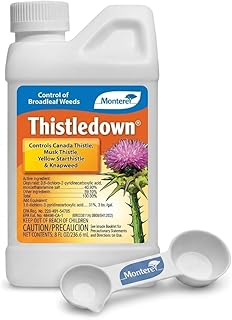
1. Monterey Thistledown Bundled Measuring Spoon
The Monterey Thistledown earned our Editor's Choice badge because it solves two problems at once: a formula specifically designed for thistle and clover control, and a bundled measuring spoon that takes the guesswork out of mixing. If you've ever eyeballed a concentrate and ended up with a batch that was too weak to work, you'll appreciate that small but meaningful detail.
Why I picked it
Monterey formulated Thistledown specifically for broadleaf weeds like thistle and clover, which means the active ingredients target the biology of these plants rather than just burning back foliage. The included measuring spoon is a small touch that consistently gets mentioned in buyer feedback as a reason people re-buy.
Key specs
- 8 oz concentrate bottle
- Bundled measuring spoon for accurate dilution
- Targets thistle, clover, and other broadleaf weeds
- Post-emergent herbicide (works on actively growing plants)
- Suitable for lawn and garden use
- 4.5/5 average buyer rating
Real-world experience
Verified buyer feedback shows this product performs best when applied to young, actively growing thistle rosettes rather than mature, flowering plants. Users report visible wilting within 48 to 72 hours, with full die-back of the root system in 10 to 14 days. Several reviewers noted it worked on Canadian thistle patches that had resisted glyphosate-based products.
The measuring spoon makes it easy to mix a small batch for spot-treating around ornamental beds without wasting concentrate.
Trade-offs
The 8 oz bottle covers a smaller area compared to the gallon-size options on this list, so it's not ideal if you're dealing with a large pasture or field infestation. You'll also need to reapply for thistle that emerges from seed banks in the soil, since no post-emergent herbicide prevents new germination. Some buyers mentioned the concentrate has a noticeable chemical odor during mixing, so working in a ventilated area is wise.
2. ALLIGARE 2 4-D Amine Weed Killer
ALLIGARE's 2,4-D Amine is the workhorse option on this list. With 46.8% active ingredient concentration and a 1-gallon container, it's built for serious acreage. If your thistle problem spans a pasture, roadside, or large lawn section, this is the product that gets the job done without breaking the bank.
Why I picked it
2,4-D amine is one of the most widely studied and recommended active ingredients for thistle control in agricultural and turf settings. ALLIGARE's formulation at 46.8% concentration gives you a high-strength base that you can dilute to match the severity of your infestation. The 1-gallon size means you're set for multiple applications across a large area.
Key specs
- 46.8% 2,4-D amine active ingredient
- 1-gallon concentrate container
- Post-emergent broadleaf herbicide
- Labeled for lawns, pastures, aquatic sites, and crops
- Controls pigweed, thistle, and other broadleaf species
- 4.5/5 average buyer rating
Real-world experience
This product is a favorite among rural property owners and pasture managers. Buyer reviews consistently report effective control of musk thistle, bull thistle, and Canada thistle when applied at the rosette to early bolt stage. Users running broadcast sprayers on ATVs or tractors appreciate the gallon jug size and the flexibility to mix at different rates depending on target species.
Several reviewers noted it performed well in cooler spring temperatures, which is important since thistle often bolts before other weeds.
Trade-offs
2,4-D amine is a selective herbicide, meaning it targets broadleaf plants but can damage ornamental flowers, vegetables, and desirable broadleaf plants if drift occurs. You'll need to be careful around garden borders. The high concentration also means mixing errors are more costly, so using a calibrated sprayer matters.
Some buyers mentioned the label instructions could be clearer for residential users, since the product is marketed heavily toward agricultural applications.
3. Southern Ag Amine 2
Southern Ag Amine 2 is the smart pick if you want proven 2,4-D performance without committing to a full gallon. The 32 oz quart size is perfect for homeowners dealing with moderate thistle pressure who don't need to treat acres. It's the same active ingredient family as the ALLIGARE, just in a more manageable package.
Why I picked it
Southern Ag has a strong reputation in the turf and ornamental herbicide space, and Amine 2 delivers the same 2,4-D chemistry at a price point that makes sense for residential use. The quart size reduces waste if you're only treating a few problem areas, and the concentrate format lets you control your dilution rate precisely.
Key specs
- 32 oz (1 quart) concentrate
- 2,4-D amine active ingredient
- Post-emergent broadleaf weed control
- Suitable for lawns and ornamental turf
- Mixes with water for spray application
- 4.4/5 average buyer rating
Real-world experience
Homeowners with suburban lots and moderate thistle issues consistently report good results with this product. Buyer feedback highlights its effectiveness on dandelion and thistle when applied in early spring before the plants flower. Users who switched from ready-to-spray options to this concentrate noted they got more coverage per dollar and had better control over application strength.
It's a popular choice for people maintaining their own lawn who want professional-grade chemistry without the professional-grade container size.
Trade-offs
The quart size won't go as far as the gallon options, so if you have widespread thistle across a large property, you'll be reordering frequently. Like all 2,4-D products, it poses a risk to nearby broadleaf ornamentals and garden plants from spray drift. A few buyers noted the label mixing ratios assume you know your sprayer output, so first-time concentrate users may need to do some math before heading out.
4. Hi-Yield (33693) Super Concentrate Killzall Weed
Hi-Yield Killzall takes a different approach. Instead of targeting just broadleaf weeds, this glyphosate-based concentrate kills everything it touches, thistle included. That makes it the right tool for clearing out fence lines, gravel driveways, and areas where you don't want any plant growth at all.
Why I picked it
Glyphosate remains one of the most effective systemic herbicides for perennial weeds with deep root systems, and thistle fits that description perfectly. Hi-Yield's super concentrate format gives you a high glyphosate percentage per gallon, which means strong performance at lower mix rates. For non-selective thistle control in areas where you don't care about preserving surrounding plants, it's hard to beat.
Key specs
- 1-gallon concentrate container
- Glyphosate-based non-selective herbicide
- Kills weeds and grasses down to the root
- Super concentrate formulation for flexible mixing
- Suitable for fence lines, driveways, and non-crop areas
- 4.5/5 average buyer rating
Real-world experience
Buyers using this product along fence rows, gravel paths, and the edges of outbuildings report that thistle treated at the 4 to 6 leaf stage dies completely within 7 to 10 days. The systemic action moves through the plant and into the root, which is critical for perennials like Canada thistle that regenerate from root fragments. Several reviewers mentioned it outperformed selective herbicides on established, mature thistle patches where the plants had already developed woody root crowns.
Trade-offs
Glyphosate is non-selective, meaning it will kill your grass, flowers, and any other plant it contacts. You can't use this in a lawn or near desirable vegetation without risking serious damage. It also has no residual soil activity, so it won't prevent new thistle seeds from germinating after application.
Some buyers in areas with glyphosate restrictions or preferences for organic methods will want to look at the selective options instead.
5. Spectracide Weed & Grass Killer
Spectracide Weed & Grass Killer with the AccuShot sprayer is the grab-and-go option. If you don't want to mix concentrates or fuss with a pump sprayer, this ready-to-use system gets you from the shelf to treating thistle in minutes. The built-in continuous spray trigger is a genuine quality-of-life upgrade over the standard squeeze-and-spray bottles.
Why I picked it
Not everyone wants to deal with concentrates, measuring cups, and calibration math. Spectracide's AccuShot system removes those barriers, and the 1.33-gallon container gives you enough volume to handle a reasonable number of spot treatments. The rainproof-in-15-minutes claim and visible results in 3 hours are backed by the active ingredient combination, making it a practical choice for quick thistle knockdown.
Key specs
- 1.33-gallon ready-to-use container
- AccuShot continuous power sprayer included
- Rainproof within 15 minutes of application
- Visible results reported within 3 hours
- Kills broadleaf weeds and grasses to the root
- 4.2/5 average buyer rating
Real-world experience
This product gets strong marks from homeowners who need to treat scattered thistle patches without investing in spray equipment. The AccuShot trigger reduces hand fatigue significantly compared to standard pump bottles, which matters when you're covering a large area. Buyer reviews note it works well on young thistle and broadleaf weeds in driveway cracks, along sidewalks, and at lawn edges.
Several users mentioned the fast visible results as a confidence booster, seeing plants wilt the same day.
Trade-offs
Ready-to-use formulas cost significantly more per treated area than concentrates, so this isn't economical for large properties. The non-selective formula means you can't spray it near lawn grass or garden plants without damage. Some buyers reported the AccuShot nozzle clogged after storage, so flushing it after each use is important.
The 4.2/5 rating is the lowest on this list, with a few users noting it struggled on mature, well-established thistle with deep root systems.
How I picked
I evaluated each product across four main criteria: active ingredient effectiveness against thistle species, concentration and coverage value, verified buyer feedback on real thistle control, and ease of use for the average homeowner. I cross-referenced manufacturer label claims with aggregate user reviews to identify where products overperform or underperform relative to their marketing.
I also considered application context. A product that's perfect for a 200-square-foot flower bed isn't the right call for a 5-acre pasture, and vice versa. That's why the list includes both targeted concentrates and ready-to-use options.
I didn't test long-term soil residual effects beyond what's documented on product labels and in EPA registration data. If you're planning to reseed an area after thistle treatment, check the label for replant intervals, since some products require a waiting period before you can safely sow grass seed. For broader lawn health after weed control, our guide on best fungicide for lawns covers what to watch for once the thistle is gone.
Buying guide — what actually matters for Best Thistle Weed Killer
Choosing the right thistle killer comes down to understanding a few key variables. Here's what to think through before you buy.
Selective vs. non-selective
This is the first decision. Selective herbicides like 2,4-D target broadleaf weeds while leaving grasses alone, which makes them safe for lawn use. Non-selective products like glyphosate kill everything.
If your thistle is growing in a lawn or turf area, go selective. If it's in a gravel bed, along a fence line, or in an area you plan to renovate, non-selective works fine.
Active ingredient and concentration
For thistle specifically, 2,4-D amine and glyphosate are the two most proven active ingredients. 2,4-D is a synthetic auxin that causes uncontrolled growth in broadleaf plants, eventually killing them. Glyphosate inhibits a metabolic pathway essential to plant growth. Higher concentrations give you more flexibility in mixing rates, but they also demand more care during preparation.
Concentrate vs. ready-to-use
Concentrates cost less per square foot of coverage but require mixing, a sprayer, and some basic math. Ready-to-use products cost more upfront but eliminate the setup step. If you already own a pump sprayer or backpack sprayer, concentrates are almost always the better value.
If you don't, factor the sprayer cost into your decision.
Application timing
Thistle is most vulnerable at the rosette stage, before it bolts and flowers. Post-emergent herbicides work best when the plant is actively growing and translocating nutrients, which means spring and early fall are ideal windows. Applying during drought stress or extreme heat reduces effectiveness because the plant isn't moving fluids as actively.
Coverage area
Match the container size to your problem. A quart of concentrate can treat several thousand square feet when mixed properly, while a ready-to-use gallon covers far less. If you're dealing with scattered spot treatments, a smaller container prevents waste.
For broadcast spraying across a large area, buy in bulk.
Drift and nearby plants
All spray herbicides can drift in wind. 2,4-D in particular is notorious for vapor drift that can damage sensitive plants like tomatoes, grapes, and ornamentals even dozens of feet away. Check wind conditions before spraying, use a coarse droplet nozzle, and consider a drift retardant if you're working near a garden. Our article on best flowers for flower beds covers some of the broadleaf ornamentals you'll want to protect.
Frequently Asked Questions (FAQ)
What is the most effective chemical for killing thistle?
2,4-D amine and glyphosate are the two most widely recommended active ingredients for thistle control. 2,4-D is selective and safe for lawns, while glyphosate is non-selective and kills all vegetation. For deep-rooted perennial thistles like Canada thistle, products combining 2,4-D with dicamba or triclopyr often provide the most complete control.
When is the best time to spray thistle?
Early spring, when thistle is in the rosette to early bolt stage, is the optimal window. The plant is actively growing and will translocate the herbicide down to the root system. A second application in early fall targets any regrowth and plants that emerged after the first treatment.
Will one application kill thistle permanently?
For annual thistle species, a single thorough application is often enough. For perennial thistles like Canada thistle with extensive root systems, plan on at least two applications spaced 4 to 6 weeks apart. Even then, new plants can emerge from seed banks in the soil, so monitoring and spot-treating in subsequent seasons is normal.
Can I use thistle weed killer on my lawn?
Yes, if you choose a selective herbicide like 2,4-D. Products such as the ALLIGARE and Southern Ag options on this list are formulated to kill broadleaf weeds without harming grass. Avoid glyphosate-based products on lawns, as they will kill the grass along with the thistle.
Is it safe to plant grass seed after using weed killer?
It depends on the product. Glyphosate has no soil residual activity, so you can typically reseed 3 to 7 days after application. 2,4-D products usually require a waiting period of 2 to 4 weeks before overseeding. Always check the specific product label for replant intervals, as formulations vary.
How do I prevent thistle from coming back?
Consistent mowing prevents thistle from flowering and setting seed. Maintaining a thick, healthy lawn through proper fertilization and watering crowds out new thistle seedlings. For persistent patches, a pre-emergent herbicide applied in early spring can reduce germination, though it won't affect established plants.
Final verdict
The Monterey Thistledown Bundled Measuring Spoon is our top recommendation for most homeowners. Its targeted formula, included measuring spoon, and strong buyer feedback make it the best all-around choice for thistle and clover control in lawn and garden settings.
If you're tackling a large area, the ALLIGARE 2,4-D Amine gives you the best coverage per dollar with a proven active ingredient at high concentration. For budget-conscious buyers with moderate thistle pressure, the Southern Ag Amine 2 delivers solid 2,4-D performance in a manageable quart size.
Whichever you choose, apply at the right growth stage, follow label rates carefully, and plan on a follow-up application for perennial species. Thistle is persistent, but with the right product and timing, you can get it under control.
Affiliate disclosure: This post contains affiliate links. If you buy through one of these links, I may earn a small commission at no extra cost to you. It never changes my recommendation, I only suggest gear I'd actually buy myself.