How to Get Rid of Tree Borers in 2026 (Step-by-Step Guide)
If you’ve noticed branches dying on your oak or what looks like sawdust at the base of your birch, you’re probably dealing with tree borers. How to get rid of tree borers starts with knowing what you’re up against. These aren’t surface pests.
They tunnel deep into the cambium layer, the living tissue just under the bark, and they can kill a mature tree within two or three seasons if left alone.
Per USDA Forest Service research, over 1,200 wood-boring beetle species exist in North America, and about 100 of those cause significant damage to landscape trees and orchards. The right treatment depends entirely on which borer you have and how far the damage has spread. Here’s how to figure that out.
Quick Answer
Spot the signs early. Look for D-shaped or round exit holes, sawdust-like frass, and canopy dieback. Identify the borer by exit hole shape, frass texture, and tree species.
Treat light infestations with a systemic insecticide. Prune out heavily infested limbs. Remove the tree if over half the canopy is dead.
First, Are You Sure It’s a Borer? (How to Spot Them Fast)
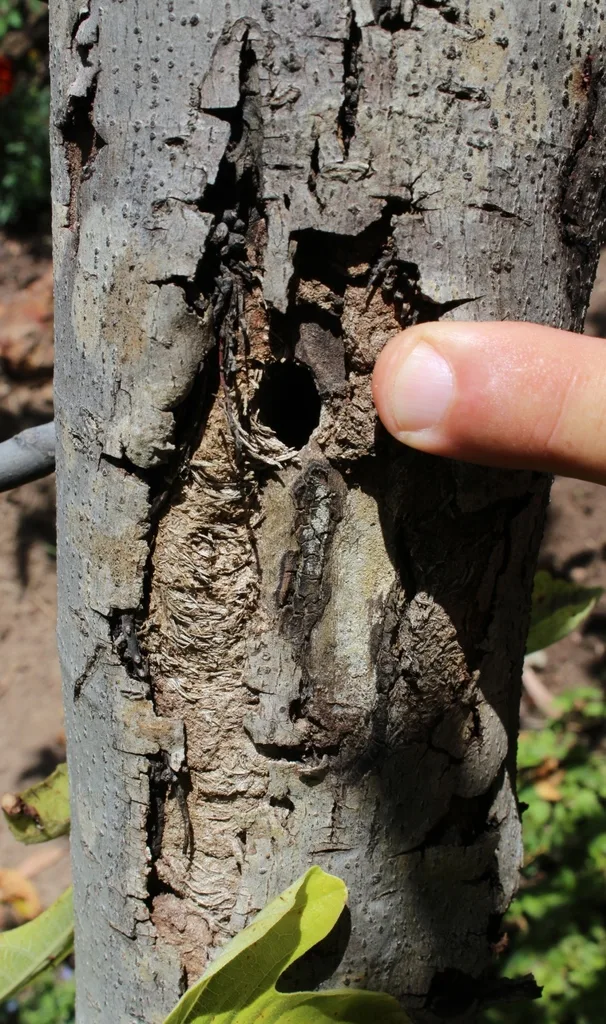
Before you reach for any treatment, you need to confirm you’re actually dealing with borers. A lot of things look like borer damage but aren’t. Drought stress, sunscald, and fungal cankers all cause branch dieback that mimics borer activity.
Here are the three telltale signs to check for:
- Exit holes. Adult borers chew perfectly round or D-shaped holes in the bark when they emerge. If you see tiny, irregular holes or slits, that’s likely a different insect.
- Frass. This is the insect’s waste mixed with chewed wood. Flatheaded borers leave fine, sawdust-like frass. Roundheaded borers produce coarse, pellet-like frass that often falls to the base of the tree.
- Bark cracks and ooze. Some borers, like the peachtree borer, cause gumming or sap flow at the base of the trunk. Others create vertical bark cracks that reveal winding galleries underneath.
If you find all three signs on a single tree, you’ve got borers. If you only see one or two, look closer before you treat.
Why Most Homeowner Treatments Fail (The Real Problem)
The biggest reason home treatments fail is timing. Most people spray insecticide when they see damage, but by then the larvae are already deep inside the wood. Contact sprays can’t reach them there.
Here’s what usually goes wrong:
- Wrong insecticide. Broad-spectrum sprays kill beneficial insects and pollinators without touching the borers. You need a systemic that moves through the tree’s vascular system.
- Wrong application method. Spraying the bark does nothing if the borer is inside. You need soil drench, trunk injection, or trunk spray that targets the right area.
- Ignoring tree stress. Borers target trees that are already weak from drought, soil compaction, or root damage. Treat the stress first or the borers will keep coming back.
- One-and-done approach. Most borers require a second treatment the next season to catch the next generation. A single spray rarely solves the problem.
If you’re dealing with a persistent infestation, check our guide on the best insecticide for carpenter ants for treating wood-boring pests effectively.
The Quick Decision Tree: Treat, Prune, or Remove?
This is where the decision tree comes in. Your next step depends on how much damage the tree has taken. Use this simple three-branch logic.
Branch A: Less than 20 Percent Canopy Damage
This is the best-case scenario. The tree has a solid chance of recovery. Your plan is to prune out infested limbs, apply a systemic insecticide, and support the tree with proper watering and mulch.
Most trees in this condition survive with aggressive treatment.
Branch B: 20 to 50 Percent Canopy Damage with Clear Entry Points
This is the gray zone. The tree can survive, but it needs professional-level care. You’ll want to prune damaged limbs, apply a systemic, and monitor closely for the next two seasons.
If you see new exit holes the following spring, you may need a trunk injection from an arborist.
Branch C: More Than 50 Percent Canopy Damage or Girdled Trunk
This tree is coming down. Borers have cut off too many vascular pathways to support life. Removal is the safest and most cost-effective option.
A dead or dying tree near your house or driveway is a safety hazard.
If you’re in a hot, dry climate where trees face extra stress, our guide on the best trees for hot dry climates can help you choose replacements that resist borers better.
How to Identify the Exact Borer (It Changes Your Next Step)
You can’t treat borers effectively until you know which species you’re up against. The insecticide, timing, and application method all change based on the borer type.
Here’s a quick breakdown of the three most common groups:
Flatheaded borers include the bronze birch borer and flatheaded appletree borer. They leave D-shaped exit holes and fine, powdery frass. Their larvae create flat, ribbon-like galleries under the bark.
These borers attack stressed trees first.
Roundheaded borers include pine sawyer beetles and locust borers. They leave round exit holes and coarse, sawdust-like frass. Their larvae create oval or round tunnels packed with fibrous waste.
These borers target conifers and hardwood trees.
Clearwing moths include the peachtree borer and dogwood borer. They leave round exit holes and cause gummosis, a sticky sap ooze at the base of the tree. Their frass is mixed with plant sap.
These borers target fruit trees and ornamental species.
Use this table for a quick ID:
| Borer Group | Exit Hole Shape | Frass Texture | Common Host Trees |
|---|---|---|---|
| Flatheaded | D-shaped | Fine, powdery | Birch, maple, oak, apple |
| Roundheaded | Round | Coarse, fibrous | Pine, locust, ash, willow |
| Clearwing | Round with sap | Moist, mixed | Peach, cherry, dogwood, birch |
Still unsure? Look at the tree species first. If it’s a birch with thinning canopy in midsummer, you’re almost certainly dealing with bronze birch borer.
If it’s a peach tree with gum at the base, that’s peachtree borer. The tree itself often tells you the answer.
The Right Treatment for Each Condition
Once you’ve identified the borer and assessed the damage level, it’s time to pick your treatment. Not all treatments work for all borer types, and using the wrong one wastes time and money.
Systemic Insecticides
Systemics are the gold standard for most tree borers. They move through the tree’s vascular system and kill larvae as they feed on the cambium. The two most common active ingredients are imidacloprid and dinotefuran.
- Soil drench. You pour the mixed insecticide around the base of the tree, and the roots absorb it. This works well for small to medium trees. It takes a few weeks to reach full effect.
- Trunk injection. An arborist injects the insecticide directly into the trunk. This works fast and can treat large trees. It costs more but delivers reliable results.
- Bark spray. You spray the lower trunk with a concentrated systemic. This works for borers that enter near the base, like the peachtree borer.
Biological Options
For light infestations, beneficial nematodes can help. These microscopic worms attack borer larvae in the soil. They are safe for pets, birds, and groundwater.
Apply them when the soil temperature is between 50 and 90 degrees Fahrenheit.
Parasitic wasps also target certain borer species, especially clearwing moths. These tiny wasps lay their eggs on borer larvae. They are commercially available but less common for home use.
Contact Sprays
Avoid contact sprays for tree borers unless you are treating a very small tree and can hit the exact moment of adult emergence. The window is narrow, usually one to two weeks in spring. Most homeowners miss it.
When treating stressed trees, good nutrition helps them fight off future attacks. Check our guide on the best organic fertilizer for fruit trees to keep your trees healthy and resilient.
Treatment by Borer Type
| Borer Type | Best Treatment | Timing |
|---|---|---|
| Bronze birch borer | Systemic (imidacloprid soil drench) | Early spring, before May |
| Emerald ash borer | Trunk injection with dinotefuran | Mid-spring to early summer |
| Peachtree borer | Bark spray on lower trunk | Late spring, before egg-laying |
| Pine sawyer beetle | Remove infested wood, systemic | Spring and again mid-summer |
If you are dealing with fungal issues alongside borers, our guide on the best fungicide for lawns can help you manage disease pressure that weakens trees.