How to Identify Lawn Fungus in 2026 (Pro Tips & Tricks)
You step onto your lawn and something is off. Maybe you see dead patches, weird circles, or a strange white dust on the grass blades. Learning how to identify lawn fungus is the first step to stopping it before it takes over the whole yard.
As of 2026, university extension programs across the US report that roughly 65 of every 100 lawn samples they receive turn out to be fungal diseases. The rest come from drought, pests, or fertilizer burn. That is why a good diagnosis matters more than guessing and grabbing a bottle of something off the shelf.
Quick Answer
To identify lawn fungus, look for patterns from a distance. Check for circles, rings, or irregular patches. Inspect individual blades for spots, powder, or cottony webbing.
Compare what you see to a visual guide. If you are still unsure, send a sample to your local extension office.
Why a Good Photo Matters More Than a Description
Two homeowners can describe the same patch of grass in totally different ways. One says "brown circles." The other says "yellow rings with a green center." That is why your phone camera is your best tool for the job.
A photo captures the exact color, shape, and texture that a written description always misses. Fungal diseases look different at different times of day, in different light, and at different stages of infection. The mycelium on brown patch only shows up in early morning dew.
Dollar spot lesions look like small water-soaked spots before they turn tan. A single photo taken at the wrong moment can miss all of that.

Extension offices and turf pathologists ask for photos first for a reason. They want to see the pattern, the lesion shape, and the color all at once. A good photo gives them everything they need to rule out the most common look-alikes.
A bad description just leads to more questions.
The key is knowing what to capture and when. That is what the rest of this guide walks through step by step.
The Two Biggest Traps That Trick Most Homeowners
Thinking it is drought when it is actually dollar spot
Dollar spot is the most misidentified lawn fungus out there. Homeowners see small brown patches and reach for the sprinkler. That makes the problem worse.
The trick is in the pattern. Drought stress turns the whole lawn a uniform brown color. Dollar spot creates distinct circular patches about the size of a silver dollar, sometimes smaller.
The patches stay separate and rarely merge into big dead areas.
Look closer at the grass blades. Dollar spot leaves lesions with light tan centers and reddish-brown borders. You can see those borders with your naked eye if you look carefully.
Drought stress just makes the blade turn brown from the tip down.
If you see small distinct spots and the soil is still moist, you are dealing with fungus, not thirst. Increasing water will only spread the spores. This is where a reliable fungicide becomes important, and knowing how to choose the right one matters.
Assuming yellow circles are from the dog (but it is fairy ring or necrotic ring spot)
Pet urine leaves a dark green ring around a yellow or dead center. That is a classic signature. But fungus rings look different.
Fairy ring shows a dark green band of grass that grows faster than the rest of the lawn. Inside that band, the grass may be dead or stunted. Mushrooms often appear along the ring after rain.
The ring can be as small as a dinner plate or as wide as 30 feet across.
Necrotic ring spot shows up as rings of dead grass with healthy grass in the middle. The rings are usually 2 to 6 inches across. You see it most in spring and fall when soil temperatures are cool.
The rule of thumb is simple. If the grass inside the ring is dead, it is fungus. If the grass inside the ring is a vibrant dark green, it is more likely pet urine.
If mushrooms are present, it is definitely fairy ring.
The 5-Minute Walkaround: Pattern First, Details Second
You do not need to spend hours diagnosing your lawn. A five minute walkaround gives you 90 percent of the information you need.
| Step | What to Do | What to Look For |
|---|---|---|
| 1 | Stand at the edge of the lawn and scan the whole area | Circles, rings, irregular patches, or uniform browning |
| 2 | Kneel down near the worst spot and look at individual blades | Lesions, spore powder, mycelium webbing, or discoloration |
| 3 | Dig up a small section of sod and check the roots | Healthy white roots or rotten dark roots; check thatch depth |
Step 1 – Check the overall shape and pattern from a distance
Walk to the corner of your yard and look at the lawn as a whole. Take out your phone and snap a wide shot. This gives you the big picture.
Ask yourself these questions:
- Are the dead areas circular or irregular?
- Are they scattered randomly or concentrated in one area?
- Do the patches form rings with healthy grass in the middle?
- Is the damage in a low spot where water pools?
Circular patches point to fungus. Irregular patches that follow a pattern of foot traffic or mower lines point to mechanical damage or compaction. Uniform browning across the whole lawn points to drought or over fertilization.
Step 2 – Kneel down and look at individual blades
Get down on your knees near the edge of a damaged area. Pick a few grass blades and look at them closely. You are looking for three things: lesions, spore powder, and mycelium.
Lesions are spots on the blade itself. They can be tan with brown borders, purple with yellow edges, or water soaked and dark. Each shape points to a different disease.
Spore powder looks like dust on the blade. Rust disease makes orange powder that rubs off on your fingers. Powdery mildew looks like white flour dusted over the grass.
Both are easy to spot if you look.
Mycelium is a cottony white or gray web that forms on the grass surface. It shows up best in the morning when dew is still on the lawn. If you see it, you have an active fungal infection right now.
Step 3 – Check the soil and thatch layer
Use a trowel or a soil probe to lift a small section of sod about three inches deep. Look at the roots and the thatch layer.
Healthy roots are white and firm. Rotten roots are brown or black and break apart easily. A thatch layer thicker than half an inch creates the perfect home for fungal spores.
The deeper the thatch, the more likely you are to see disease.
If the roots are healthy and the thatch is thin, you can rule out take all patch and large patch. Those diseases rot the roots first. If the roots are dark and mushy, you have a root infecting fungus and need to treat the soil, not just the leaves.
Blade-Level Clues: What to Look For (and How to See It)
This is where the diagnosis gets specific. The patterns on the grass blades themselves tell you exactly which fungus you are dealing with.
Lesions (spots on the grass blades)
Lesions are the most reliable clue. Each fungus leaves a distinct mark.
Dollar spot lesions are small and hourglass shaped. They start as water soaked spots and turn tan with reddish-brown borders. The lesion wraps around the width of the blade.
You can see the color contrast without a magnifying glass.
Brown patch lesions are dark and irregular. They look like dark purple or black spots that spread quickly. The lesions are bigger than dollar spot spots and often cover the whole blade from tip to base.
Leaf spot lesions are small and oval shaped. They start as tiny purple or black dots. As they grow, the center turns tan and the border stays dark.
This gives them a target like appearance.
Rust lesions look like orange or yellow pustules. They break open and release orange powder. If you wipe the blade with a white tissue, the powder transfers easily.
That is a clear sign of rust fungus.
Spore colors (powder, rust, or black smut)
Spores are the reproductive structures of the fungus. They release as powder or dust that you can see on the grass.
Orange powder means rust fungus. White powder means powdery mildew. Black powder means smut fungus.
All three are easy to spot from a standing position if the infection is heavy enough.
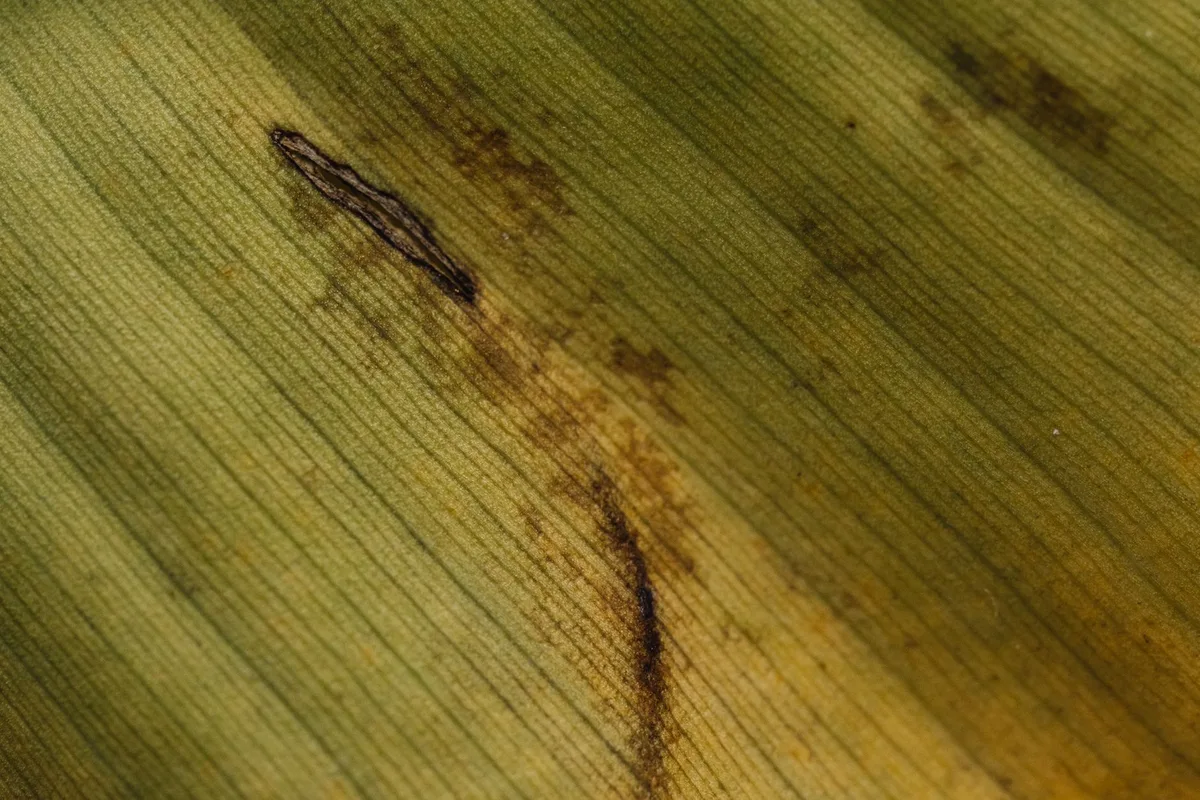
The color of the spore powder tells you the treatment path. Rust needs a different approach than powdery mildew. Smut needs yet another.
Identifying the color early stops you from wasting money on the wrong product.
Mycelium (that cottony web you see in the morning dew)
Mycelium is the living body of the fungus. It looks like white or gray cobwebs stretched across the grass blades and the soil surface.
You can only see mycelium when the grass is wet. Early morning is the best time. The dew makes the mycelium stand out as a white cottony layer.
By midday, it dries up and disappears.
Brown patch mycelium looks like a smoke ring around the edge of an infected patch. It is thick and ropey. Dollar spot mycelium is lighter and more web like, stretching between blades.
If you see mycelium, you have an active infection that is spreading right now. Do not wait to treat it. The fungus is producing new spores while you stand there.
What to Photograph (and How to Get a Clean Shot)
Taking a good photo means knowing what the pathologist or extension agent needs to see. It is not about artistic composition. It is about capturing the diagnostic clues clearly.
Best time of day to capture the evidence
Shoot your photos early in the morning, between 6 and 8 am. That is when the dew is still on the grass and the mycelium is visible.
Midday sun washes out the colors. Lesion borders look pale. Spore powder blows away.
Mycelium dries up and vanishes. If you take photos at noon, you lose half the clues.
If you cannot shoot in the morning, wait for an overcast day. Cloudy light is softer and shows the lesion colors better than direct sun. Just know that you will not see mycelium without moisture.
Which angle shows the telltale signs
Take three photos from different distances.
First, a wide shot from 10 to 15 feet away that shows the overall pattern. This captures the shape of the patch, the size, and how it relates to the rest of the lawn.
Second, a close up from 6 to 12 inches away that shows individual grass blades. Focus on the lesions and any spore powder. Hold the camera steady and let it autofocus on the blade.
Third, a soil level shot that shows the roots and thatch. Pull back a small square of sod with your fingers or a trowel and photograph the root system. Include a ruler or a coin in the frame for scale.
Why a hand lens or macro lens on your phone helps
A cheap hand lens, the kind you get for 10 dollars at a garden store, makes a huge difference. It magnifies the lesions so you can see the exact shape and color. Some phone macro lenses clip onto your camera and cost under 20 dollars.
With magnification, you can tell the difference between dollar spot and brown patch lesions in seconds. Without it, you are guessing based on shape alone. The extension office pathologist will thank you for the detailed photo.
Turn on your phone's grid overlay to make sure the grass blade goes diagonally across the frame. That keeps the whole lesion in focus and lets the pathologist see the borders clearly. A blurry photo is just as bad as a missing photo.
Three Look-Alike Diseases That Often Get Mixed Up
Brown patch vs. dollar spot vs. summer patch
Brown patch hits in hot humid weather. It creates irregular patches up to 2 feet wide. The grass turns dark brown in a circle that expands outward.
You see a grayish smoke ring of mycelium around the edge in the morning.
Dollar spot runs on cooler nights with heavy dew. Its patches are small and distinct, about 2 to 3 inches across. The lesions on the blades are hourglass shaped with tan centers and reddish borders.
Brown patch lesions are dark and irregular.
Summer patch attacks the roots. You pull up the sod and find dark rotten roots. The grass above turns yellow then brown.
It shows up as circles or irregular patches, but the roots give it away. Brown patch and dollar spot leave the roots mostly healthy.
| Disease | Patch Size | Lesion Shape | Root Condition |
|---|---|---|---|
| Brown patch | 6 in. to 2 ft. | Dark, irregular | Healthy |
| Dollar spot | 2 to 3 in. | Hourglass, tan with red border | Healthy |
| Summer patch | 2 to 12 in. | None visible above | Dark, rotted |
Powdery mildew vs. rust vs. leaf spot
Powdery mildew looks like white flour dusted over the blades. It rubs off easily. It thrives in shade with poor air circulation.
Rust makes orange powder that transfers to your fingers. Leaf spot shows purple or black dots on the blades with tan centers.
All three are easy to tell apart by color. White is mildew. Orange is rust.
Purple or black is leaf spot. Nothing else creates that specific color signature.
Fairy ring vs. large patch vs. take all patch
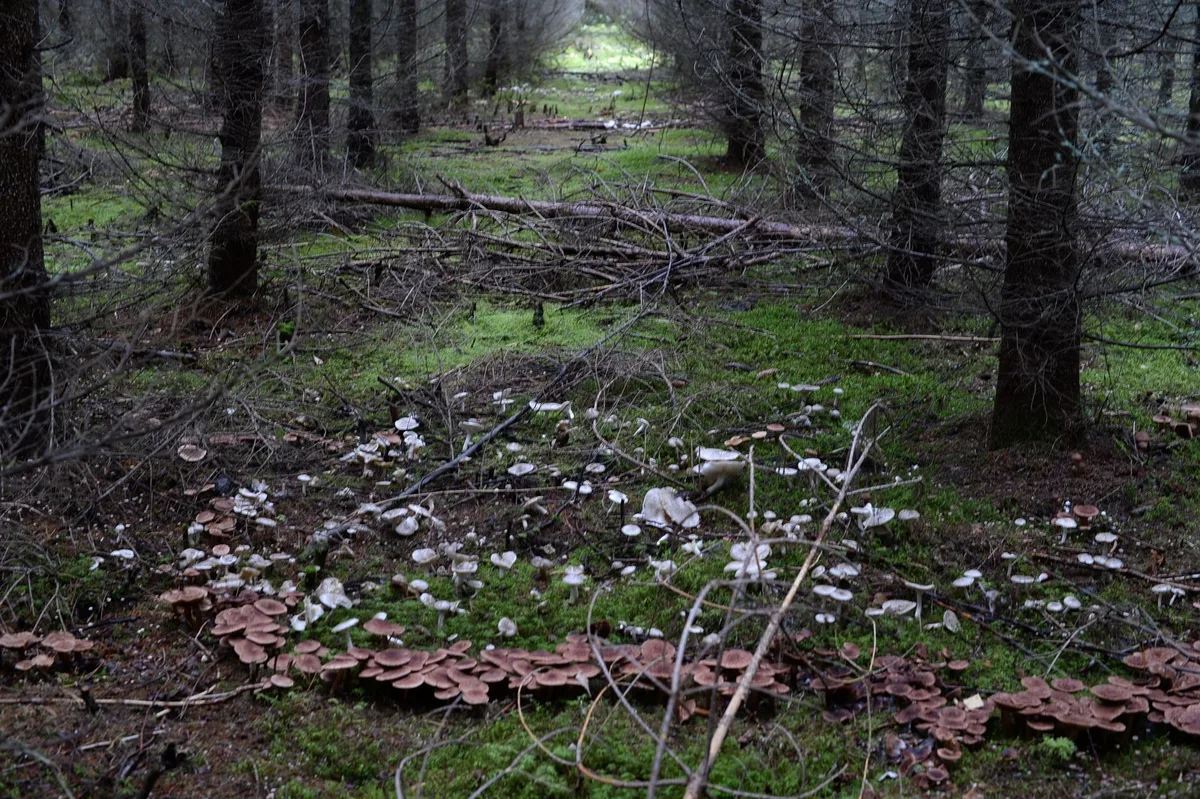
Fairy ring creates a dark green ring of fast growing grass. The inside is dead or stunted. Mushrooms appear after rain.
The ring expands year after year.
Large patch hits warm season grasses in spring and fall. It makes large irregular yellow patches that turn brown. The leaf sheath rots at the base.
You can pull the blade easily from the sheath.
Take all patch starts as small purple spots that expand into large dead areas. The roots and stolons turn black. It spreads slowly over multiple seasons.
If the roots are black, it is take all patch. If the sheath is rotting, it is large patch. If there are mushrooms in a circle, it is fairy ring.
When You Are Still Not Sure: The 2 Week Lab Test
Some diseases look too similar to trust your own eyes. That is when you send a sample to your local extension office. The lab test removes all the guesswork.
How to take a sample for your extension office
Cut a small square of sod about 3 inches deep and 4 inches wide. Include the roots, thatch, and live grass. Place it in a plastic bag but do not seal it tight.
The sample needs some air.
Write down the date, grass type, when symptoms started, recent weather, and any treatments you applied. The pathologist needs that context. Put the sample in a padded envelope and mail it right away.
What the lab fee covers and what results look like
Most extension offices charge 15 to 35 dollars per sample as of 2026. The fee covers a trained pathologist who examines the sample under a microscope and cultures the fungus in a lab dish.
You get back a written report that names the exact disease. Some offices also include treatment recommendations. The process takes 1 to 2 weeks.
If the fungus has already spread, you may lose more lawn while waiting. But you also avoid treating the wrong thing.

Practical FAQs About Finding Fungus Early
Can I see fungus without a magnifying glass?
Yes, for most common lawn fungi. Brown patch patches are visible from across the yard. Rust powder rubs off on your fingers.
Powdery mildew looks like white dust. A hand lens helps for dollar spot lesions and leaf spot, but you can see those with good eyesight in bright morning light.
Does fungus always show up right after rain?
Not always. Some fungi need specific temperatures more than moisture. Brown patch appears during hot humid nights even without rain.
Snow mold grows under snow cover. Dollar spot appears during cool nights with heavy dew. Rain makes it worse but is not required.
How do I know it is not grub damage or fertilizer burn?
Pull up a section of sod. Grubs are white C shaped larvae in the soil. Fertilizer burn turns the whole lawn brown evenly.
Fungus makes distinct patches or rings. If the damage looks like someone spilled something in a pattern, check your recent fertilizer application.
If the damage is random and the soil has grubs, you have an insect problem. If the damage matches a pattern you spread, you burned it. If the damage is circular or ring shaped, it is fungus.
Your Pocket Guide on the Next Lawn Walk
Next time you step outside, follow this checklist.
- Scan the lawn from the edge. Note circles, rings, or irregular patches.
- Kneel down at the worst spot. Look for lesions, spore powder, and mycelium.
- Check the soil and roots. Healthy roots rule out root rot diseases.
- Take three photos. One wide, one close up of blades, one of the roots.
- Compare your photos to a visual guide or send them to your extension office.
Take note of the weather from the past week. Hot nights with humidity point to brown patch. Cool nights with dew point to dollar spot.
If you see mushrooms, it is fairy ring.
Once you identify the fungus, you can move on to treatment. Picking the right fungicide matters as much as the diagnosis itself. Knowing what you are dealing with is the hard part.
You have already done that.