How to Improve Backyard Drainage for 2026: Complete Guide
It’s frustrating when your backyard turns into a marsh every time it rains. You look out the window and see a soggy lawn, a muddy patch by the patio, and water pooling right where your kids want to play. The good news is that learning how to improve backyard drainage doesn’t require a degree in civil engineering.
Most fixes are straightforward, and the right one depends on a few simple conditions in your yard.
Manufacturer specifications from drainage pipe companies indicate that a 1% slope (roughly one foot of drop per 100 feet) is the minimum to keep water moving. As of 2026, that standard hasn’t changed. But before you start digging, you need to figure out what kind of water problem you’re actually dealing with.
Because the solution changes completely based on your soil, slope, and where the water comes from.

Quick Answer
The best approach to fix backyard drainage depends on your situation. First, check where water collects and how fast it drains. Then test your soil type.
Finally, pick the method that matches: grade the surface, extend downspouts, install a French drain, or dig a dry well. Always slope pipes at least 1% and call 811 before digging.
Step 1: Identify Your Water Problem
Before you spend money on gravel or pipe, take a walk outside after the next heavy rain. Don’t go when it’s sprinkling. Wait until the sky clears and then follow the water.
Look for these signs:
- Standing water that stays for more than 12 hours after the rain stops.
- Puddles right next to the foundation or under downspouts.
- Muddy patches that never seem to dry out.
- Erosion channels where water runs off a slope.
- Lawn fungus or moss growing in low spots (that extra moisture invites problems like a need for a good lawn fungicide).
Is it surface runoff or groundwater? Stick a screwdriver or a thin metal rod into the wet spot. If you hit water just an inch or two down, you have a high water table or groundwater issue. If the water sits on top of the soil but the ground below feels dry, it’s a surface drainage problem.
This distinction matters a lot because a French drain won’t fix a high water table. It only collects surface water that seeps into the trench.
Another quick test: watch where the water goes when it rains. Does it flow from your roof down the downspout and onto the lawn? Does runoff from the neighbor’s yard spill onto your property?
Mark the direction with flags or a garden stake. You need to understand the source before you can pick the right fix.
Step 2: Diagnose Your Yard’s Drainage Conditions
Now that you know what’s wet, it’s time to figure out why. Two things control how fast water drains: your soil type and the slope of your yard.
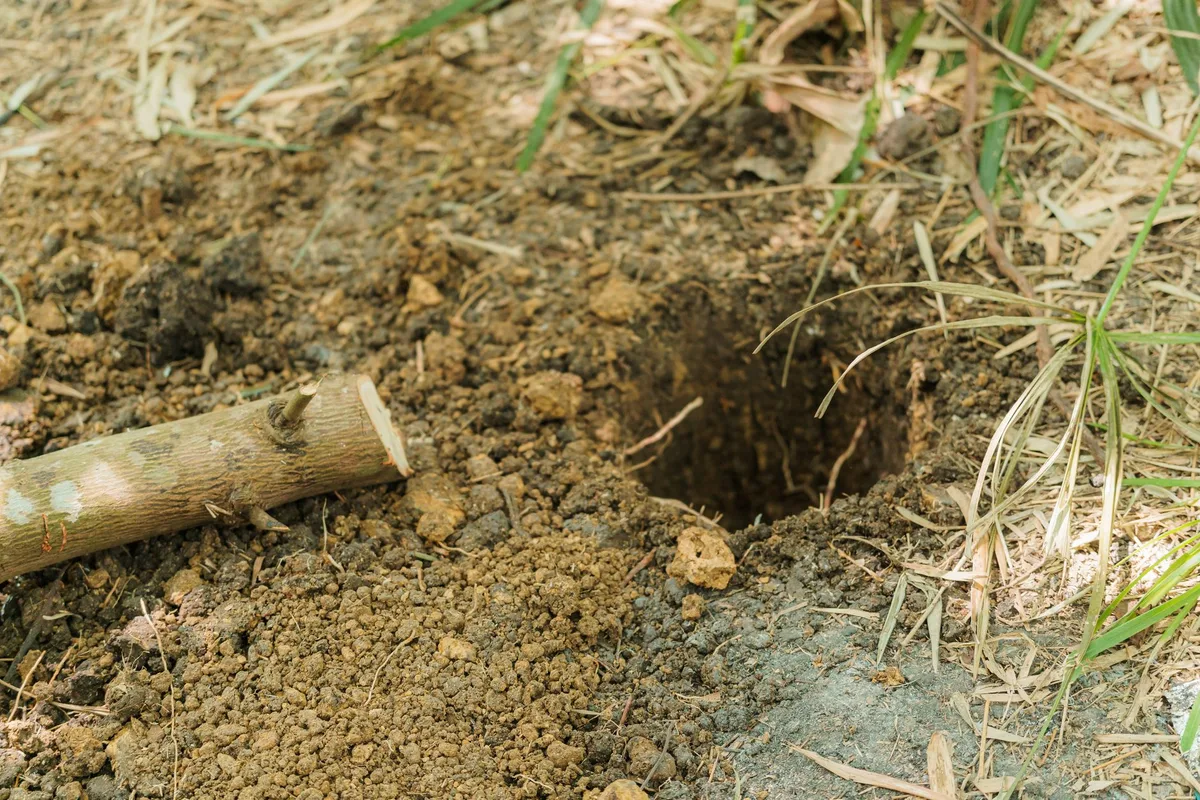
The test hole method. Dig a small hole about 12 inches deep and 6 inches wide in the wettest spot. Fill it with water and let it drain completely. Then fill it again.
Time how long it takes for the water level to drop. If it takes more than 12 hours to drain, you have heavy clay soil. If it drains in 2 to 4 hours, you have sandy or loamy soil.
If it drains in less than 30 minutes, the water is probably running off into the groundwater rather than being absorbed. That’s a separate issue.
The string line test. Drive two stakes into the ground at opposite ends of the wet area about 20 feet apart. Tie a string between them and level it with a line level. Measure the distance from the string to the ground at each stake.
If the ground is lower at one end, you have some slope. If it’s flat, you have no slope. The ideal slope for drainage is at least 2% (a two-foot drop per 100 feet).
Anything less than 1% means water will sit.
Your water outlet matters most. Gravity is your friend. If you have a downhill spot where water can exit your yard (a ditch, a storm drain, a lower area of the lawn), you can use a simple pipe to drain the water away. If you have no downhill outlet because your yard is the low point, you need a dry well or a sump pump.
This is the single most important condition to check. Don’t skip it.
Step 3: Choose Your Fix Based on Your Situation
This is where the decision tree branches. Match your conditions to the right solution.
If Water Pools in Low Spots with No Slope
Your first option is the simplest and cheapest: regrade the area. Add topsoil to the low spot and slope it away from your house or toward a drainable area. You need enough soil to raise the grade by about 6 inches over a 10-foot distance.
Tamp it down firmly and reseed with a grass variety that tolerates some moisture.
If the low spot is large, you might need to bring in a few cubic yards of fill dirt. A transit level or laser level helps you get the slope right, but a long 2×4 and a bubble level work fine for small areas. Grading works when the water is shallow and you have somewhere for it to go.
If your yard is completely flat with no existing drain point, surface grading alone won’t cut it. You need to combine it with another method.
If Water Comes from Downspouts
This is the most common backyard drainage problem. Your gutters dump a lot of water into a very small area. Fix it by extending the downspout at least 6 feet away from the foundation.
Use a flexible downspout extension (the accordion kind) for a quick fix. It’s cheap and takes five minutes to snap on. But be aware that extensions can get kicked around or mowed over.
A buried downspout pipe is a cleaner permanent solution. Dig a trench 12 to 18 inches deep from the downspout to the discharge point. Lay solid 4-inch PVC pipe, connect it to the downspout with a special adapter, and route it to a pop-up emitter that opens when water flows.
Make sure the pipe has at least a 2% slope so water doesn’t settle in the pipe.
Rain gardens are another excellent option if your soil perc test shows decent drainage. A rain garden is a shallow depression planted with native flowers and grasses that absorb rainwater. It should be at least 10 feet from your foundation and sized to handle the volume from your roof.
You can choose plants that attract pollinators, but the key is to use deep-rooted species that drink up water.
If You Have Clay Soil or Standing Water After Rain
Clay soil drains slowly because its particles are tiny and pack together tightly. A French drain is the standard solution here. It’s a trench filled with gravel that contains a perforated pipe.
Water seeps into the trench, flows into the pipe, and is carried away to a discharge point.
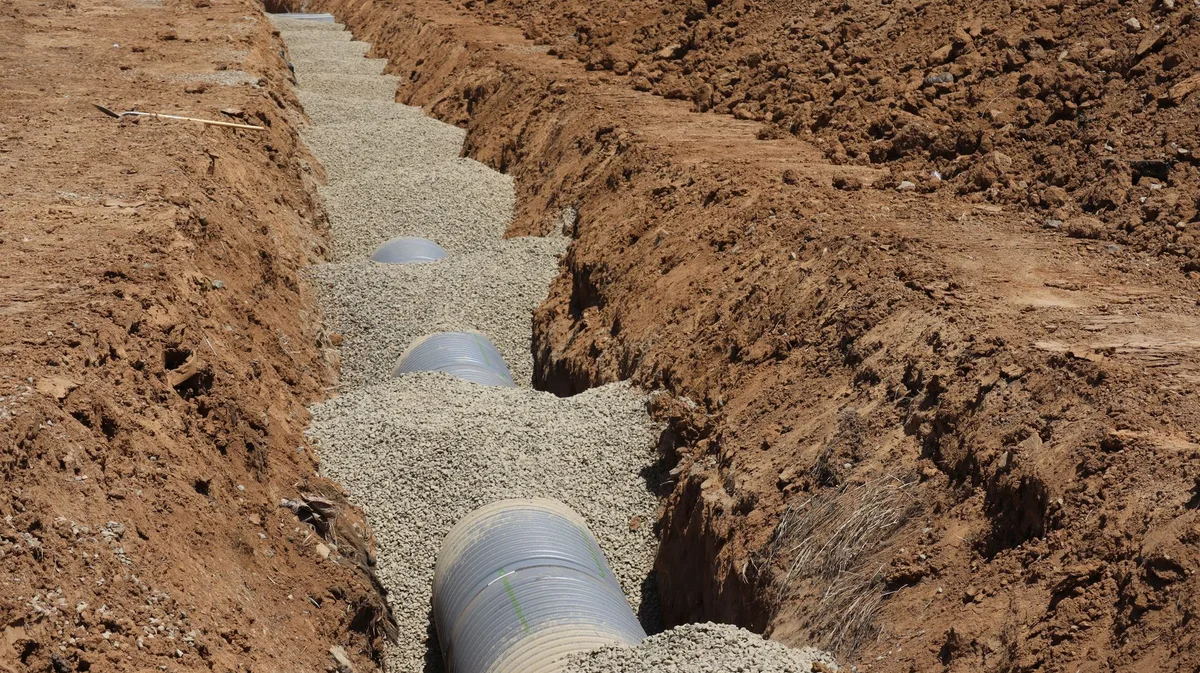
Trench specs. Dig a trench about 18 inches deep and 12 to 18 inches wide. Line it with landscape fabric (geotextile filter fabric) to keep silt out. Lay a 4-inch perforated pipe on a bed of 3/4-inch washed stone.
Cover the pipe with more stone, then fold the fabric over the top, and cap with topsoil or sod. Slope the pipe at 1% minimum. The discharge point can be a pop-up emitter at a downhill edge of your yard or a ditch.
Why filter fabric matters. Many DIY French drains fail because they skip the fabric or use cheap landscape fabric that lets silt through. Over a few years, the gravel clogs and water has nowhere to go. Spend the extra few dollars on proper geotextile fabric.
It’s worth it.
If your clay is truly heavy (perc test took over 24 hours to drain the hole), a French drain may still work, but the trench will fill slowly. In that case, consider making the trench wider or adding a second parallel trench. Sump pumps are a more reliable option for heavy clay, covered in the next section.
If You Have No Downhill Outlet
When your yard is the lowest point in the neighborhood and there’s no place to gravity-drain water, you need a dry well or a sump pump.
Dry well basics. A dry well is a pit filled with gravel or a plastic perforated tank buried in the ground. Water drains into it from a French drain or a downspout, then slowly soaks into the surrounding soil. It works only if your soil has at least 1 to 2 inches per hour of percolation.
Clay soils with very slow perc won’t benefit from a dry well because the water will just sit in the well and eventually overflow.
Sump pump option. If you have no downhill outlet and poor soil perc, a sump pump is your answer. Install a sump basin (a large plastic bucket with holes) at the lowest point of your yard. The water collects in the basin.
When it reaches a certain level, a float switch triggers the pump, which pushes the water up and out through a discharge pipe to a point that gravity can handle, typically a street gutter, drainage ditch, or storm sewer. Make sure the discharge pipe is at least 5 feet from your foundation to prevent water from seeping back in.
Check local codes before installing a sump pump discharge. Some municipalities require a permit or direct you to tie into a storm drain system. And always install a check valve on the discharge line to prevent backflow.
Common Drainage Mistakes (And How to Avoid Them)
Even well-intentioned DIYers make errors that turn a simple fix into a recurring headache. Here are the biggest ones to watch out for.
Digging before calling 811. This is non-negotiable. In the US, you must contact 811 at least two business days before any digging project. They’ll mark underground gas lines, electric cables, and water pipes.
Hitting a gas line with a shovel is not a funny story. It’s a medical and legal emergency. Call 811.
Don’t skip it.
Picking the wrong pipe size. A 3-inch perforated pipe might seem adequate, but it clogs faster and carries less volume than a 4-inch pipe. Stick with 4-inch as the minimum. Use 6-inch only for large commercial applications or multiple roof downspouts feeding into one line.
Forgetting to slope the pipe properly. You need at least a 1% slope for water to move by gravity. If the pipe is even slightly level, water settles and silt accumulates. Use a string line and a level, or rent a laser level, to check your slope before backfilling.
Routing water onto a neighbor’s property. It’s not just rude. In many areas it’s illegal. Check local stormwater ordinances and your property lines.
That runoff you send downhill might end up flooding their basement. And they can take legal action.
Skipping the perc test before a dry well. As covered earlier, if your soil percolates slower than the well can fill, the dry well becomes a swamp pit. Always test the soil before installing one. If the test hole takes more than 24 hours to drain, skip the dry well and consider a sump pump instead.
Ignoring the fungus factor. Standing water in a lawn for more than 24 hours encourages lawn diseases like dollar spot and brown patch. If you’ve already dealt with lawn fungus before, a proper drainage fix can reduce the need for repeated fungicide applications. It’s a long-term health move for your grass.
Using the wrong gravel. Pea gravel or smooth river rock packs down and doesn’t let water flow through as well as crushed angular stone. Use 3/4-inch washed stone or “drain rock” with sharp edges. The gaps between angular stones stay open, allowing water to move freely.