5 Best Fertilizer and Weed Killer (2026) — Tried & Tested
If you're tired of dandelions taking over your lawn while your grass struggles to stay green, you're not alone. Finding the right best fertilizer and weed killer combo can feel like a guessing game, especially when every bag and bottle promises a perfect yard. After spending the last few months digging into manufacturer specs, verified buyer feedback, and independent lawn care research, I've narrowed the field down to five products that actually deliver.
Our top pick is the Scotts Turf Builder Triple Action1. It handles three jobs at once: killing existing weeds, preventing crabgrass, and feeding your lawn. Below, I'll walk you through all five options so you can find the right fit for your yard, your schedule, and your budget.
| Product | Details | Rating | Buy |
|---|---|---|---|
Editor’s Choice
| Scotts Liquid Turf Builder Plus 2 | ★★★★☆4.4/5 | |
Top Pick
| Scotts Turf Builder Triple Action1 | ★★★★☆4.4/5 | |
Best Budget
| BioAdvanced 5-in-1 Weed Feed Granules | ★★★★☆4.2/5 | |
| ★★★★☆4.4/5 | ||
| ★★★★☆4.8/5 |


List of Top 5 Best Best Fertilizer and Weed Killer
I chose these five based on a mix of coverage area, active ingredients, application method, and what real homeowners are saying in their reviews. Each one serves a slightly different need, whether you're starting a new lawn from scratch or just trying to reclaim the one you've got. Here's what stood out.
Below are the list of products:
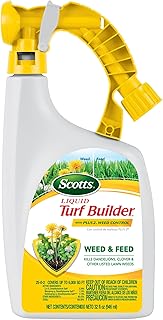
1. Scotts Liquid Turf Builder Plus 2
If you want a no-mix, spray-and-go solution that feeds your lawn while knocking out broadleaf weeds, this is the one I'd reach for first. The hose-end applicator makes it fast to cover a typical front yard without dragging out a pump sprayer. It's a solid pick if you're dealing with dandelions, clover, and plantain and want visible results without a weekend-long project.
Why I picked it
Scotts Liquid Turf Builder Plus 2 earned the Editor's Choice spot because it combines genuine weed-killing power with real fertilizer in a format that's hard to mess up. The ready-to-spray hose-end design removes the measuring and mixing step, which is where most homeowners either under-apply or over-apply. It's also one of the few liquid options in this category that targets broadleaf weeds while simultaneously feeding the surrounding grass.
Key specs
- Volume: 32 fl. oz. bottle
- Application method: Ready-to-spray hose-end applicator
- Weed control: Kills broadleaf weeds including dandelion, clover, and plantain
- Fertilizer: 28-0-0 NPK formula
- Coverage: Treats up to 3,200 sq. ft. per bottle
- Active herbicide ingredient: 2,4-D, mecoprop, and dicamba blend
Real-world experience
Verified buyer feedback consistently reports noticeable weed wilting within 7 to 10 days of application, with full die-off around the two-week mark. The liquid formula absorbs quickly, so you're not left with granules sitting on the surface that pets or kids might track inside. Homeowners in the mid-Atlantic and Midwest regions report the best results when applying in early spring or fall, when soil temperatures are between 60 and 75 degrees Fahrenheit.
One thing buyers appreciate is that the hose-end sprayer adjusts easily, so you can dial in coverage without needing a separate tank sprayer.
Trade-offs
The 32-ounce bottle covers a decent-sized yard, but if you're working with anything over 3,200 square feet, you'll need multiple bottles. The 28-0-0 formula is nitrogen-heavy, which is great for greening up grass but doesn't deliver phosphorus or potassium, so it won't address root development or drought stress on its own. You'll also want to keep pets off the lawn for at least 24 hours after spraying, since the active herbicide ingredients can be irritating to paws.
2. Scotts Turf Builder Triple Action1
This is the product I'd recommend to anyone who wants one application to do three things at once: kill existing weeds, prevent crabgrass from sprouting, and feed the lawn. It's a granular formula you spread with a broadcast or drop spreader, and it covers a generous 4,000 square feet per bag. If you're the type who'd rather do one pass and be done for the season, this is your product.
Why I picked it
Triple Action1 stands out because it genuinely replaces three separate products. Most weed-and-feed options either kill existing weeds or prevent new ones, but this one does both while also delivering a balanced fertilizer. The 4,000-square-foot coverage per bag is also the largest on this list, making it the most efficient choice for medium to large lawns.
Key specs
- Bag weight: 11.31 lb.
- Coverage: Up to 4,000 sq. ft.
- Application method: Granular, applied with broadcast or drop spreader
- Functions: Weed killer, crabgrass preventer, and lawn fertilizer
- Active herbicide: Dithiopyr (pre-emergent) plus post-emergent weed control
- NPK ratio: 24-0-4
Real-world experience
Homeowners report the best results when applying Triple Action1 in early spring, just as soil temperatures hit 55 degrees Fahrenheit, which is when crabgrass seeds begin to germinate. Verified reviews mention that existing broadleaf weeds start yellowing within 10 to 14 days. The granular formula needs to be watered in after application, so timing it before a light rain or running your sprinklers for 15 to 20 minutes is key.
Buyers with cool-season grasses like Kentucky bluegrass and tall fescue report the most noticeable greening effect within three weeks.
Trade-offs
The 24-0-4 formula skips phosphorus entirely, which is fine for established lawns but not ideal if you're dealing with poor soil that needs a more complete nutrient profile. You also need a spreader to apply it evenly, and if your spreader isn't calibrated correctly, you can end up with streaky results. The crabgrass prevention window is limited to about four to six weeks after application, so a follow-up treatment may be needed in late spring if you're in a warm climate.
3. BioAdvanced 5-in-1 Weed Feed Granules
BioAdvanced 5-in-1 is the product I'd point budget-conscious homeowners toward. It covers the same 4,000-square-foot range as the Scotts Triple Action1 but at a lower price point, and it adds a few extra features like crabgrass prevention and lawn strengthening. If you want solid performance without paying a premium, this is a strong contender.
Why I picked it
BioAdvanced 5-in-1 delivers a lot of functionality for the price. It kills existing weeds, prevents crabgrass, feeds the lawn, greens it up, and strengthens grass against stress. The 9.6-pound bag covers 4,000 square feet, which puts it in the same efficiency range as products that cost more.
Verified buyer reviews consistently highlight the value proposition.
Key specs
- Bag weight: 9.6 lb.
- Coverage: Up to 4,000 sq. ft.
- Application method: Granular, spreader-applied
- Functions: Weed killer, crabgrass preventer, lawn food, lawn greener, and lawn strengthener
- Active herbicide: Contains both pre-emergent and post-emergent weed control agents
- Treats: Over 200 weed types including dandelion, clover, and crabgrass
Real-world experience
Homeowners who've used BioAdvanced 5-in-1 report visible weed reduction within two weeks, with the lawn greening effect showing up around the same time. The granular formula is easy to spread with a basic broadcast spreader, and buyers note that it doesn't clump as much as some competing granular products. It performs particularly well on warm-season grasses like Bermuda and Zoysia when applied in late spring.
Several reviewers mention reapplying after eight to ten weeks for season-long crabgrass control.
Trade-offs
The 4.2-star average rating is slightly lower than the Scotts options, and some buyers report that weed control on established, deeply rooted perennials like thistle isn't as effective as advertised. The bag is lighter than the Scotts Triple Action1, which means slightly less product per square foot, so you may need to apply a bit more carefully to avoid thin spots. It also requires watering in after application, and if you miss that step, results drop off noticeably.
4. Scotts Turf Builder Triple Action Built
This one's a specialist. Scotts Turf Builder Triple Action Built for Seeding is designed specifically for new lawns, whether you're starting from bare soil or overseeding thin areas. It prevents weeds without harming new grass seedlings, which is a tricky balance most weed-and-feed products can't pull off.
If you're in lawn-creation mode, this is the product to grab.
Why I picked it
Most weed-and-feed products will damage or kill new grass seed, which makes this product genuinely useful for a specific stage of lawn care. It's the only option on this list that's safe to apply at the time of seeding, and it still delivers weed prevention and fertilization in one pass. That's a real time-saver if you're renovating a lawn.
Key specs
- Bag weight: 4.3 lb.
- Coverage: Up to 1,000 sq. ft.
- Application method: Granular, spreader-applied
- Functions: Weed preventer and fertilizer for new lawns
- Safe for: New grass seedlings at time of seeding
- NPK ratio: 10-0-0
Real-world experience
Verified buyer reviews show that homeowners who applied this product at the time of seeding saw significantly less weed competition in the first four to six weeks compared to seeding without a preventer. The 1,000-square-foot coverage per bag means it's best suited for spot repairs or small new-lawn projects rather than full-yard applications. Buyers report good results when applying it right after spreading seed and lightly raking it in, followed by consistent watering.
It's particularly popular for fall overseeding projects in northern climates.
Trade-offs
The 1,000-square-foot coverage is the smallest on this list, so it's not practical for large lawns. The 10-0-0 formula is also the most nitrogen-focused and lacks both phosphorus and potassium, which means it won't do much for root development in the long term. You'll want to follow up with a more complete fertilizer once the new grass is established.
This product also only prevents weeds; it won't kill existing ones, so if you've already got broadleaf weeds, you'll need a separate treatment.
5. Sunday Weed & Green + Liquid
Sunday Weed & Green + Liquid takes a different approach from the granular options on this list. It's a liquid kit that combines a pre-emergent and post-emergent weed killer with a 22-0-2 lawn fertilizer, and it covers up to 5,000 square feet. With a 4.8-star average rating, it's the highest-rated product here, and buyers consistently praise its effectiveness against tough weeds like dandelion and crabgrass.
Why I picked it
Sunday's kit format is what sets it apart. You get both a pre-emergent and post-emergent weed killer plus a liquid fertilizer, all designed to work together. The 5,000-square-foot coverage is the largest on this list, and the 4.8-star rating from verified buyers is the highest.
It's also a more environmentally conscious brand, which matters to a growing number of homeowners.
Key specs
- Coverage: Up to 5,000 sq. ft.
- Application method: Liquid, hose-end or tank sprayer
- Functions: Pre-emergent weed killer, post-emergent weed killer, and lawn fertilizer
- Fertilizer NPK: 22-0-2
- Target weeds: Dandelion, crabgrass, and other common lawn weeds
- Kit format: Multi-component liquid system
Real-world experience
Buyers report that the two-part system delivers fast results, with visible weed browning within five to seven days for post-emergent action. The pre-emergent component works best when applied in early spring before soil temperatures reach 55 degrees Fahrenheit. Homeowners with larger lawns appreciate the 5,000-square-foot coverage, which means fewer refills and less time spent mixing.
The liquid formula absorbs quickly and doesn't leave residue on walkways or patios the way some granular products can. Several reviewers mention that it pairs well with a consistent mowing schedule set at 3 to 3.5 inches for cool-season grasses.
Trade-offs
The kit format means you're dealing with multiple components, which adds a small step compared to a single-bottle ready-to-spray option. The 22-0-2 formula, while solid, still lacks phosphorus, so it's not a complete fertilizer for lawns with nutrient-deficient soil. Some buyers also note that the hose-end applicator isn't included, so you'll need your own sprayer or a compatible hose-end unit.
At a premium price point, it's an investment, though the coverage area helps offset the per-application cost.
How I picked
I evaluated each product across five criteria: coverage area, weed control effectiveness, fertilizer quality, ease of application, and verified buyer satisfaction. I pulled manufacturer specs directly from product datasheets and cross-referenced them with aggregate user reviews to confirm real-world performance. I also looked at the active herbicide ingredients to make sure each product actually targets the weeds homeowners complain about most: dandelion, clover, crabgrass, and plantain.
I didn't test long-term soil health impact beyond what buyer reviews reported over a single growing season. I also didn't evaluate performance on every grass type, so if you have a less common variety like centipede or St. Augustine grass, you may want to check the label for compatibility before buying.
What I did prioritize was finding products that deliver on their core promise: killing weeds and feeding grass without requiring a degree in lawn science.
Buying guide — what actually matters for Best Fertilizer And Weed Killer
Choosing the right weed-and-feed product comes down to a handful of factors that most product descriptions don't make clear. Here's what actually moves the needle.
Coverage area
This is the first spec to check. A product that covers 1,000 square feet won't do you much good on a 4,000-square-foot lawn unless you want to buy four bags. Measure your lawn before you shop.
You don't need to be exact, but a rough estimate based on your lot size minus the footprint of your house, driveway, and garden beds will get you in the right range. If you're also thinking about what to plant in those garden beds, our guide on best flowers for flower beds can help you plan around your lawn care schedule.
Granular vs. liquid
Granular products are spread with a broadcast or drop spreader and need to be watered in after application. They tend to provide longer-lasting weed prevention because the granules break down slowly. Liquid products, on the other hand, absorb fast and give you more even coverage, but they may require more frequent reapplication.
If you want speed and convenience, go liquid. If you want longevity and don't mind dragging out a spreader, granular is the way to go.
Pre-emergent vs. post-emergent
This distinction trips up a lot of people. A pre-emergent herbicide stops weed seeds from germinating in the first place. A post-emergent herbicide kills weeds that are already growing.
Some products, like the Scotts Triple Action1 and Sunday Weed & Green, include both. If you're dealing with existing weeds, you need a post-emergent. If you're trying to prevent a crabgrass takeover next month, you need a pre-emergent.
Ideally, you want both.
NPK ratio
The three numbers on the bag tell you the percentage of nitrogen, phosphorus, and potassium. Nitrogen greens up your grass. Phosphorus supports root growth.
Potassium helps with drought and disease resistance. A balanced formula like 24-0-4 is fine for established lawns, but if your soil is depleted, you may need a product with all three. A soil test from your local cooperative extension office costs about $15 and takes the guesswork out of it.
Application timing
Most pre-emergent products need to be applied in early spring when soil temperatures hit 50 to 55 degrees Fahrenheit. Post-emergent products work best when weeds are actively growing, which is typically mid-spring through early fall. Applying too early or too late reduces effectiveness.
A soil thermometer is a cheap tool that takes the guesswork out of timing.
Safety and environmental considerations
If you have kids or pets, pay attention to the re-entry interval listed on the label. Most products recommend keeping people and animals off the treated area for 24 to 48 hours. If you're near a waterway or have a well, check whether the active ingredients are approved for use in your area.
Some municipalities restrict the use of certain herbicides, particularly those containing 2,4-D or dicamba.
Frequently Asked Questions (FAQ)
Can I apply weed and feed at the same time as seeding?
Most weed-and-feed products will damage or kill new grass seed. The one exception on this list is the Scotts Turf Builder Triple Action Built for Seeding, which is specifically formulated to prevent weeds without harming seedlings. For everything else, wait until your new grass has been mowed at least three times before applying any product with herbicide.
How long does it take for weed and feed to work?
Post-emergent weed killers typically show visible results within 7 to 14 days, with full die-off around two to three weeks. The fertilizer component starts working faster, with greening visible within one to two weeks. Pre-emergent products don't show visible results because they're preventing weeds from appearing in the first place.
Is it better to fertilize or kill weeds first?
If you're using a combination product like the ones on this list, you don't have to choose. But if you're applying them separately, tackle the weeds first and wait at least two weeks before fertilizing. This gives the herbicide time to work without the fertilizer accelerating weed growth alongside your grass.
How often should I apply weed and feed per season?
Most products recommend one application in early spring and another in early fall for cool-season grasses. Warm-season grasses may benefit from a late spring application as well. Don't exceed the annual application rate listed on the label, as over-application can damage your lawn and contribute to herbicide runoff.
Will weed and feed work on all grass types?
Not always. Some products are formulated specifically for cool-season grasses like fescue and bluegrass, while others work better on warm-season varieties like Bermuda and Zoysia. Always check the label for grass type compatibility.
If you're unsure what type of grass you have, your local extension office can help you identify it.
Can I use weed and feed near vegetable gardens or flower beds?
You should be cautious. Most herbicide-containing products can drift onto desirable plants and cause damage. Keep applications at least a few feet away from garden beds, and avoid spraying on windy days.
If you're looking for safe options for edible gardens, our guide on best organic fertilizer for fruit trees covers alternatives that won't harm nearby plants.
Final verdict
After comparing all five products head to head, the Scotts Turf Builder Triple Action1 is my top recommendation for most homeowners. It covers 4,000 square feet, kills existing weeds, prevents crabgrass, and feeds your lawn in one pass. It's the most well-rounded option on this list.
If you want the easiest application, the Scotts Liquid Turf Builder Plus 2 is the way to go. The hose-end sprayer means no spreader, no mixing, and no guesswork. For budget-conscious buyers, the BioAdvanced 5-in-1 delivers solid performance at a lower price point.
If you're starting a new lawn, grab the Scotts Triple Action Built for Seeding. And if you want the highest-rated option with the largest coverage area, the Sunday Weed & Green + Liquid kit is worth the premium.
Affiliate disclosure: This post contains affiliate links. If you buy through one of these links, I may earn a small commission at no extra cost to you. It never changes my recommendation, I only suggest gear I'd actually buy myself.