How Much Water Does Grass Need in 2026 (What Actually Works)
The '1 Inch Per Week' Rule Is Lying to You
If you've ever searched for how much water does grass need, you've probably heard the same number everywhere. One inch per week. Simple.
Done. Except it's not that simple, and following that rule blindly might actually ruin your lawn.
The truth is, your watering schedule depends on at least four things your neighbor's lawn can't tell you. Your grass type, your soil texture, your climate, and your sprinkler setup all change the answer. As of 2026, turfgrass researchers at multiple university extension programs still say there is no universal watering number.
Here is what actually matters, and how to find the right schedule for your specific yard.
Quick Answer
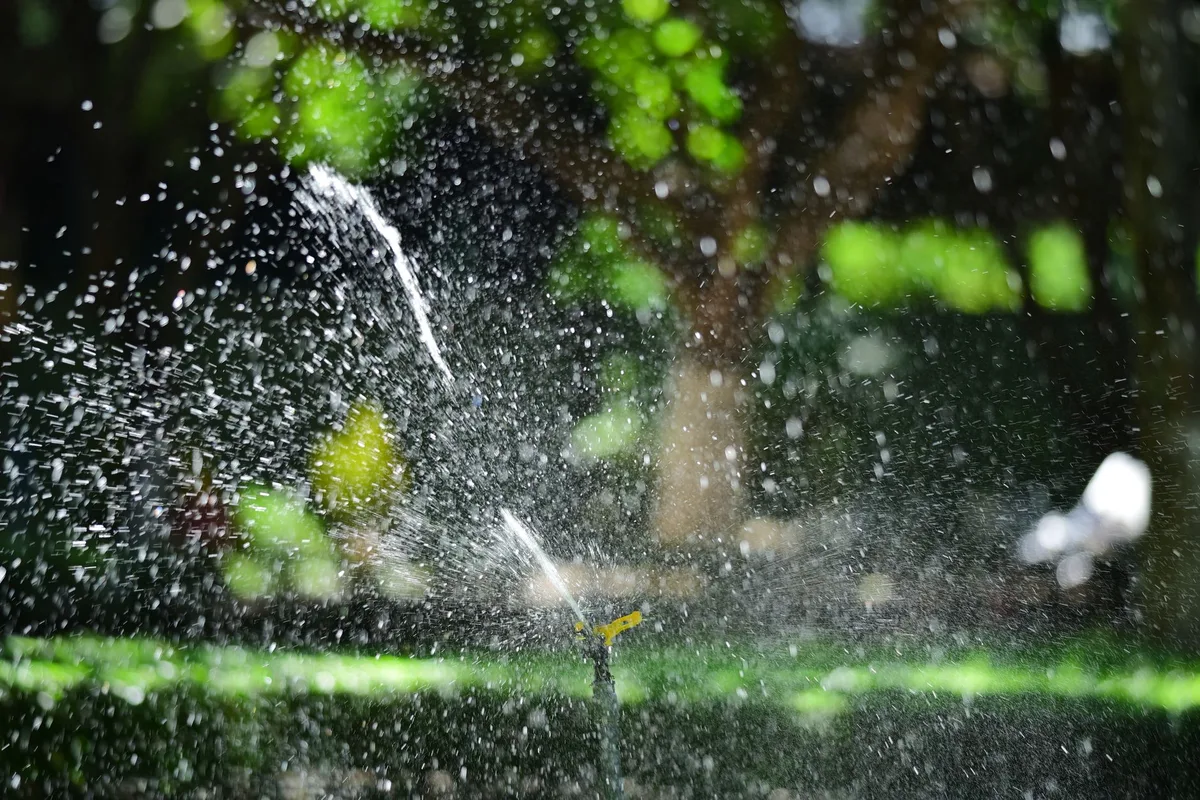
Grass needs 1 to 1.5 inches of water per week total. This includes rainfall. Apply it in one or two deep sessions.
Never water every day. Water early in the morning to reduce evaporation. Adjust for your soil type and grass variety.
Clay soil holds water longer. Sandy soil drains fast. Your exact number depends on these factors.
The '1 Inch Per Week' Rule Is Lying to You
That standard recommendation came from old extension service guides for cool-season grasses growing in loamy soil with moderate summer temperatures. If you have Bermuda grass on sandy soil in Texas, that number is way off. If you have tall fescue on clay in Ohio, it might be close but the timing is wrong.
Here is why the rule falls apart for most lawns.
One inch per week assumes even distribution and no runoff. Most sprinkler systems waste 30 to 50 percent of water to evaporation and overspray. That number comes from manufacturer specifications and irrigation industry data.
So when you run your system for 30 minutes, your grass might only see half an inch.
The rule also ignores dormancy. Warm-season grasses like Bermuda and zoysia go dormant in cool weather and need almost no water. Cool-season grasses like fescue and bluegrass slow down in summer heat and actually need less water during the hottest months, not more.
Our research across multiple university turf programs shows that watering on autopilot through seasonal changes causes more lawn problems than any other single mistake.
The real answer depends on three variables you can measure yourself.
Step 1: Identify Your Grass Type
Your grass type determines how often and how deeply you should water. Cool-season and warm-season grasses have completely different growth cycles and water needs.
Cool-Season Grasses
These grasses grow actively in spring and fall. They slow down or go dormant in summer heat. Common types include tall fescue, Kentucky bluegrass, perennial ryegrass, and fine fescue.
- Active growth: 60 to 75 degrees Fahrenheit
- Summer behavior: goes semi-dormant in heat, needs less water
- Root depth: 6 to 8 inches typical
- Watering strategy: deep but less frequent in summer, more frequent in spring and fall
For cool-season grass, water when the grass shows signs of wilt. The footprint test works well. Walk across the lawn.
If your footprints stay visible after a few minutes, the grass needs water.
Warm-Season Grasses
These grasses thrive in summer heat. They go dormant and turn brown in winter. Common types include Bermuda, zoysia, St.
Augustine, and centipede.
- Active growth: 80 to 95 degrees Fahrenheit
- Summer behavior: peak growth, needs consistent deep water
- Root depth: 8 to 12 inches typical
- Watering strategy: deep and regular during growing season, very little during dormancy
Warm-season grass is more drought tolerant by nature. St. Augustine needs more water than Bermuda.
Zoysia sits in the middle. Check the label from your sod supplier if you are unsure what variety you have. A quick lawn check before setting your timer can save you from overwatering problems later.
Step 2: Figure Out Your Soil Type
Soil type controls how fast water soaks in and how long it stays available to the roots. This is the variable most homeowners ignore, and it causes the most watering mistakes.
The Jar Test
You can identify your soil in about five minutes. Dig a small sample from your lawn, about four inches deep. Remove any roots or rocks.
Put the soil in a clear jar and fill it with water. Shake it hard for a minute, then set it down and wait.
After one minute, measure the sand layer that settles at the bottom. After two hours, measure the silt layer. After 24 hours, measure the clay layer on top.
- Sand: gritty feel, settles in seconds
- Silt: smooth feel like flour, settles in hours
- Clay: sticky feel, stays suspended for a day or more

How Soil Type Changes Watering
Clay soil holds water like a sponge. It absorbs slowly but retains moisture for days. Watering too often on clay causes runoff and shallow roots.
For clay soil, water deeply, let it dry out between sessions, and use cycle-soak to avoid runoff.
Sandy soil drains like a sieve. Water passes through fast and takes nutrients with it. For sandy soil, water more frequently but for shorter durations.
You may need to water three times per week instead of once.
Loamy soil is the ideal balance. It drains well but holds enough moisture for deep root growth. Loam is rare in nature but common in high quality topsoil blends.
If you have loam, the standard recommendations work well for you.
Here is a quick reference table for how soil type changes your watering approach.
| Soil Type | Infiltration Rate | Water Retention | Recommended Frequency | Risk |
|---|---|---|---|---|
| Sandy | Fast | Low | 2 to 3 times per week | Underwatering, nutrient loss |
| Loam | Moderate | Moderate | 1 to 2 times per week | Ideally balanced |
| Clay | Slow | High | 1 time per week | Overwatering, runoff, fungus |
Step 3: Measure What Your Sprinkler System Actually Puts Out
This step changes everything. Most people set their sprinkler timer based on a guess or what a neighbor told them. You need to measure what your specific system delivers.
The Tuna Can Test
Grab three to five empty tuna cans or cat food cans. They should have straight sides. Place them around the area your sprinkler covers.
One near the head, one in the middle, one at the far edge. Run your sprinkler for exactly 15 minutes.
After 15 minutes, check each can. Use a ruler to measure the depth of water in each can. Add the measurements together, then divide by the number of cans to get your average.
That tells you how much water your system delivers in 15 minutes.
For example, if you have four cans with depths of 0.2, 0.3, 0.25, and 0.35 inches, your average is 0.275 inches per 15 minutes. That means your system delivers roughly 0.55 inches per 30 minutes of run time.
How to Calculate Your Needed Run Time
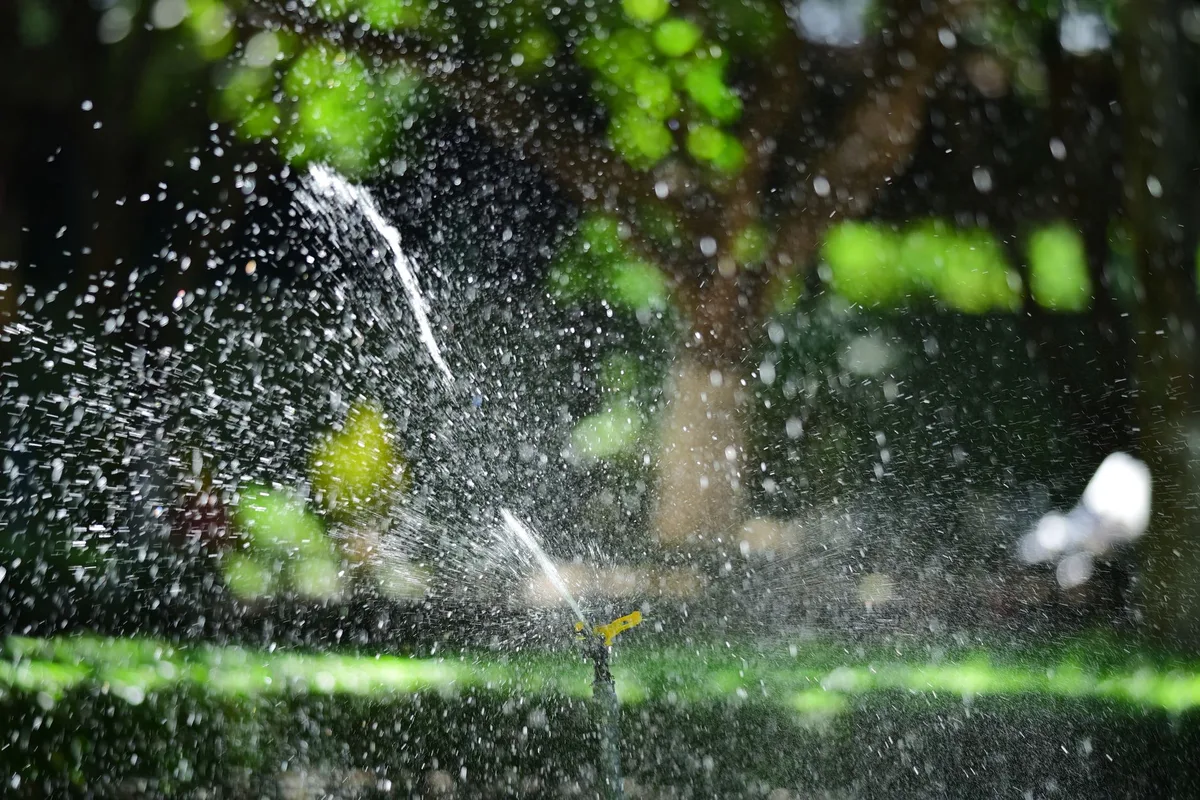
Now you know your precipitation rate. You also know your target is 1 to 1.5 inches per week including rain. Here is the math.
Target per week: 1 inch
Your system delivers: 0.275 inches per 15 minutes
Run time needed: 1 divided by 0.275 equals about 3.6 fifteen-minute cycles per week
That works out to roughly 54 minutes total per week, split into two or three sessions. If you water twice per week, each session runs about 27 minutes. Adjust for your specific numbers.
This measurement accounts for your sprinkler type, water pressure, and coverage pattern. It is the only reliable way to know what your lawn actually receives. Skip this step, and you are guessing.
Step 4: Build Your Custom Watering Schedule (Decision Tree)
This is where everything comes together. Use your grass type, soil type, and measured sprinkler output to build a schedule that fits your specific lawn.
If you skipped the tuna can test in Step 3, go back and do it. Guessing your run time is the fastest way to waste water or damage your grass.
If You Have Clay Soil + Cool-Season Grass
Clay holds water well. Cool-season grass slows down in summer heat. This combination means you water less often.
Water once per week during summer. Apply about 1 inch total. Watch for runoff.
Clay absorbs slowly, so break your watering into two cycles. Water for 15 minutes, let it soak in for 30 minutes, then water again for 15 minutes. This is the cycle and soak method.
In spring and fall, you might not need to water at all if rainfall is normal. Cool-season grass in clay soil stays hydrated longer than you think.
If You Have Sandy Soil + Warm-Season Grass
Sandy soil drains fast. Warm-season grass grows actively in heat. This combination needs more frequent watering.
Water two to three times per week. Each session delivers about half an inch. Your total per week should reach 1.5 inches.
The sand will drain quickly, so do not wait for the soil to dry completely between sessions.
Bermuda grass handles this well. St. Augustine needs more consistency.
If you have St. Augustine on sand, water on the higher end of that range.
If You Have Loam Soil + Any Grass
Loam is forgiving. You have the ideal balance of drainage and retention.
Water once or twice per week. Each session delivers 0.5 to 0.75 inches. Total weekly target is 1 to 1.5 inches.
Both cool-season and warm-season grasses perform well in loam with standard watering.
Monitor rainfall closely. If you get half an inch of rain, skip one watering session. If you get a full inch, skip the whole week.
Quick Reference Table
| Grass Type | Soil Type | Summer Frequency | Summer Weekly Total | Winter Frequency |
|---|---|---|---|---|
| Cool-season | Clay | 1x per week | 1 inch | Very little |
| Cool-season | Loam | 1 to 2x per week | 1 to 1.5 inches | Minimal |
| Cool-season | Sandy | 2 to 3x per week | 1.5 inches | Rarely needed |
| Warm-season | Clay | 1x per week | 1 inch | Dormant, not needed |
| Warm-season | Loam | 1 to 2x per week | 1 to 1.5 inches | Dormant, not needed |
| Warm-season | Sandy | 2 to 3x per week | 1.5 inches | Dormant, not needed |
This table works as a starting point. Adjust based on your tuna can test results and local weather.
Step 5: Apply Water the Right Way (Cycle and Soak Method)
How you apply water matters as much as how much you apply. The cycle and soak method prevents runoff and pushes water deep into the root zone.
Instead of running your sprinkler for 30 minutes straight, run it for 15 minutes. Turn it off for 30 to 60 minutes. Then run it again for another 15 minutes.
Repeat until you reach your total target.
This gives the water time to soak into the soil. A long single session on clay soil just runs off into the street. A long session on sandy soil pushes water past the root zone before the roots can absorb it.
How to Avoid Runoff on Slopes and Hard Soil
Slopes make watering harder. Water runs downhill before it can soak in. Hard soil acts the same way.
For slopes, use the cycle and soak method with shorter cycles. Water for 10 minutes. Wait 30 minutes.
Water for another 10 minutes. This lets each application soak in before the next one arrives.
You can also install a drip zone or use a rotary sprinkler with a lower precipitation rate. Rotary heads deliver water more slowly than spray heads, which helps with runoff. Manufacturer specs for rotary heads typically show half the output rate of standard spray heads.
Why One Long Watering Session Wastes Water
A single long session creates three problems. Runoff wastes water. Shallow roots form because the water never penetrates deep.
And the soil surface stays wet too long, encouraging fungus.
Turfgrass extension research consistently shows that deep, infrequent watering produces healthier roots than frequent shallow watering. The ideal schedule pushes water to 6 inches deep, then lets the soil dry before the next session.
This wet-dry cycle is essential. Roots need oxygen. Constant moisture suffocates them and promotes disease.
Special Cases That Change Everything
Not every lawn follows the standard schedule. Here are the exceptions that require adjustments.
Watering New Sod or Fresh Seed
New grass needs completely different treatment. Sod and seed have no established root system. They dry out fast and die fast.
For new sod, water every day for the first two weeks. The soil should stay moist but not muddy. Water 10 to 15 minutes per zone each day.
After two weeks, gradually reduce frequency.
For new seed, water two to three times per day for short durations. The top inch of soil must stay damp. Once the seedlings reach 2 inches tall, reduce to once per day.
After the first mowing, shift to the standard schedule.
Watering a Lawn in Shade vs. Full Sun
Shaded grass needs less water. Sun exposure drives evaporation and plant water use. A lawn in full shade can use half the water of a lawn in full sun.
Water shaded areas less frequently. Let the soil dry more between sessions. Shade stays damp longer, which increases disease risk.
If the shade comes from trees, the roots also compete for water, so watch for dry spots near tree bases.
Watering During a Drought or Heat Wave
During extreme heat, grass goes into survival mode. Cool-season grass turns brown and goes dormant. Warm-season grass keeps growing but needs more water.
In a heat wave, standard recommendations change. Do not try to keep cool-season grass green. It costs too much water and stresses the plant.
Let it go dormant. It will come back when temperatures drop and rain returns.
For warm-season grass in extreme heat, increase frequency slightly but keep watering deep. Shallow watering during a heat wave causes root burn and permanent damage.
Watering a Lawn on a Slope
Slope watering already covered in the cycle and soak section. The key point is that slopes need shorter, more frequent watering cycles to prevent runoff. Use low precipitation rate sprinklers like rotary nozzles instead of spray heads.
Common Watering Mistakes That Ruin Your Lawn
Most lawn problems come from watering errors. Here are the ones we see most often.
Overwatering: The #1 Cause of Lawn Problems
Overwatering causes shallow roots, fungus, weeds, and wasted money. It is more common than underwatering. Most people water too often, not too much.
Signs of overwatering include mushrooms in the lawn, standing water, yellowing grass, and a spongy feel when you walk. If you see these signs, cut your watering frequency in half.
Aggregate reviews from turfgrass extension programs show that overwatered lawns have three times more disease pressure than properly watered lawns. That is not a small difference.

Watering at the Wrong Time of Day
Midday watering wastes 30 to 50 percent to evaporation. Evening watering leaves the grass wet overnight, inviting fungus. Early morning is the only good time.
Water between 4 and 7 AM. The water soaks in before the sun gets high. The grass dries during the day.
Disease risk drops and water efficiency improves.
If you cannot water in the morning, late afternoon is the second best option. Give the grass at least four hours to dry before nightfall.
Ignoring Rainfall Totals
Rain counts toward your weekly total. If you get half an inch of rain, subtract that from your weekly target. Many people keep watering on their timer schedule regardless of weather.
Use a rain gauge to track rainfall. Place it in an open area away from trees and buildings. Check it after each storm.
Adjust your sprinkler schedule accordingly.
Smart controllers with rain sensors handle this automatically. But a simple manual rain gauge and a notebook work just as well.
Setting Your Timer Once and Forgetting It
Watering needs change with the seasons. The schedule that works in June will overwater in September and underwater in July.
Adjust your timer at least four times per year. Once for spring, once for summer, once for fall, and once for winter dormancy. Mark it on your calendar.
Seasonal adjustments are the cheapest way to improve lawn health.
Expert Tips for Smarter Watering
These tips come from turfgrass research and decades of practical lawn management.
How to Use the Footprint Test
Walk across your lawn in the afternoon. Look behind you. If your footprints stay visible in the grass after a few minutes, the grass is wilted and needs water.
If the grass springs back, it has enough moisture.
This test is free, instant, and reliable. It works for all grass types in all climates. Use it before each scheduled watering session to confirm the grass actually needs water.
When and Why to Water Deeply and Infrequently
Deep watering pushes moisture down where roots grow. Shallow watering keeps moisture at the surface where it evaporates and where weed seeds germinate.
Water once or twice per week instead of every day. Apply enough to reach 6 inches deep. Check depth by pushing a screwdriver into the soil after watering.
The screwdriver should slide in easily to that depth.
The right fungicide choice becomes more important if you have been overwatering. It works better when you fix the schedule first.
How to Adjust Your Schedule Season by Season
Spring and fall are active growth periods for cool-season grass. Summer is active growth for warm-season grass. Winter is dormancy for both in most climates.
- Spring: Water once per week if rain is scarce. Do not water if rain is normal.
- Summer: Water according to your grass type and soil combination from the decision tree.
- Fall: Reduce frequency as temperatures drop. Cool-season grass may need no watering after September.
- Winter: Turn off your irrigation system. Grass goes dormant. Let rain handle it.
If you have a sprinkler system, drain and winterize it before the first freeze. A frozen pipe costs more to fix than any watering mistake.
Frequently Asked Questions
Should I water every day?
No. Daily watering encourages shallow roots and disease. Deep, infrequent watering is always better.
Water once or twice per week at most.
How long should I run each zone?
It depends on your sprinkler output. Run the tuna can test from Step 3. Then calculate the run time needed to deliver 0.5 to 0.75 inches per session.
Most zones need 20 to 40 minutes.
Is morning or evening better for watering?
Morning is better. Water between 4 and 7 AM. Evening watering leaves grass wet overnight and increases fungal pressure.
Midday watering wastes half the water to evaporation.
Can I water too much even if it's hot?
Yes. Overwatering in heat causes root suffocation and disease. Hot weather increases evaporation but does not change the soil's ability to hold water.
Stick to your schedule and check the footprint test.
Do I need a smart irrigation controller?
You do not need one but it helps. Smart controllers adjust based on rainfall and evaporation data. They save water and prevent overwatering.
A basic timer with a rain gauge works too.
Your Quick-Reference Decision Guide
Grass Type × Soil Type × Season: Recommended Watering Schedule
| Season | Cool-Season Grass | Warm-Season Grass |
|---|---|---|
| Spring | 1x per week, 0.5 to 1 inch | 1x per week, 0.5 inch |
| Summer | 1 to 2x per week, 1 to 1.5 inches | 1 to 2x per week, 1 to 1.5 inches |
| Fall | Minimal, let rain handle it | 1x per week, 0.5 inch |
| Winter | Off, dormant | Off, dormant |
Adjust each entry based on your soil type from the earlier table.
Signs Your Lawn Needs Water (and Signs It's Had Enough)
Needs water: footprints stay visible, grass blades fold in half, color turns blue-gray, soil feels dry 3 inches down.
Had enough: mushrooms appear, standing water pools after rain, grass feels spongy, yellow patches develop, runoff flows into the street.
Check for these signs before you touch the timer. The lawn will tell you what it needs. You just have to watch.