How Often Should You Mow Your Lawn for 2026: Complete Guide
How Often Should You Mow Your Lawn is a question that trips up more homeowners than you'd think. Ask five neighbors and you'll get five different answers, Monday, Saturday, every two weeks, "when it looks shaggy." The truth is there's no single magic day that works for everyone. Your lawn changes week to week, and your mowing schedule needs to change with it.
University turfgrass programs have been studying this for decades. They all point to one simple rule that changes everything: never cut off more than one-third of the grass blade in a single mow. That single guideline, known as the one-third rule, is the key to knowing exactly how often you should mow.
Let's walk through it step by step so you can stop guessing and start mowing on the right rhythm for your specific lawn.
Quick Answer
Mow your lawn whenever the grass has grown one-third above your target height. That's the rule. For most lawns in peak growing season, that means every five to seven days.
Warm-season grasses like Bermuda may need mowing every three to four days. Cool-season grasses in spring and fall often need a weekly cut. During drought or heat, slow growth means you can wait ten to fourteen days.
Measure the grass first. Then decide.
Why "Once a Week" Usually Fails You
A fixed weekly schedule feels convenient. You put "mow lawn" on Saturday morning and you're done. But your grass doesn't grow on a calendar.
Growth rate shifts with temperature, rainfall, fertilizer, and the time of year.
In spring, cool-season grasses surge. You might need to mow every four or five days to stay ahead. Come July, the same grass might only need cutting every ten days.
Stick to a rigid once-a-week plan and you'll scalp it in spring and let it get shaggy in summer.
The real issue is that once a week ignores the one-third rule. If you let the grass get too tall between cuts, you're forced to remove more than one-third of the blade when you finally mow. That stresses the plant.
It turns the lawn brown, weakens the root system, and opens the door for weeds and disease.
Think of it this way. You're not mowing on a schedule. You're mowing when the grass tells you it's time.
The calendar is just a rough guide.
The One Rule That Changes Everything
The one-third rule is the closest thing to a universal law in lawn care. It applies to every grass type, every climate, every season. Here it is in plain English.
Never cut off more than one third of the grass blade's current height in a single mowing session.
That means if your target height is three inches, you mow when the grass reaches about four and a half inches. You cut off the top inch and a half, exactly one third. The plant keeps enough leaf surface to photosynthesize and recover quickly.
Break this rule and here's what happens. The shock of losing too much leaf at once forces the grass to tap into root reserves. Roots stop growing deeper.
The lawn thins out. Weeds move in. And you end up with that brown, scalped look that takes weeks to recover from.
So how do you use this rule to set your schedule? Measure the grass height. If it's less than one-third above your target, leave it.
If it's at that threshold or higher, it's time to mow. Simple as that.
Your Grass Type Decides the Range
Not all grass is the same. The ideal mowing height for your lawn depends entirely on what species you're growing. And that height range is what you use to apply the one-third rule.
Cool-Season Grasses
These thrive in northern climates with cold winters and moderate summers. They grow most actively in spring and fall.
- Kentucky bluegrass: 2.5 to 3.5 inches
- Tall fescue: 3 to 4 inches (go higher in summer)
- Fine fescue: 2.5 to 3.5 inches
- Perennial ryegrass: 2 to 3 inches
Warm-Season Grasses
These love heat and grow best in southern regions. They peak in summer and go dormant in winter.
- Bermuda grass: 1 to 2 inches
- Zoysia grass: 1 to 2 inches (up to 2.5 in shade)
- St. Augustine: 2.5 to 4 inches
- Centipede grass: 1.5 to 2.5 inches
- Bahia grass: 2.5 to 4 inches
Pick your target height from the middle of your grass type's range. That gives you room to go a little higher during heat stress and a little lower in spring or fall when conditions are ideal.
If you're not sure what grass you have, take a sample to your local extension office. Most will identify it for free. Getting this right is the foundation of everything else.
When to Mow This Week: A Quick Decision Flow
Here's where the one-third rule turns into a practical decision you can make every few days. Use this simple flow to decide whether to mow today or wait.
Step 1: Check the current height
Go outside and measure the grass. Use a ruler or a height gauge. Don't guess.
People are consistently wrong when they eyeball it.
If your target height is three inches and the grass is at three and a half inches, you're not there yet. Wait.
Step 2: Apply the one-third rule
Take your target height and multiply by 1.33. That's the height at which you need to mow.
| Target Height | Mow When Grass Reaches |
|---|---|
| 2 inches | 2.66 inches |
| 2.5 inches | 3.3 inches |
| 3 inches | 4 inches |
| 3.5 inches | 4.66 inches |
| 4 inches | 5.3 inches |
If the grass is at or above that number, it's mowing time. If it's below, wait and check again in two or three days.
Step 3: Consider growth rate
Is it spring with lots of rain and fertilizer? Growth could be two inches per week. That means you might mow every four or five days.
Is it the middle of a dry August? Growth might be half an inch per week. You could go ten to fourteen days between cuts.
Is it an irrigated lawn in summer? Water keeps growth going, so don't let your guard down just because it's hot.
Step 4: Check moisture
Is the grass wet from rain or morning dew? If yes, wait until it's dry. Mowing wet grass causes clumping, uneven cuts, and spreads fungal diseases.
A dry lawn cuts cleanly and leaves a better result.
That's it. Four questions. Height, one-third rule, growth rate, moisture.
Answer them honestly and you'll never mow too early or too late again.
The Right Way to Set Your Mowing Height
Setting the mower height correctly is where most people trip up. They set it once in spring and never touch it again. That's a mistake.
Your cutting height should change through the season based on what the grass needs.
Spring
Start the season on the lower end of your grass type's range. This helps remove dead material from winter and encourages the grass to thicken up. For tall fescue, that might be three inches.
For Bermuda, one inch.
Summer
Raise the height. Grass growing in heat stress needs more leaf surface to survive. Taller grass shades the soil, holds moisture longer, and keeps roots cooler.
If you usually mow tall fescue at three inches, bump it to three and a half or even four inches in July.
Fall
Lower it back down gradually as temperatures cool. This helps the grass prepare for winter and reduces the risk of snow mold in northern climates. Don't scalp it, just drop back to your normal spring height.
Checking the mower deck
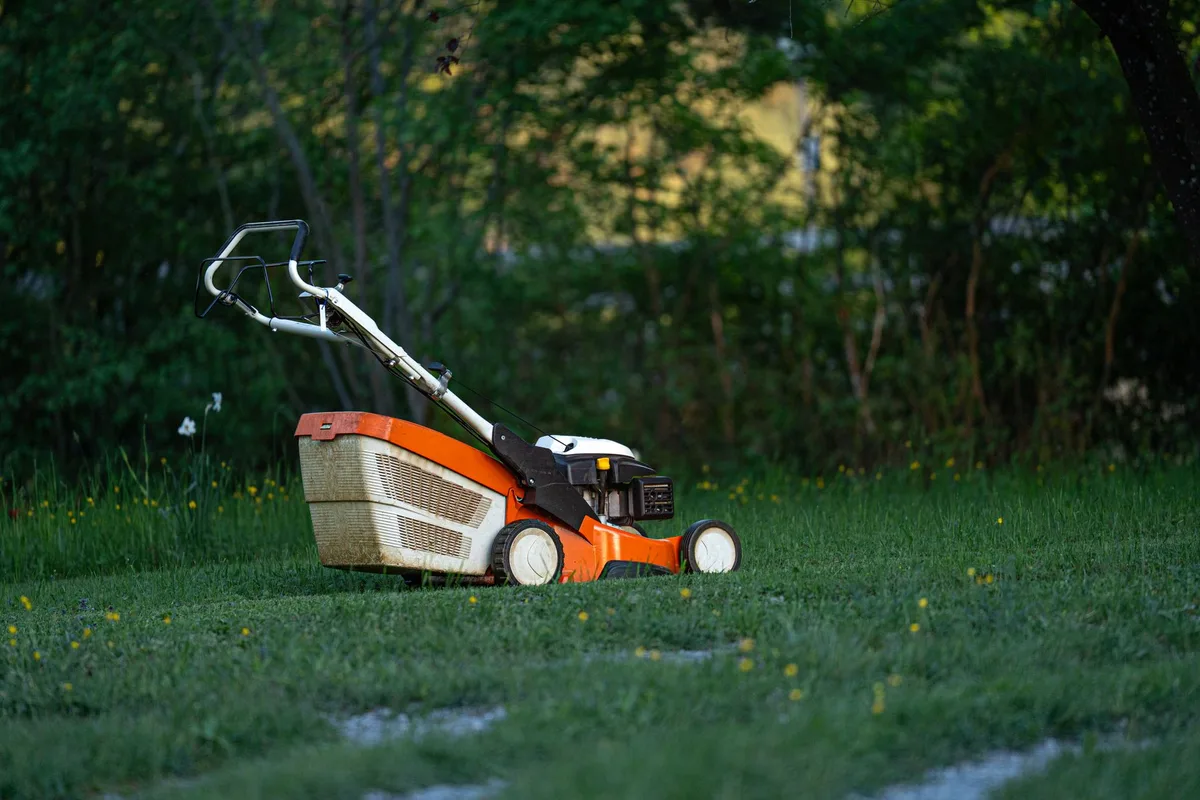
Here's an easy way to verify your cutting height. Park the mower on a flat driveway or patio. Measure from the ground to the blade tip with the mower off and the spark plug disconnected.
Adjust each wheel so the deck is level side to side. An uneven deck scalps one side of the lawn and leaves the other side too long.
Also check if you need simple DIY repairs on your mower before the season starts. A loose belt or dull blade throws off the whole cut. Sharp blades are critical, a dull blade tears the grass instead of cutting it, leaving ragged tips that turn brown within 24 hours.
If you're dealing with fungus issues from poor mowing habits or wet conditions, the right fungicide for lawns can help get things back under control. But fixing the mowing schedule is the first step.
For lawns under shade trees, growth is slower and grass stays wetter longer. Those areas may need mowing less often. Some of the best trees for hot dry climates let in dappled light that changes how the grass underneath grows.
Set the height, sharpen the blade, and check it every few mows. Your lawn will tell you if it's working.