How to Tree Borers 2026
If you've noticed D-shaped holes in your ash tree's bark or sawdust piles around the trunk, you're dealing with tree borers. These wood-boring insects tunnel through the cambium and sapwood, cutting off the tree's vascular system and causing rapid decline or death if left untreated.
The USDA Forest Service estimates that emerald ash borer alone has killed hundreds of millions of ash trees across North America since its detection in 2002. Here's how to identify which borer you're facing, assess the damage, and decide whether treatment or removal makes sense.
Quick Answer
Tree borers are wood-boring beetle larvae that feed inside tree trunks. Identify your borer species by exit hole shape and host tree type. Treat early infestations with systemic insecticides applied via soil drench or trunk injection.
Treatment works best in spring before adult emergence. Trees with more than 30% canopy dieback usually can't be saved.
What Tree Borers Are and Why They're So Destructive
Tree borers aren't a single pest. The term covers dozens of beetle species whose larvae tunnel through living wood. These include metallic wood borers (flatheaded borers), longhorn beetles (roundheaded borers), and clearwing moths.
Adult beetles lay eggs in bark crevices or directly on the trunk. When larvae hatch, they bore into the tree and feed on the cambium layer, the thin living tissue that transports water and nutrients. A heavy infestation essentially girdles the tree from the inside.
What makes borers so damaging is that you rarely notice them until the tree is already in trouble. By the time you see exit holes or canopy dieback, the larvae have been feeding for months or even years. The tree's ability to recover depends on how much of the vascular system remains intact.
Stressed trees attract borers more readily than healthy ones. Drought, soil compaction, recent transplanting, or mechanical injury all weaken a tree's natural defenses and release chemical signals that draw egg-laying adults.
How to Tell If Your Tree Has Borers (Signs and Symptoms)
Early detection is everything. Here's what to look for during a visual inspection:
Exit holes in the bark
Round, oval, or D-shaped holes appear when adult beetles emerge. Hole size and shape vary by species. Emerald ash borer creates distinctive D-shaped holes roughly 1/8 inch across.
Longhorn beetles leave round holes up to 1/2 inch in diameter.
Frass (sawdust-like material)
Fresh frass around the trunk base or in bark crevices indicates active feeding. It looks like fine sawdust or packed pellets depending on the borer species.
S-shaped galleries under the bark
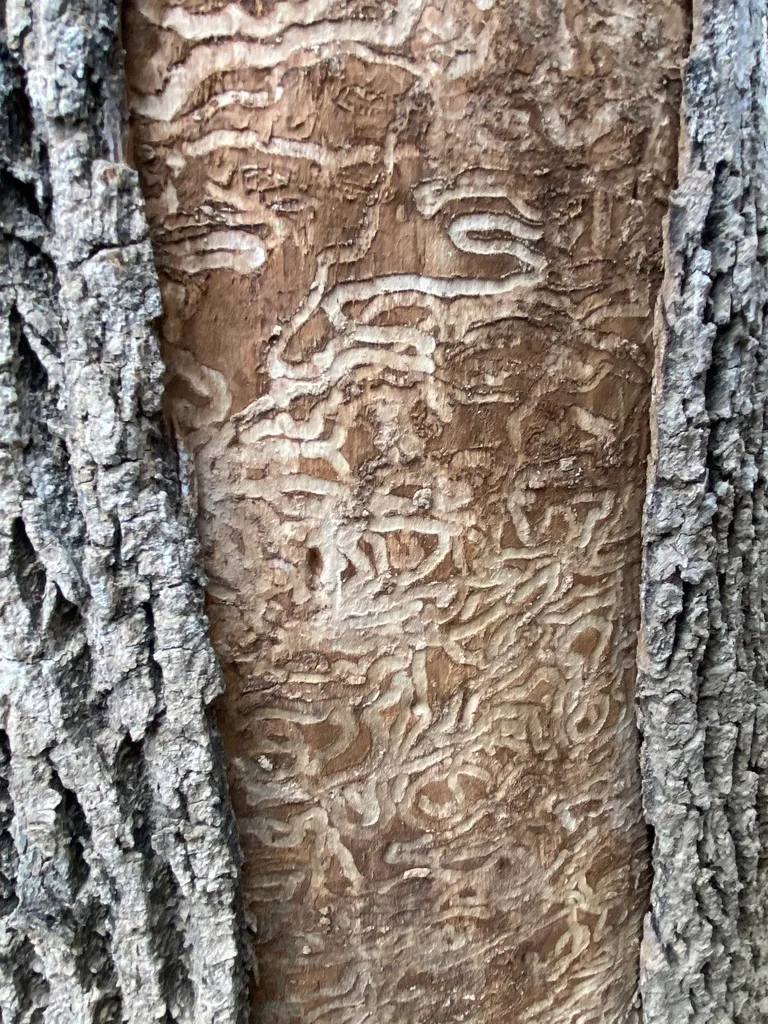
Peel back a section of loose bark. You'll see serpentine tunnels where larvae have fed. Emerald ash borer galleries wind back and forth in a distinctive pattern.
Bronze birch borer creates lateral galleries that run along the grain.
Canopy dieback
Thinning foliage at the top of the tree or isolated dead branches signal vascular damage. Dieback usually starts in the upper canopy and works downward as the infestation spreads.
Bark splitting and cracks
Feeding damage disrupts cambium growth, causing vertical splits in the bark. You might also see raised bark or bumps where larvae are feeding just beneath the surface.
Epicormic shoots
These are small sprouts that emerge from the trunk or main branches. They're a stress response when the tree tries to compensate for lost canopy.
Woodpecker damage
Woodpeckers feed on borer larvae and can strip large sections of bark. Heavy woodpecker activity is often the first visible clue that borers are present.
Time your inspection for late spring or early summer when adult beetles emerge. Exit holes are easier to spot when they're fresh, and you can confirm active infestation if you see beetles on the trunk.
Identifying Which Type of Borer You're Dealing With
Treatment depends on knowing exactly which pest you're facing. Here's how to tell them apart.
Emerald Ash Borer (EAB)
Host trees are ash species only (Fraxinus genus). Exit holes are D-shaped and roughly 1/8 inch wide. Look for S-shaped galleries under the bark that cut through both sapwood and outer bark layers.
Adults are metallic green beetles about 1/2 inch long. They emerge in late May through June in most regions. Larvae are white, flat, and segmented with a pair of brown pincers at the tail end.
EAB is an invasive species and subject to federal and state quarantine regulations. If you confirm EAB, contact your state department of agriculture or cooperative extension service.
Bronze Birch Borer
This flatheaded borer targets birch trees, especially European white birch and paper birch. Exit holes are oval or D-shaped, about 1/4 inch across. Galleries run horizontally along the grain just under the bark.
Adults are bronze or olive-colored beetles roughly 1/2 inch long. They emerge in late spring. Larvae are white with a flattened, segmented body.
Bronze birch borer thrives in hot, dry conditions. Trees planted outside their natural range or in compacted urban soils are especially vulnerable.
Flatheaded Appletree Borer
Despite the name, this borer attacks a wide range of hardwoods including oak, maple, hickory, and fruit trees. It's an opportunistic pest that targets stressed or newly planted trees.
Exit holes are oval and about 1/4 inch wide. Galleries are shallow and irregular, usually confined to the outer sapwood. Adults are flat, metallic gray-green beetles about 1/2 inch long.
Larvae are white and legless with a broad, flattened thorax.
This borer rarely kills healthy, established trees but can girdle saplings or recently transplanted specimens.
Roundheaded Borers (Longhorn Beetles)
This group includes dozens of native and invasive species. The Asian longhorned beetle is the most destructive, attacking maple, birch, willow, elm, and other hardwoods.
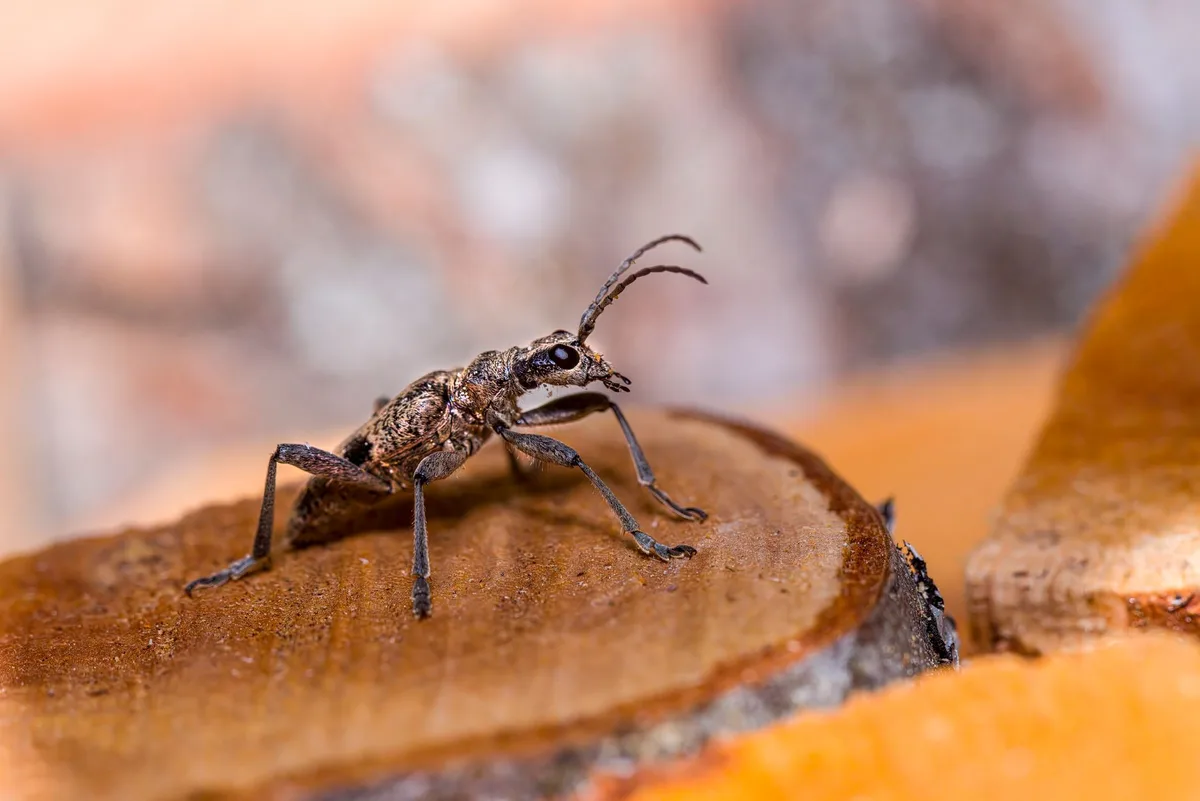
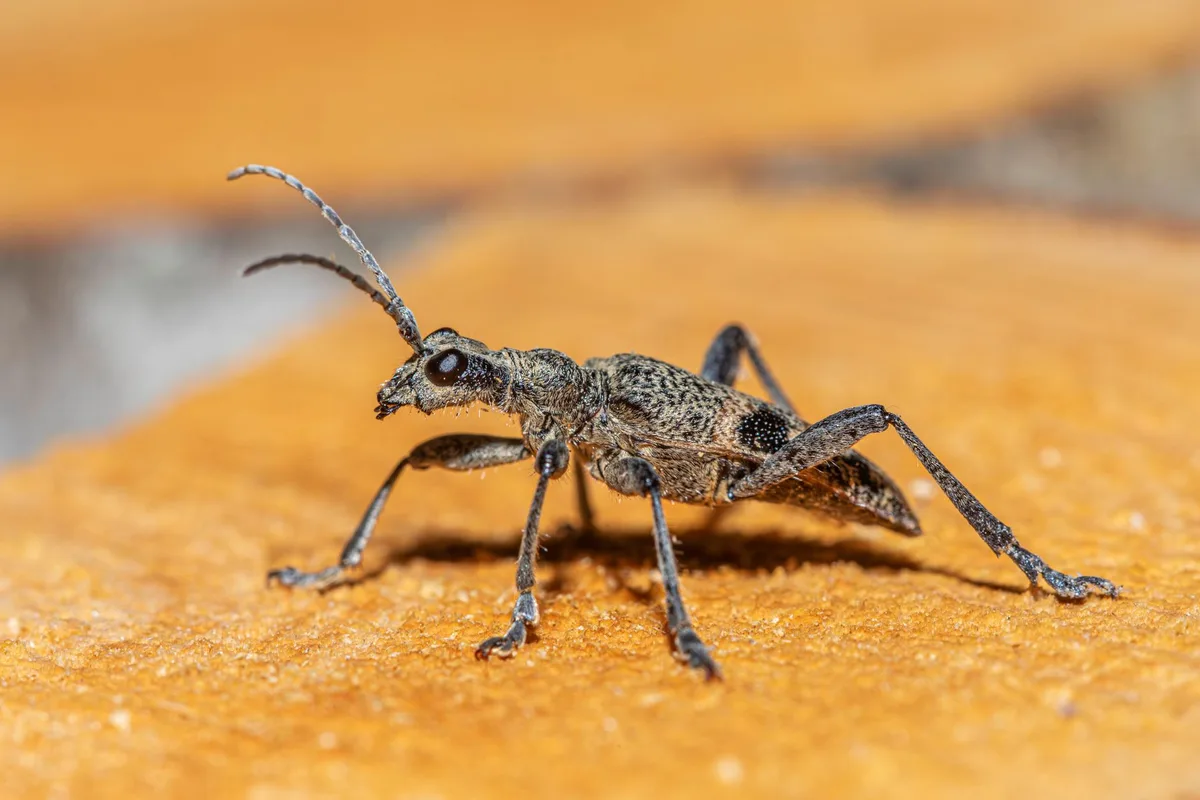
Exit holes are perfectly round and large, typically 3/8 to 1/2 inch in diameter. Galleries penetrate deep into the heartwood. Adults are black with white spots and long, segmented antennae.
Larvae are cream-colored, cylindrical, and legless.
Native longhorn beetles usually attack dead or dying wood. Invasive species like Asian longhorned beetle will bore into healthy trees and cause rapid decline.
Clearwing Borers
These moth larvae attack ornamental trees and shrubs, including dogwood, birch, ash, and stone fruit trees. Peachtree borer is the most common in orchards and landscapes.
You won't see exit holes. Instead, look for gummy sap mixed with frass at the trunk base. Adults are day-flying moths that resemble wasps, with clear wings and yellow or red bands on the abdomen.
Larvae are white or cream-colored with a brown head.
Clearwing borers feed on the lower trunk and root crown, making them harder to detect until the tree shows severe stress.
Assessing How Bad the Infestation Is
Once you've identified the pest, you need to decide if the tree can be saved. Here's the decision framework.
Canopy dieback percentage
Estimate how much of the canopy is dead or thinning. Less than 30% dieback means the tree still has enough vascular function to respond to treatment. Between 30% and 50% is a judgment call, treatment might stabilize the tree but recovery is slow.
More than 50% dieback usually means the tree is too far gone.
Number and density of exit holes
Count exit holes on the trunk and main branches. A few scattered holes suggest a light infestation that's caught early. Dozens of holes clustered in one area indicate a heavy population that's been feeding for multiple seasons.
Bark condition
Peel back a section of loose bark. If the cambium underneath is still green or white, the vascular system is alive. Brown or black cambium means that section of the tree is dead.
Structural integrity
Borers weaken wood structure. Large exit holes or extensive galleries can compromise the trunk's ability to support the canopy. If the tree poses a hazard near buildings, power lines, or walkways, removal might be the safer choice even if treatment is technically possible.
Tree species and value
Some trees are worth treating, others aren't. A mature ash or birch in a landscape setting justifies the cost of systemic insecticide treatment. A scrubby volunteer tree in the back corner of the yard doesn't.
Species matters too. Ash trees respond well to systemic treatments if caught early. Birch trees are harder to save once bronze birch borer gets established because the damage progresses so quickly.
Treatment Options: What Works and When
If you've decided the tree is worth saving, here are your options.
Systemic Insecticides (Soil Drench vs. Trunk Injection)
Systemic insecticides are the most effective treatment for active borer infestations. The chemical is absorbed through roots or directly into the trunk, circulates through the vascular system, and kills feeding larvae.
Soil drench application
You mix the insecticide with water and pour it around the root zone. The tree absorbs the chemical through fine root hairs over several days. Soil drenches work best on smaller trees with trunk diameters under 12 inches.
Active ingredients include imidacloprid and dinotefuran. Imidacloprid is slower-acting but provides protection for up to two years. Dinotefuran works faster, within weeks, but only protects for one season.
Apply soil drenches in spring before adult emergence or in early fall when root uptake is strong. You'll need to water the area thoroughly before and after application to move the chemical into the root zone.
Trunk injection
A certified arborist drills small holes into the trunk and injects insecticide directly into the sapwood. The chemical circulates through the vascular system within hours.
Trunk injection delivers higher concentrations of insecticide exactly where larvae are feeding. It's the preferred method for large trees, trees with limited root zones (like street trees), or situations where soil contamination is a concern.
Emamectin benzoate is the most common trunk-injected insecticide. It provides two years of protection with a single treatment. Imidacloprid and dinotefuran are also available for trunk injection but require annual reapplication.
Trunk injection must be done by a licensed applicator in most states. The procedure creates entry points that can admit decay fungi, so it's not recommended for trees that are already structurally compromised.
| Method | Best For | Protection Duration | Cost (DIY or Professional) |
|---|---|---|---|
| Soil drench (imidacloprid) | Small to medium trees, preventive treatment | 1-2 years | $50-$150 DIY |
| Soil drench (dinotefuran) | Fast knockdown, immediate threats | 1 year | $60-$120 DIY |
| Trunk injection (emamectin benzoate) | Large trees, heavy infestations, street trees | 2 years | $150-$400 professional |
| Trunk injection (imidacloprid) | Moderate infestations, quicker effect | 1 year | $150-$300 professional |
Contact Sprays and Bark Applications
Contact insecticides kill adult beetles before they lay eggs. They don't kill larvae already inside the tree, so they're only useful as a preventive measure or to protect nearby uninfested trees.
You spray the trunk and main branches during adult emergence. Timing is critical. For emerald ash borer, that means late May through June in most regions.
Bronze birch borer emerges in late spring. Check with your state cooperative extension for local emergence windows.
Permethrin and bifenthrin are common active ingredients. Reapply every two to three weeks during the adult flight period. Coverage must be thorough, missing sections of bark leaves gaps where beetles can land and oviposit.
Contact sprays are labor-intensive and less effective than systemics. They make sense if you're protecting high-value trees in an area with known borer pressure and want to avoid soil or trunk applications.
Biological Controls (Parasitic Wasps and Nematodes)
Biological control uses natural enemies to suppress borer populations. It's a long-term strategy, not a quick fix for an active infestation.
Parasitic wasps
Several species of tiny parasitoid wasps attack borer larvae. The USDA has released wasps targeting emerald ash borer in quarantine zones. The wasps lay eggs inside borer larvae, and the wasp larvae consume the host from the inside.
Parasitic wasps are released by state or federal agencies, not sold for homeowner use. They reduce borer populations over multiple seasons but won't save a tree that's already heavily infested.
Entomopathogenic nematodes
These microscopic roundworms infect and kill borer larvae. You mix them with water and spray the solution onto the trunk. Nematodes enter the tree through exit holes and bark crevices, seeking out larvae in their galleries.
Nematode treatments require specific application conditions, high humidity, moderate temperatures, and repeated applications. Success rates are inconsistent. Research suggests they work best as part of an integrated pest management program rather than a standalone treatment.
Biological controls fit well if you're managing a woodlot or natural area where chemical treatments aren't practical. They don't replace systemic insecticides for saving individual landscape trees.
Timing Your Treatment: Windows That Actually Work
Timing makes or breaks borer treatment. Systemic insecticides only work when the tree is actively moving sap through its vascular system, and you need to kill larvae before they complete their life cycle and emerge as adults.
For most borer species, spring is the critical treatment window. Apply soil drenches or schedule trunk injections in April through early June, before adult beetles emerge and while trees are in active growth. The chemical reaches feeding larvae while they're still small and vulnerable.
Emerald ash borer has a strict calendar. Treat ash trees between mid-April and mid-May in most regions. Later applications miss the window when larvae are actively feeding in the outer sapwood.
Fall treatments can work in southern states where root uptake continues into October, but spring remains the most reliable window.
Bronze birch borer treatments should happen in late April through May, just before adults emerge in late spring. A second application in early fall can provide additional protection if borer pressure is high.
Don't treat during drought. Trees under water stress shut down sap flow, and systemic insecticides won't circulate properly. Water the tree deeply for two weeks before a soil drench application.
If you're using trunk injection during dry conditions, make sure the arborist confirms the tree has adequate sap flow before drilling.
Preventive treatments follow the same timing rules. If you're in an area with known borer pressure and want to protect high-value trees, apply systemic insecticides in spring even if you haven't seen damage yet.
DIY Treatment vs. Hiring a Certified Arborist
Soil drench applications are straightforward enough for most homeowners. You mix the product according to label directions, pour it around the root zone, and water it in. No special equipment required beyond a bucket and measuring cup.
Trunk injection is a different story. It requires drilling into the trunk at precise depths and angles, injecting the right volume of chemical, and sealing the holes afterward. Poor technique leaves wounds that invite decay fungi or fail to deliver the insecticide where it's needed.
Hire a certified arborist if the tree has a trunk diameter over 12 inches, if canopy dieback exceeds 20%, or if you're dealing with a high-value specimen near buildings or power lines. Arborists carry liability insurance and have the training to assess whether the tree is structurally sound enough to justify treatment.
Look for an International Society of Arboriculture (ISA) certified arborist with experience treating borer infestations. Ask specifically about their success rate with the borer species you're dealing with. Not all arborists have hands-on experience with invasive species like emerald ash borer or Asian longhorned beetle.
Get a written treatment plan that specifies the insecticide, application method, and expected outcomes. Reputable arborists will inspect the tree first, give you an honest assessment of survival odds, and recommend removal if the infestation is too advanced.
DIY soil drenches cost $50 to $150 depending on tree size and product choice. Professional trunk injection runs $150 to $400 per tree. Removal costs $500 to $3,000 or more depending on size and access.
Those numbers help frame the decision.
Step-by-Step: How to Apply Systemic Insecticides
Here's the process for a DIY soil drench application. This method works for trees under 12 inches in trunk diameter.
Step 1: Measure the trunk diameter
Use a tape measure at chest height, 4.5 feet above ground. Calculate the dose based on trunk diameter or circumference, whichever the product label specifies. Don't guess.
Underdosing won't protect the tree, overdosing can damage roots.
Step 2: Water the root zone deeply
Soak the area under the canopy drip line two days before application. You want the soil moist but not saturated. Wet soil improves root uptake and moves the chemical into the root zone faster.
Step 3: Mix the insecticide
Follow label directions exactly. Most products are concentrated liquids that you dilute with water. Wear gloves and eye protection.
Mix in a clean bucket, not a sprayer you've used for herbicides.

Step 4: Apply around the root zone
Pour the diluted solution in a band around the trunk, starting about 12 inches from the base and extending out to the drip line. You're targeting the fine feeder roots where uptake happens. Don't pour directly against the trunk.
Step 5: Water it in
Immediately after application, water the treated area with at least one inch of water. This moves the insecticide down into the root zone where it can be absorbed. Skip this step and the chemical sits on the surface, breaking down in sunlight.
Step 6: Mark the tree and record the date
Tag the tree with the treatment date and product used. Set a calendar reminder for the next application. Most soil drenches need reapplication every one to two years depending on the active ingredient.
Keep people and pets off the treated area until the soil dries. Store leftover concentrate in its original container, tightly sealed, in a cool dry place away from children and pets.
When Treatment Won't Work (and Removal Is the Right Call)
Some trees are too far gone to save. Here's when removal makes more sense than treatment.
If canopy dieback exceeds 50%, the tree has lost too much vascular function to recover. Even if treatment kills the remaining larvae, the tree won't regrow enough canopy to survive long term. You're spending money to delay the inevitable.
Structural damage is another red flag. If the trunk has extensive galleries or large sections of dead cambium, the wood can't support the canopy safely. A failure near a house, driveway, or walkway creates liability you don't want.
Multiple years of infestation mean the tree has been declining for a long time. By the time you notice heavy exit holes and severe dieback, several generations of borers have already fed. The damage is cumulative and often irreversible.
Some species don't respond well to treatment even when caught early. European white birch, for example, declines so rapidly from bronze birch borer that treatment rarely buys more than a few extra years. Native river birch is more resistant and a better replacement choice.
Economics matter too. If treatment costs approach 50% of removal cost and survival odds are low, removal followed by replanting makes more financial sense. A young healthy tree will outgrow a struggling treated tree within five to ten years.
Consider replacement species that resist the borers in your area. If you're losing ash to emerald ash borer, replanting with another ash isn't smart. Choose oak, maple, or other species suited to hot dry climates if drought stress was a contributing factor.
Preventive Measures to Protect Healthy Trees
Healthy trees resist borers better than stressed ones. Here's how to reduce vulnerability.
Water during drought
Borers target water-stressed trees. Deep watering once a week during dry periods keeps the vascular system functioning and helps trees produce defensive compounds that deter egg-laying adults. Apply one inch of water per week, measured with a rain gauge.
Mulch properly
A three-inch layer of wood chip mulch keeps roots cool, retains moisture, and improves soil structure. Keep mulch six inches away from the trunk to prevent bark rot. Mulch volcanoes (piled against the trunk) create exactly the kind of stress that attracts borers.
Avoid trunk injuries
Mechanical damage from mowers, string trimmers, or construction equipment creates entry points and releases stress signals. Protect trunks with mulch rings or trunk guards. Don't nail signs or decorations into the bark.
Fertilize cautiously
Excessive nitrogen pushes lush growth that's more attractive to some borer species. Avoid high-nitrogen fertilizers for fruit trees or ornamentals unless a soil test confirms a deficiency. Slow-release formulations are safer than quick-release products.
Prune dead wood promptly
Remove dead or dying branches as soon as you notice them. Dead wood attracts egg-laying beetles and gives larvae a foothold before they move into living tissue. Make clean cuts just outside the branch collar, don't leave stubs.
Monitor regularly
Walk your property in late spring and early summer when adult beetles are active. Look for exit holes, frass, or adults on the trunk. Catching an infestation in the first season dramatically improves treatment success.
Check state and federal quarantine maps if you're in an area with invasive borers. Firewood transport restrictions exist for good reason. Never move untreated firewood more than ten miles from where it was cut.
As of 2026, emerald ash borer quarantine zones cover most of the eastern United States and parts of the Midwest.
Mistakes That Make Borer Problems Worse
Treating at the wrong time wastes money and lets the infestation progress. Late-season applications after adults have already emerged miss the vulnerable larval stage entirely.
Using the wrong insecticide for your target species is another common error. Imidacloprid works well for emerald ash borer but shows limited effectiveness against bronze birch borer. Always confirm the product label lists your specific pest.
Skipping follow-up treatments on two-year protection products leaves trees vulnerable in year three. Mark your calendar and reapply on schedule, even if the tree looks healthy.
Costs: What You'll Actually Pay for Treatment or Removal
DIY soil drench treatments cost $50 to $150 per application for a large tree. Professional trunk injection runs $150 to $400 depending on tree size and access difficulty.
Expect to retreat every one to two years depending on the insecticide used. Over a ten-year period, protecting a mature ash tree costs $750 to $2,000 in treatment expenses.
Tree removal ranges from $500 for small trees to $3,000 or more for large specimens near structures. Stump grinding adds another $150 to $400. Factor in replacement tree cost if you're replanting.
Quarantine Rules and Legal Requirements for Infested Wood
Federal and state quarantines restrict movement of wood from infested areas. Emerald ash borer quarantine zones cover most states east of the Rocky Mountains as of 2026.
You can't transport firewood, lumber, or wood chips outside quarantine boundaries without treatment certification. Violating quarantine regulations carries fines up to $50,000 for individuals.
Chip infested wood on site or cover and solarize it for at least one year before disposal. Never burn green wood in a campfire or move it to another property.
Decision Guide: What to Do Based on Your Situation
If canopy dieback is under 30% and you've correctly identified the borer species, treat with systemic insecticide in spring. Choose trunk injection for large trees, soil drench for smaller specimens.
When dieback exceeds 50% or structural integrity is compromised, remove the tree and replant with a resistant species. Budget $1,500 to $4,000 for removal and replacement.
For trees in quarantine zones showing early symptoms, contact your state forestry department before taking action. Some areas offer cost-share programs for treatment or removal.
Frequently Asked Questions
Can I save a tree that already has exit holes?
Yes, if canopy dieback is under 30%. Exit holes confirm past infestation but don't mean the tree is doomed. Treat immediately with systemic insecticide to kill remaining larvae.
How long does systemic insecticide take to work?
Dinotefuran acts within two to four weeks. Imidacloprid takes six to eight weeks. Emamectin benzoate requires four to six weeks for full effect.
Do I need to remove a tree with borers?
Not always. Light infestations caught early respond well to treatment. Remove only when dieback exceeds 50%, structural damage is severe, or the tree poses a safety hazard.
Will woodpecker damage kill my tree?
No. Woodpeckers strip bark to reach borer larvae. The damage looks alarming but doesn't harm the tree.
It actually confirms active infestation that needs treatment.
Can borers spread to nearby trees?
Absolutely. Adult beetles fly to nearby host trees to lay eggs. Treat or remove infested trees promptly and consider preventive treatments for high-value trees within 100 yards.