How to Protect Your Lawn From Heat (2026) — Quick Guide
You stand in the backyard, squinting at a lawn that looked fine two weeks ago. Now it’s got patches of brown, footprints that won’t bounce back, and that sickly gray-green tint that says your grass is cooking. You need to know how to protect your lawn from heat, and the standard advice you’ve heard, water more, mow higher, isn’t helping because it’s missing one crucial thing: the answer depends entirely on where your lawn is in the heat stress cycle.
Aggregate data from university turf programs shows that over 60 percent of heat-related lawn damage is actually caused by the wrong response, watering too often or at the wrong time, mowing too short, or applying fertilizer when roots have already shut down. The right approach changes depending on your grass type, your climate, and how far along the stress curve your lawn has traveled. So let’s walk through this step by step, starting with why your lawn might be reacting differently than your neighbor’s.
Why Your Lawn Reacts to Heat Differently Than You Think

It’s easy to assume all grass behaves the same under a heatwave. But cool-season grasses like tall fescue and Kentucky bluegrass are biologically programmed to slow down or go dormant when soil temperatures consistently hit 75°F or higher. Warm-season grasses like Bermuda, zoysia, and St.
Augustine, on the other hand, thrive in that range, they’re actively growing when it’s 85°F, and they only start to struggle when the mercury pushes past 95°F for days on end.
That’s why your neighbor’s Bermuda lawn looks lush while your fescue is turning brown. You’re treating them the same, but they’re operating on completely different biological clocks.
The other big factor is soil type. Clay holds water forever but drains slowly, so deep watering once a week is plenty. Sandy soil lets water run right through, so you might need to split that same inch of water into three or four lighter soakings.
If you’re watering without knowing your soil’s drain rate, you’re guessing, and the grass pays the price.
This is where most generalized advice falls apart. It gives you a one-size-fits-all schedule without checking these variables first. And that’s exactly why we’re building a decision tree instead.
The Two Big Questions That Change Everything
Before you reach for the hose or raise the mower deck, you need to answer two questions. Everything else flows from these:
- What type of grass do you have, cool-season or warm-season?
- What stress level is your lawn in right now, actively growing, heat-stressed, or already dormant?
These two answers determine whether you water, when you water, how high you cut, and whether you should even touch the fertilizer spreader. If you get them wrong, you can push a stressed lawn into dormancy overnight, or worse, wake a dormant lawn into a heat wave and kill it.
Let’s take them one at a time.
Quick Answer: The Decision Tree in One Glance
If you just need the short version right now, here it is in paragraph form. For cool-season grass that’s still green and growing: water deeply once a week with about 1 to 1.5 inches, mow at 3.5 to 4 inches, and do not fertilize until temperatures drop below 80°F. For cool-season grass that’s already brown and dormant: stop watering completely.
Let it rest. It won’t die if it stays dry. For warm-season grass that’s green: water the same amount but you can stretch to every 5 to 7 days depending on heat, mow at 2.5 to 3 inches, and you can give a light potassium-only feed if needed.
For warm-season grass that’s going dormant: that’s rare, but if it’s turning brown, water deep once and wait, it usually recovers on its own.
These are the high-level branches. The rest of this guide shows you exactly how to decide which branch you’re on.
Step 1: Identify Your Grass Type – Cool-Season or Warm-Season?

You don’t need to be a botanist. Look at your lawn right now, in the middle of summer. If it’s green and thriving, it’s likely warm-season.
If it’s struggling, browning, or has gone dormant, it’s almost certainly cool-season, unless you have an unusual variety.
Here’s a quick breakdown:
- Cool-season grasses (tall fescue, Kentucky bluegrass, perennial ryegrass, fine fescue) grow best in spring and fall. They slow down when soil hits 75°F and go dormant above 85°F. Leaves are usually medium to dark green, and the blades are fine to medium width.
- Warm-season grasses (Bermuda, zoysia, St. Augustine, centipede, buffalo grass) thrive in heat. They green up late in spring, peak in midsummer, and turn brown after the first frost. Bermuda has fine blades, St. Augustine has wide, coarse blades, and zoysia feels stiff underfoot.
If you’re still unsure, take a close-up photo and compare it with your state extension service’s turfgrass ID guide. Manufacturer specifications for grass seed blends also list the dominant species on the bag. Or just ask a neighbor who’s had a lawn for a decade, they usually know.
Once you know your grass type, you can move to step two.
Step 2: Check Your Lawn’s Current Stress Level – Active, Stressed, or Dormant?

This is where the decision tree really branches. Your grass type tells you what it can handle. The stress level tells you what it’s doing right now.
There are three states:
- Actively growing, The lawn is green, stands up when you walk on it, and you see new leaf growth. It’s handling the heat fine, for now.
- Heat-stressed, You notice footprints that stay pressed down after you walk across (the “footprint test”). Leaves may look folded lengthwise or have a blue-gray tint. Soil near the surface feels dry, and the grass doesn’t spring back when you tug a blade. This is the warning zone.
- Dormant, The lawn is completely brown or straw-colored, with no green at the crown (the base of the plant where leaves emerge). The soil is bone dry to a depth of 4 to 6 inches. Don’t confuse this with dead grass, dormant grass will recover when rain or watering resumes. Dead grass won’t.
The footprint test is the easiest way to tell the difference between stressed and dormant. Walk across the lawn at midday. If your footprints stay visible for more than a few minutes, the grass is stressed and needs water.
If they disappear quickly, it still has enough turgor pressure to recover.
Now, if you’re dealing with brown patches that look like disease rather than drought, yellow rings, fuzzy mold, or spots that spread outward, that’s a different problem. Overwatering during heat can cause fungal infections, especially brown patch and dollar spot. If you suspect disease, check out our guide on choosing the right treatment products to match the specific fungus.
The wrong spray can make things worse.
But if the entire lawn is browning uniformly and the footprint test confirms stress, you’re in the right place. Next, we’ll walk through each branch, what to do if your lawn is actively growing, heat-stressed, or already dormant. That’s where the real action plan lives.
Branch A: If Your Lawn Is Actively Growing (What to Do)
If your grass is green, stands up after you walk on it, and you spot new leaf growth, you’re in the best scenario. The lawn is handling the heat fine for now, but you still need to adjust your routine to keep it that way.
Stick to deep, infrequent watering. Aim for about 1 to 1.5 inches per week including rainfall, applied in one or two sessions. Water early in the morning, ideally between 4 a.m. and 8 a.m., so the grass dries before evening. That window cuts evaporation and reduces disease pressure.
Raise the mower deck to the highest setting your grass type allows. For cool-season grasses, that’s 3.5 to 4 inches. For warm-season, 2.5 to 3 inches.
Taller blades shade the soil, keep roots cooler, and slow water loss. Never cut more than one-third of the blade height in a single mow.
Hold off on nitrogen fertilizer entirely. If you must feed, use a potassium-only product (like 0-0-25 or a potash supplement) to support root strength without pushing leaf growth. Nitrogen during heat stress forces the grass to grow faster than its roots can support, and that leads to rapid burnout.
Leave clippings on the lawn. They decompose and return moisture and organic matter to the soil. Just make sure they’re short enough to settle between the blades. If they clump, spread them with a rake.
This is maintenance mode. You’re not fighting a problem; you’re preventing one.
Branch B: If Your Lawn Is Heat-Stressed (How to Save It)
Your lawn passes the footprint test, footprints stay pressed down. Leaves may fold lengthwise or take on a blue-gray color. That’s the signal that internal water pressure is dropping.
You need to act, but carefully.
Water deep and immediately if you haven’t in the past several days. Apply 0.75 to 1 inch of water in one session. The goal is to wet the root zone to about 6 inches deep.
Don’t water shallowly every evening, that encourages shallow roots and fungus.
Use the “cycle and soak” method if you’re on a sprinkler system. Run each zone for 10 to 15 minutes, wait 30 to 60 minutes, then run it again until you’ve delivered the full inch. This prevents runoff on compacted or sloped areas.
On sandy soils, you might need three shorter cycles.
Keep the mower deck at its maximum height. Even if you usually cut lower, bump it up one notch during a stress event. You want every bit of shade the leaves can provide. If the grass is already soft and wilted, skip the mow altogether until it perks up after a good soak.
Don’t fertilize. I repeat, do not fertilize a heat-stressed lawn. The roots are shutting down to conserve energy. Pushing nitrogen into them is like asking a tired runner to sprint.
It can cause leaf burn and long-term damage.
If your lawn is heat-stressed but not dormant, you can usually pull it back within a week with the right watering. Watch for the footprint test to improve. Once footprints disappear within a few minutes, you’ve rehydrated successfully.
Branch C: If Your Lawn Is Already Dormant (Leave It or Wake It?)
The grass is straw-colored. The crown is still alive and white at the base, but the blades are brown. This is a survival strategy, not death.
Do not water a dormant lawn. I know that sounds counterintuitive, but watering lightly will bring it out of dormancy, then another hot day will kill it. Dormant grass uses almost no water. It can stay brown for 4 to 6 weeks without dying, as long as it gets occasional rain, about 0.5 inches every three to four weeks, to keep the crown hydrated.
If you absolutely need green for an HOA inspection or a special event, you can wake it up. But you must commit to regular deep watering for the rest of the season. Water 1 inch immediately, then continue with 1 to 1.5 inches weekly until temperatures drop.
If a heat wave hits again while it’s actively growing, you’ll lose more grass than if you had left it dormant.
Keep foot traffic off a dormant lawn. The crowns are brittle and can snap easily. Don’t mow it either, there’s nothing to cut, and the mower wheels can rut the soil.
Warm-season grasses rarely go dormant in summer unless there’s extreme drought. If your Bermuda looks brown in July, check for insects or disease first. St.
Augustine, in particular, doesn’t tolerate deep dormancy. If it turns brown, you likely have a problem beyond heat.
Watering Rules That Change Based on Your Branch
Each branch has its own watering rhythm. Here’s a quick reference table so you don’t have to scroll back.
| Branch | Water frequency | Amount per session | Best time | Special notes |
|---|---|---|---|---|
| Actively growing | Once a week (or split into two) | 1 to 1.5 inches total | 4 a.m. to 8 a.m. | Adjust for rainfall; skip if soil is still moist |
| Heat-stressed | Immediately, then every 5 to 7 days | 0.75 to 1 inch per session | Early morning | Use cycle-and-soak on heavy soil |
| Dormant | Only if no rain for 3+ weeks | 0.5 inches every 3 to 4 weeks | Anytime it’s not scorching | Water just enough to moisten the crown, not flood the root zone |
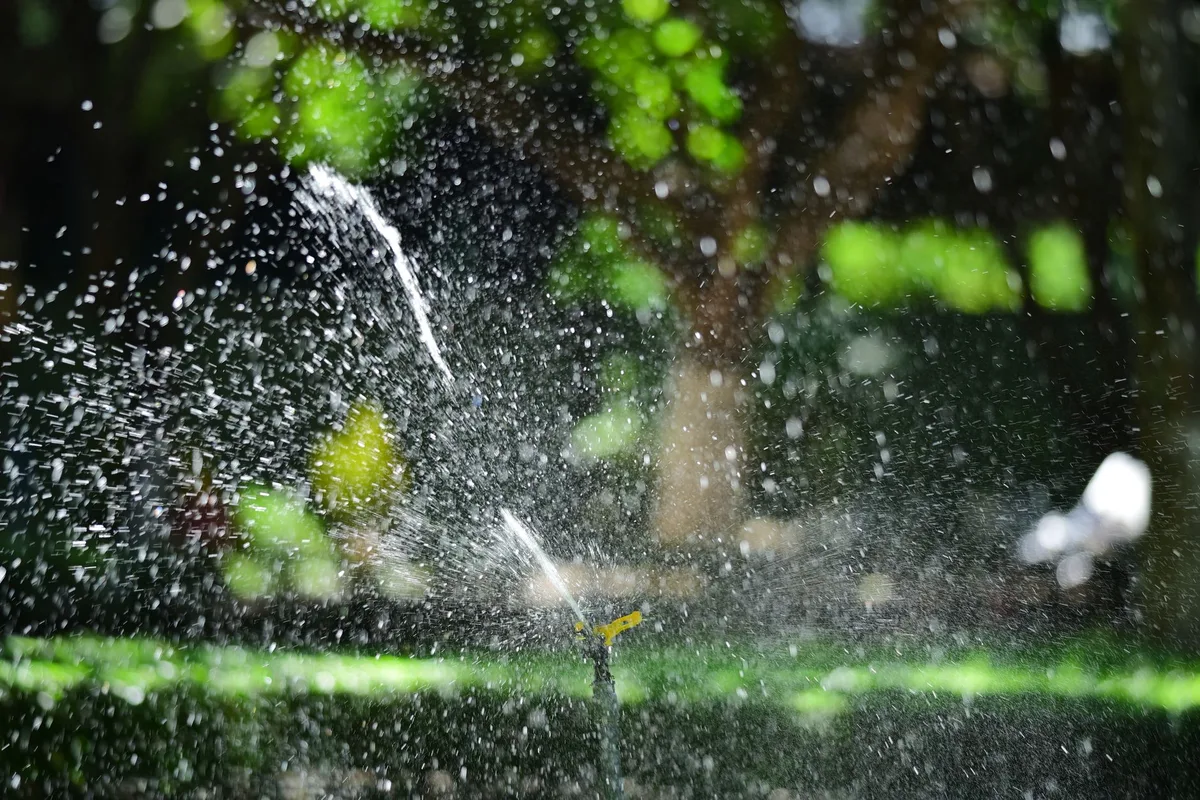
The easiest way to measure how much water your sprinkler puts out is the tuna can test. Place three or four empty tuna cans (or any shallow straight-sided container) in the spray zone. Run the sprinkler for 15 minutes.
Measure the water depth in each can with a ruler. Average the depths, then multiply by four to get the hourly rate. If you collect 0.25 inches in 15 minutes, that’s 1 inch per hour.
Now you know exactly how long to run each zone.
One more rule that applies to all branches: never water between 10 a.m. and 4 p.m. on a hot day. Up to 50 percent of that water can evaporate before it reaches the roots. Evening watering raises humidity overnight and invites fungal disease.
Early morning is the only window that works.
Mowing Adjustments for Each Situation
Your mowing strategy changes with your branch. There’s no single “mow high” rule that covers everything.
For an actively growing lawn: Mow at the highest recommended height for your grass type. Tall fescue is happiest at 4 inches in summer. Kentucky bluegrass at 3.5 inches.
Bermuda or zoysia at 2.5 to 3 inches. Keep your blade sharp, a dull blade tears the leaf tips, creating brown frayed edges that stress the plant further.
For a heat-stressed lawn: Raise the deck one more notch if possible. If you’re already at 4 inches, consider skipping this week’s cut entirely. The grass needs all its leaf surface area for photosynthesis and shading.
Cutting just the top quarter inch removes that shade and exposes the soil to direct sun.
For a dormant lawn: Don’t mow at all. There’s no functional leaf tissue, and the mower tires can compact the soil, making recovery slower when rain returns. If you absolutely must mow for appearance (HOA inspections again), use a reel mower with a very high setting.
Reel mowers cut cleanly without the wheel pressure of a gas mower.
General maintenance during heat: Clean the underside of your mower deck after each use. Wet grass clippings and dried leaf fragments can host fungal spores that spread to weak turf. Also, check the right oil level before each season, a mower that overheats in the sun can stall mid-lawn, and restarting it in full heat adds extra stress.
Keep your mower in the shed until midday heat passes if you can. Mowing in the early morning while dew is heavy can spread disease. The ideal mow time during a heat wave is late afternoon or early evening, just before the sun gets low enough to cool the ground.
Fertilizer and Soil Care – When to Feed, When to Stop
This is where most people make their biggest mistake. Fertilizing a heat-stressed lawn is like pouring gasoline on a smoldering fire. It forces leaf growth that the roots cannot support.
Feed only when soil temperatures stay below 80°F. For warm-season grasses, a light potassium application in early summer is fine. For cool-season grasses, stop all nitrogen by late May. Resume in September when nighttime lows drop below 65°F.
Topdress with compost instead of fertilizer. A quarter-inch layer of screened compost spread over the lawn in late spring adds organic matter and helps the soil hold moisture. It feeds the soil biology, not just the leaves. That’s a slow-release approach that won’t burn roots.
Check your soil pH. Grass absorbs water and nutrients best when pH is between 6.0 and 7.0. If your soil is too acidic or alkaline, no amount of water or fertilizer will fix the stress. A simple soil test from your local extension office costs about 15 dollars and takes 10 minutes.
Common Mistakes That Wreck a Heat-Stressed Lawn
Mistake 1: Watering every day for 10 minutes. This is the most common error. Light daily watering wets only the top inch of soil. Roots stay shallow and burn faster.
One deep soak per week is far better than seven quick passes.
Mistake 2: Cutting the grass shorter because it looks ragged. People think scalping reduces water needs. It does the opposite. Shorter grass exposes the soil to direct sun and dries out the root zone.
Always mow higher during heat.
Mistake 3: Applying weed-and-feed products in July. Most weed-and-feed products contain nitrogen and broadleaf herbicides. The nitrogen stresses the grass. The herbicides can volatilize in heat and drift onto desirable plants.
Wait until fall for weed control.
Mistake 4: Walking on dormant or stressed grass daily. Foot traffic crushes the crowns and compacts the soil. If you need to cross the lawn, use stepping stones or wait until the grass recovers.
Mistake 5: Ignoring the thatch layer. Thatch more than half an inch thick blocks water from reaching the soil. If your lawn has heavy thatch, core aerate in the spring or fall. Do not dethatch during active heat stress, as it tears up the crowns.
Recovery Plan After a Heat Wave
The heat wave breaks. Temperatures drop below 85°F for a few days. Now what do you do?
For cool-season lawns that stayed green: Resume normal watering but cut back to once a week if rain returns. Apply a light nitrogen fertilizer (half the label rate) to encourage recovery. Mow at the normal height for your grass type.
For cool-season lawns that went dormant: Wait for a full inch of rainfall or a thorough deep watering. Within 7 to 14 days, you should see green shoots at the base. Do not fertilize until the lawn is at least 50 percent green.
Do not mow until the grass reaches 4 inches tall.
For warm-season lawns: They bounce back fast. Resume regular watering and mowing. If you see bare patches, overseed in late summer with a compatible variety.
For Bermuda, use hulled Bermuda seed. For zoysia, use plugs or sod rather than seed.
Watch for disease. The transition from hot and dry to warm and wet is prime time for brown patch and dollar spot. A good fungicide applied preventatively can save you from losing large sections. Check our recommendations for the right type if you spot telltale rings or lesions.
When to Let It Go Dormant vs. When to Fight for Green
This is the hardest decision in summer lawn care. Here is how to decide.
Let it go dormant if: You have cool-season grass. You face water restrictions. You will be away for more than two weeks.
Your soil is shallow or rocky and cannot hold deep moisture. The lawn has gone dormant successfully in past summers. You can tolerate brown grass for 4 to 6 weeks.
Fight for green if: You have warm-season grass (especially St. Augustine, which rarely survives true dormancy). You have an HOA that fines for brown lawns.
You have newly sodded or overseeded areas. You have irrigation access and the budget to water consistently. The heat wave is expected to last less than 10 days.
The middle ground strategy: If you cannot decide, water once every two weeks with 0.75 inches. This keeps the lawn in a semi-dormant state where the crown survives but the blades stay mostly brown. It is not ideal, but it prevents death without requiring full weekly watering.
Quick Reference Table: Actions by Grass Type and Stress Level
| Grass type | Stress level | Water | Mow height | Fertilizer |
|---|---|---|---|---|
| Cool-season (fescue, bluegrass) | Active | 1 in/week | 3.5–4 in | None until fall |
| Cool-season | Stressed | 1 in immediately, then weekly | 4 in | None |
| Cool-season | Dormant | 0.5 in every 3–4 weeks only | Don’t mow | None |
| Warm-season (Bermuda, zoysia) | Active | 1–1.5 in/week | 2.5–3 in | Potassium only |
| Warm-season | Stressed | 0.75 in immediately | 3 in | None |
| Warm-season | Dormant (rare) | 0.5 in every 2 weeks | Don’t mow | None |
Frequently Asked Questions
Should I water my lawn every day in extreme heat?
No. Daily shallow watering creates weak, shallow roots that burn faster. Water deeply once or twice per week with 1 to 1.5 inches total.
This trains roots to grow deeper where the soil stays cooler and moister.
Can brown grass come back after a heat wave?
Yes, if it is dormant and not dead. Check the crown at the base of the plant. If it is white or light green, the grass is alive.
Wait for rain or a deep watering. New growth should appear within 7 to 14 days.
Is it safe to fertilize a lawn during a heatwave?
No. Fertilizing a heat-stressed lawn forces leaf growth that roots cannot support. It can cause leaf burn, disease, and long-term damage.
Wait until soil temperatures drop below 80°F for cool-season lawns or until fall.
How do I tell if my lawn is dead or just dormant?
Pull gently on a brown blade. If the whole plant comes out with no resistance, the root has died. If you feel resistance, the crown is alive.
Also check for a white or green base at soil level. Dormant grass has a living crown; dead grass is brown all the way through.
Does mowing shorter help grass survive heat?
No. Taller grass shades the soil, keeps roots cooler, and reduces evaporation. Always mow at the highest recommended height for your grass type during summer.
Never cut more than one-third of the blade height.
What grass type handles heat the best?
Bermuda grass and zoysia grass are the most heat-tolerant options. They thrive in temperatures above 90°F. Buffalo grass is also excellent for low-water areas.
Cool-season varieties like tall fescue can survive heat if managed correctly but need more attention.